Belgium is small and its rail network is dense, which makes Brussels an ideal base for day trips. Medieval cities, battlefields and canal towns are all within about an hour. Here is how to choose, how to travel and what to expect from each.
How to get there
Most trips are easiest by train. Belgian trains run frequently from Brussels-Central, Brussels-Midi and Brussels-Nord, and the main stations are in the middle of the cities you will visit. Buy tickets at a machine, at the counter or in the operator's app, and check the platform on the board shortly before departure. Services can be busy on Friday evenings and Sunday evenings, and engineering works occasionally change timetables at weekends, so check your return before you set out. A guided tour costs more, but handles transport, timing and commentary, which is helpful when you have limited time or prefer not to plan.
Bruges: the postcard
Bruges is the obvious choice and the one most visitors take. The old centre, a UNESCO World Heritage site, is a tight grid of canals, cobbled lanes, a market square with a landmark belfry and quiet courtyards known as begijnhofs. Expect around an hour by train, and a full day on a guided trip. It is busiest from late spring through summer and around the festive period, so go on a weekday and arrive early if you can; the lanes are far more atmospheric in the morning. A canal boat ride is the classic way to see the sights, and the city is best explored on foot, because everything is close.
Waterloo: history in a landscape
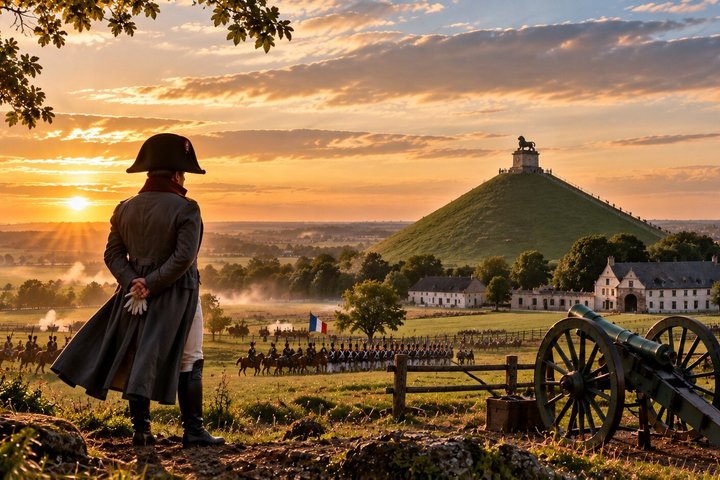
The Waterloo battlefield lies south of Brussels, where Napoleon's army was defeated in 1815. The site is more atmospheric than many expect: you can climb the Lion's Mound for a view across the fields, visit the memorial museum and see the panorama painting that wraps around a rotunda. It is a half-day trip, and well suited to history lovers and families with older children. Public transport is possible but a guided tour makes the visit much easier, since the main sites are spread across open countryside.
Ghent: the livelier alternative
Ghent has the same medieval charm as Bruges with a younger, more local feel, thanks to its large university. Its centre is a short walk from the main station by tram or on foot, and the highlights include a castle beside the water, a historic cathedral and the old harbour area lined with merchant houses. It takes roughly half an hour to forty minutes by train and is a good choice if you want fewer tour groups. You can combine it with Bruges on a long day, though two cities in a day is tiring.
Antwerp: fashion, diamonds and a great station
Antwerp is a bigger, more urban trip, known for its fashion scene, its diamond district, its cathedral and a station that is itself a major sight. It also has strong museums and a lively food and nightlife scene. The journey is roughly half an hour. It suits travellers who prefer a city with energy over a pristine medieval centre.
Leuven and Mechelen: the quiet ones
If you want an easy half-day, Leuven and Mechelen are the pick. Leuven is a student city with one of Europe's oldest universities, a flamboyant town hall and plenty of beer cafés. Mechelen is smaller and quieter, with a large cathedral tower and a pleasant river. Both are around twenty to thirty minutes by train, and both are rarely crowded.
Choosing for your trip
For a first visit, choose Bruges. For history, choose Waterloo. For a lively, authentic atmosphere, choose Ghent. For a big-city feel, choose Antwerp. For a gentle half-day with a beer at the end, choose Leuven or Mechelen. Allow one full day for Bruges, and combine Leuven or Mechelen with a late lunch. If you have only two days in Brussels, skip the day trip and stay in the capital; there is plenty to fill your time.
Practical tips
Wear comfortable shoes, since every one of these towns is cobbled. Carry a light waterproof, check opening hours for churches and museums, which often close on Mondays or have a lunch break, and book timed tickets for anything popular. In winter the days are short, so start early. Finally, keep an eye on the last train back, especially on Sundays when services are less frequent.