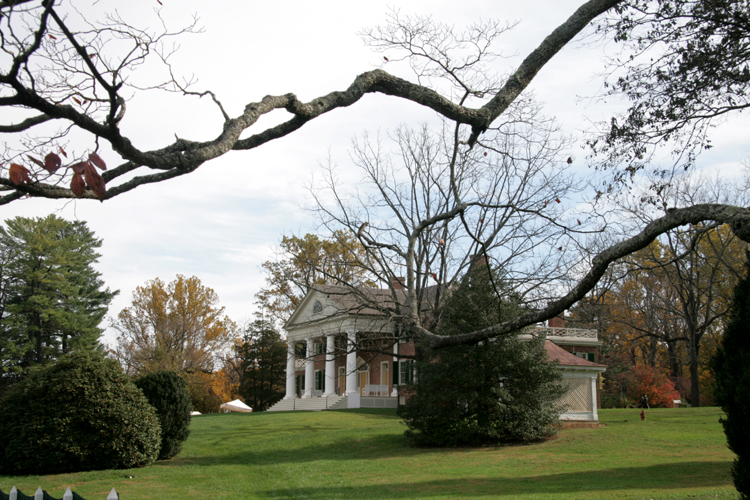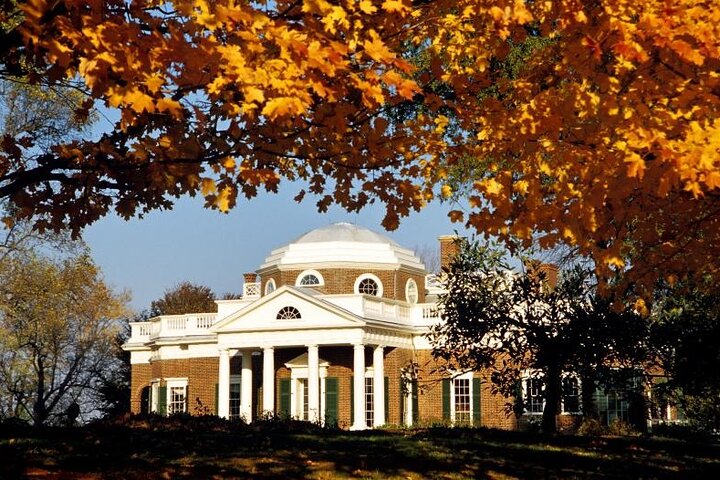
Monticello is the reason many people come to Charlottesville, and it lives up to the billing. Thomas Jefferson began building the house on a small mountaintop southeast of town in 1769 and spent four decades redesigning it, borrowing from Palladio and from his own restless imagination. The result is one of the most recognizable houses in America, with a dome, a columned portico and a floor plan full of inventions, and in 1987 it was inscribed as a UNESCO World Heritage Site together with the University of Virginia. It is also a place that asks hard questions, because the same hill was home to hundreds of enslaved people whose labor made Jefferson's life possible.
The visit begins at the base of the mountain, where the visitor center holds exhibits, a shop and a cafe, and a shuttle carries guests up to the house. Admission normally includes the grounds and a timed house tour, and the house tour is the heart of the day. Guides lead small groups through the entrance hall with its collection of natural history specimens and Native American artifacts, the parlor and the dining room, and Jefferson's book room, bedroom and study.
You see the clock that tracks the days of the week, the polygraph that copied his letters as he wrote them, the alcove bed and the dome room above, which is reached only on specific tours. Jefferson's ingenuity is everywhere, and so is the sense of a house that was never finished.
The story the site tells today is broader than the house. Mulberry Row, the plantation's industrial street, was lined with workshops, cabins and storehouses where enslaved men, women and children worked as blacksmiths, nailmakers, carpenters, domestic servants and field hands. Interpretation there, and in the restored rooms associated with Sally Hemings and the Hemings family, treats slavery as central rather than as a footnote.
Guided tours focused on enslaved life are offered separately from the standard house tour, and many returning visitors say they are the most memorable hour on the mountain. Jefferson's family graveyard, still used by his descendants, lies on the grounds and is open to walk past.
The gardens deserve time of their own. Jefferson treated the mountainside as an experimental farm, and the restored vegetable garden, with its terraced beds overlooking the Southwest Mountains, shows what he grew and why. The flower beds, the winding walks and the orchards are at their best from spring through early autumn, and the views across the Piedmont explain his choice of site. Allow time to walk down by the paths rather than taking the shuttle both ways, and to browse the shop for seeds and plants descended from Jefferson's own varieties.
Plan the visit rather than improvising it. Tickets for house tours are timed, and popular slots fill, especially in October, on summer weekends and during holiday periods, so booking ahead is wise. Most people spend three to four hours, and a morning arrival avoids the heat and the tour buses. For visitors without a car, or those coming from Washington, a small-group day tour that includes Monticello is a practical alternative. Wear comfortable shoes, because the paths are hilly, and check the current schedule for specialty tours when you book.
What to expect
The experience
A timed guided tour of the house, followed by self-guided time on the gardens, Mulberry Row and the graveyard. Specialty tours cover slavery, gardens and behind-the-scenes spaces.
Best time
Weekday mornings for lighter crowds; spring and early autumn for the gardens; October for color, with the biggest crowds.
How long
Three to four hours, longer with a specialty tour and lunch.
Tips
Book a timed house tour in advance, wear good shoes for the hills, and walk down from the house through the grounds if you have the energy.
Quick picks
- Best for
- History lovers and first-time visitors who want the signature sight.
- Families
- Older children who like gadgets and stories; younger ones enjoy the gardens.
- Couples
- Early tour, a garden stroll and a vineyard lunch afterward.
- Pair with
- Michie Tavern for lunch and Highland (Monroe's home) the same afternoon.
- Time needed
- Half a day.
Good questions
Is Monticello the same as UVA?+
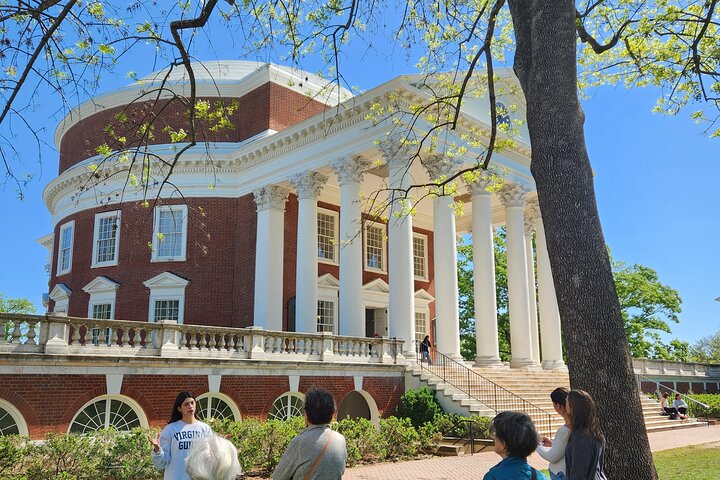
No. They are separate sites, but both were designed by Jefferson and share one UNESCO World Heritage inscription.
Do I need to book ahead?+
Timed house tours can sell out in busy months, so reserving ahead is sensible, especially for weekends and autumn.
How far is it from downtown Charlottesville?+
About four miles southeast, a ten to fifteen minute drive.
Is the site accessible?+
The visitor center and shuttle are designed for access, but parts of the grounds are steep. Ask about accessible routes when you book.
Is there a tour about slavery?+
Yes. Dedicated tours focused on the lives of enslaved people are offered alongside the standard house tour.