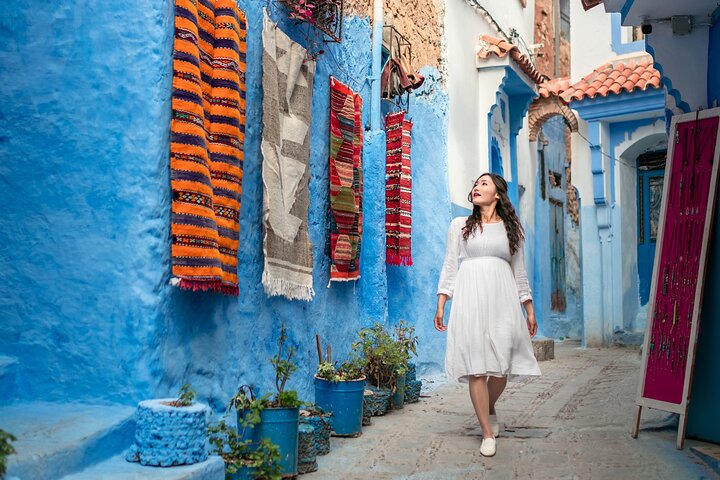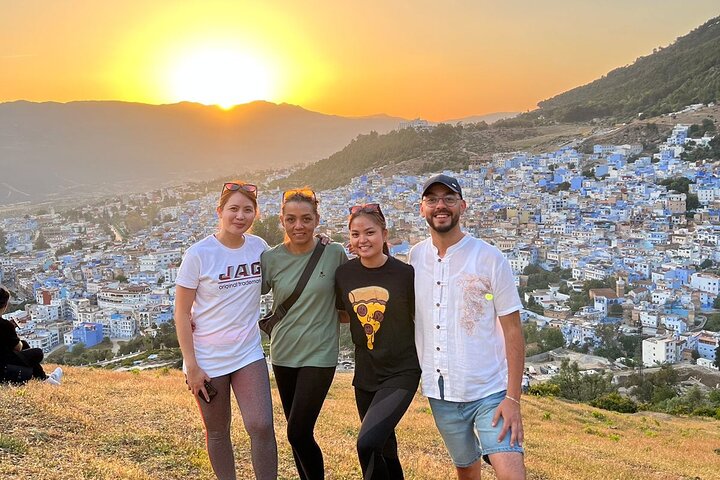
Most visitors stay close to Plaza Uta el-Hammam, but the real character of Chefchaouen shows in the residential districts that climb the hillside, including the Andalusian quarter and the Souika district. These lanes were settled by families who came to the Rif from southern Spain in the centuries after the Reconquest, and the architecture still carries traces of that heritage: arched doorways, tiled thresholds, small courtyards and wooden shutters. The walls are washed in layers of blue, from pale sky to deep indigo, and the effect is strongest where the lanes narrow and the steps turn. The answer to why the town is blue depends on who you ask. Some say the colour was brought by Jewish refugees, others point to its cooling effect or its reputation for keeping insects away, and many locals simply say they like it and repaint every year. Whatever the reason, the result is a maze that rewards walking without a plan.
This is not a sight with a gate or a ticket, which is exactly its charm. You simply walk uphill from the main square and let the lanes lead you. Expect steep stepped passages, tiny squares with a fountain or a bakery oven, and doors that range from plain to heavily studded. Residents live here, so the mood is domestic: laundry on a line, a cat on a step, children coming home from school.
Several of the small riads and guest houses in town sit in these streets, which is a good reason to stay here if you want to wake up in the middle of the scene rather than visit it.
Go early. Between about eight and ten in the morning the light is soft, the lanes are cool and the day-trip crowds have not yet arrived. The same lanes at midday can feel busy with groups, while in the evening they empty again and the lamps come on. Wear shoes with grip, because the polished stone can be slippery, and keep a small offline map handy, since it is easy to get turned around. If you meet someone offering to guide you, a polite no is enough.
Ask before photographing residents or their doorways, and keep noise down in the residential stretches. Combine this walk with a mint tea on a rooftop terrace, then finish at the Ras el-Maa spring or the Spanish Mosque path for a view back over the blue roofs. The tourism board describes the medina as built on a mountainside with narrow, winding streets and blue-tinted alleys, and that is precisely what you find here.
To get the most from the walk, set a loose goal rather than a route. Aim for a rooftop terrace you have heard about, a bakery for a warm loaf or the upper edge of town where the lanes meet the hillside, and let the detours happen on the way. Pause at each small square to look back, because the angles change with every few steps and the colour shifts from pale to deep blue depending on the light.
Staying nearby makes this easy, since you can slip out before breakfast and be back in time for the rooftop meal your host prepares. It is also the best answer to the common complaint that Chefchaouen is too busy, because a few lanes up the crowd falls away.
What to expect
The experience
A free, self-guided wander through the quieter residential lanes above the main square, with no tickets and no fixed route.
Best time
Between about eight and ten in the morning, when the light is soft and the lanes are almost empty.
How long
One to two hours, more if you stop for tea or photographs.
Tips
Wear shoes with grip, carry an offline map, ask before photographing people or doorways, and decline unrequested guiding politely.
Quick picks
- Best for
- Photographers and slow travellers who want the blue lanes without the crowds.
- Families
- Children enjoy the colour, but the lanes have many steps, so leave the stroller at the hotel.
- Couples
- Wander uphill in the early morning, then share mint tea on a rooftop terrace.
- Pair with
- Ras el-Maa spring and the Spanish Mosque path are both a short walk from these lanes.
- Time needed
- One to two hours at an unhurried pace.
Good questions
Why is Chefchaouen painted blue?+
There is no single agreed answer. Explanations include the influence of Jewish refugees, the cooling effect of the colour and a belief that it deters insects. Locals also repaint each year simply because they like it.
Is it free to walk the residential lanes?+
Yes, there is no ticket or gate. You only pay for tea, snacks or anything you buy along the way.
Can I get lost?+
Easily, but the town is small and you will come out somewhere recognisable. Keep an offline map and head downhill to return to the main square.
Can I photograph residents?+
Always ask first, and respect a refusal. Doorways and lanes are fine to photograph, but people and private courtyards deserve permission.
Is it suitable for visitors with limited mobility?+
It is challenging. The lanes are steep and stepped in many places, so a flatter route near the main square is a better choice.