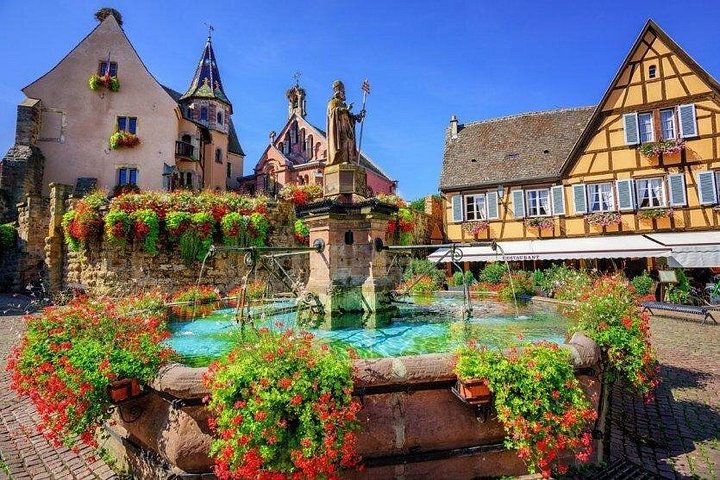
Riquewihr is the village that many people picture when they think of Alsace. It sits on a gentle slope among vineyards north of Colmar, and its medieval ramparts and gates are largely intact, enclosing a main street of tall, richly decorated half-timbered houses, many from the sixteenth and seventeenth centuries. Rather than being rebuilt, the town was spared the worst of later wars and development, and the result is a streetscape that feels unusually whole. The tower known as the Dolder, a gate with a long history as a lookout, closes the street at one end, while the Thieves' Tower and other defensive buildings sit nearby. The village is wine country in the strictest sense: producers have worked here for centuries, and the slopes around the walls include well-known grand cru sites that suit Riesling in particular. Wine cellars are tucked into courtyards, signs hang from wrought-iron brackets, and shops sell local specialities, from gingerbread and honey to preserves and pastries. It is small, so you can see the essentials in a couple of hours, but it rewards time spent on side lanes and courtyards.
How to see it
Enter through the lower gate and walk the main street uphill toward the Dolder tower, then turn into the side lanes to see courtyards, wells and carved doorways. Look up as well as ahead, since decorative gables, oriel windows and painted dates are part of the village's character.
Climb the tower if it is open to enjoy a view over rooftops and vineyards, and walk a short stretch of the outer lane beside the vines for photographs without crowds. The village has several small museums and cellars that charge entry, but the streets themselves are free.
Wine and food
Riquewihr is an excellent place to taste Riesling and Gewurztraminer, and many family-run estates welcome visitors without long formalities. Ask what a grand cru means in practice, since the answer ties wine to a particular slope and soil. Local restaurants serve choucroute, tarte flambée, baeckeoffe and other regional dishes, and a wine bar or cellar is a good alternative if you want something lighter. Bakeries sell kougelhopf, the fluted Alsatian cake, and gingerbread shops fill the lanes with spice in December.
Crowds and timing
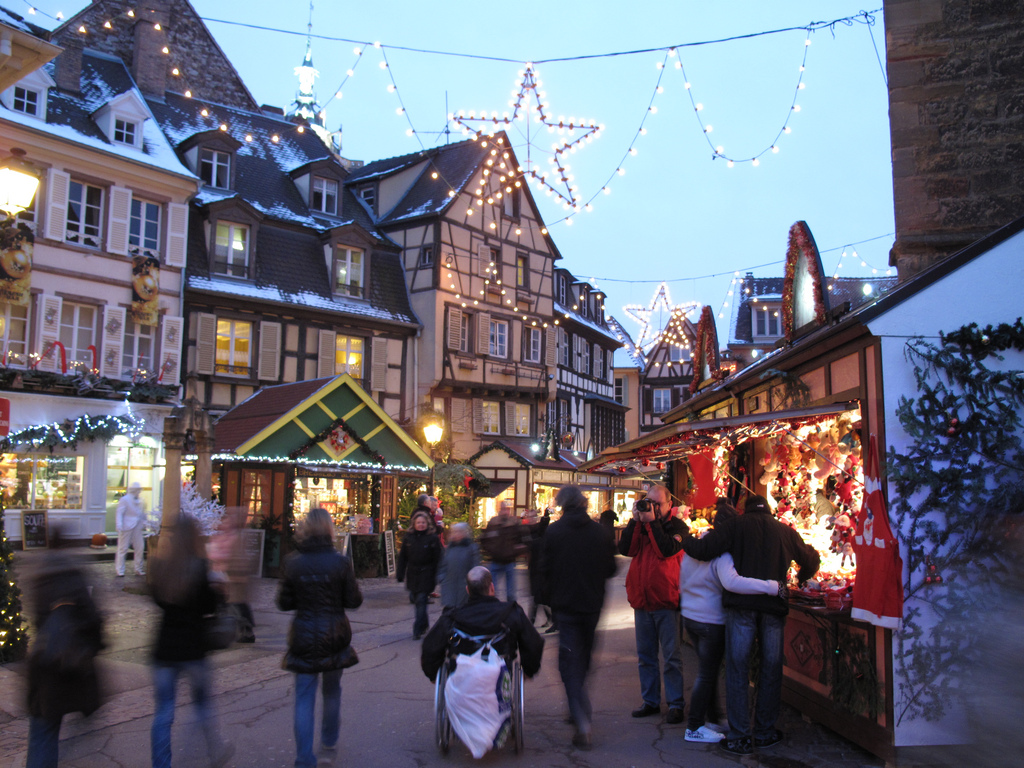
The main street is busy in the middle of the day, especially from late spring to early autumn and through the Christmas season, when the village hosts a market and its streets are lit. Arrive early or stay for the late afternoon, when day-trippers leave.
Parking is outside the walls, and the village is a short walk from the car park. It is an easy stop on a small-group Wine Route day, and by car it sits close to the vineyard villages of Ribeauvillé and Kientzheim, so you can combine several in one day.
Cobbles and slopes are uneven, so wear sturdy shoes, and check with the tourist office for opening times of museums, towers and cellars in your travel month. If you have time, walk the short path along the vines outside the ramparts at the end of the day, when the sun lights the walls and the village looks its best. Ask your grower about food pairings, since many will happily recommend a dish to match the wine you are tasting, and note that some cellars close for lunch, so plan tastings for mid-morning or mid-afternoon.
What to expect
The experience
A self-guided walk along the main street and side lanes of a walled town, with optional cellar tastings and small museums.
Best time
Early morning or late afternoon, outside the midday crowds; spring and autumn are pleasant.
How long
Two to three hours, longer with lunch and a tasting.
Tips
Walk beyond the main street, taste a grand cru Riesling, and wear sturdy shoes for the slope and cobbles.
Quick picks
- Best for
- First-timers who want the classic Alsace wine village in one compact visit.
- Families
- Easy to walk, with towers and gates to spot; the main street is busy at midday, so hold hands.
- Couples
- A long lunch, a cellar tasting and a stroll along the vines at the village walls.
- Pair with
- Eguisheim and Kaysersberg, or Haut-Koenigsbourg castle on a longer day.
- Time needed
- Half a day with a tasting and lunch.
Good questions
How far is Riquewihr from Colmar?+
It is about twelve kilometres north of Colmar, a short drive, and a common stop on small-group Wine Route days.
Is it free to visit?+
Yes, the streets are open and free. Museums, towers and cellar tastings may charge entry.
What is Riquewihr known for?+
Its largely intact medieval walls, its Renaissance half-timbered houses and its Riesling and Gewurztraminer vineyards.
When is it least crowded?+
Early morning and late afternoon, and weekdays outside school holidays. Midday in summer and December is busiest.
Can I combine it with other villages?+
Yes. It is close to Ribeauvillé and Kientzheim and fits into one-day tours with Eguisheim and Kaysersberg.