Walk a few minutes from the Plaza de las Tendillas along Calle Claudio Marcelo and you come upon something unexpected: a row of tall Corinthian columns and a raised platform from a Roman temple, standing in the middle of a modern street. The tourism board lists it among the huge temples built in Roman Córdoba, which was the capital of the province of Baetica and one of the largest and richest cities in Roman Spain. The temple dates from the first century and is thought to have been part of a sanctuary in the heart of the city, near the forum area, and it was probably dedicated to the imperial cult. Its remains were discovered in the 1950s during works to widen the street and the town hall, and the excavations were followed by a careful reconstruction in which several columns and part of the entablature were re-erected with their original stone. The marble and granite pieces, the carved capitals and the large podium give a sense of the scale of the original building. The site is one of the most visible reminders of Roman Córdoba, which also left behind the bridge, the theatre under the Archaeological Museum, the mosaics in the Alcázar and the great amphitheatre recently identified in the city.
How to visit
The temple is in the open air and surrounded by railings, so you can see it from the street at any time without paying. It is easy to reach on foot from the Plaza de las Tendillas, the Mezquita and the Plaza de la Corredera, and the visit takes only ten to twenty minutes.
The best time to photograph it is in the late afternoon or in the evening, when the stone glows in warm light and the columns are floodlit against the sky. Some tours include it as a stop and explain the history of the site.
What to look for
Concentrate on the carved Corinthian capitals, whose acanthus leaves are among the best examples of Roman craftsmanship in the city, and on the size of the platform that carried the temple, which shows how much space it commanded. Try to imagine the street below as a colonnaded plaza, with priests, merchants and officials passing between the temple and the forum. A short walk along the nearby streets brings you to the town hall and to the area where other Roman remains have been found, so the visit can be extended into a small Roman trail.
Making the most of it
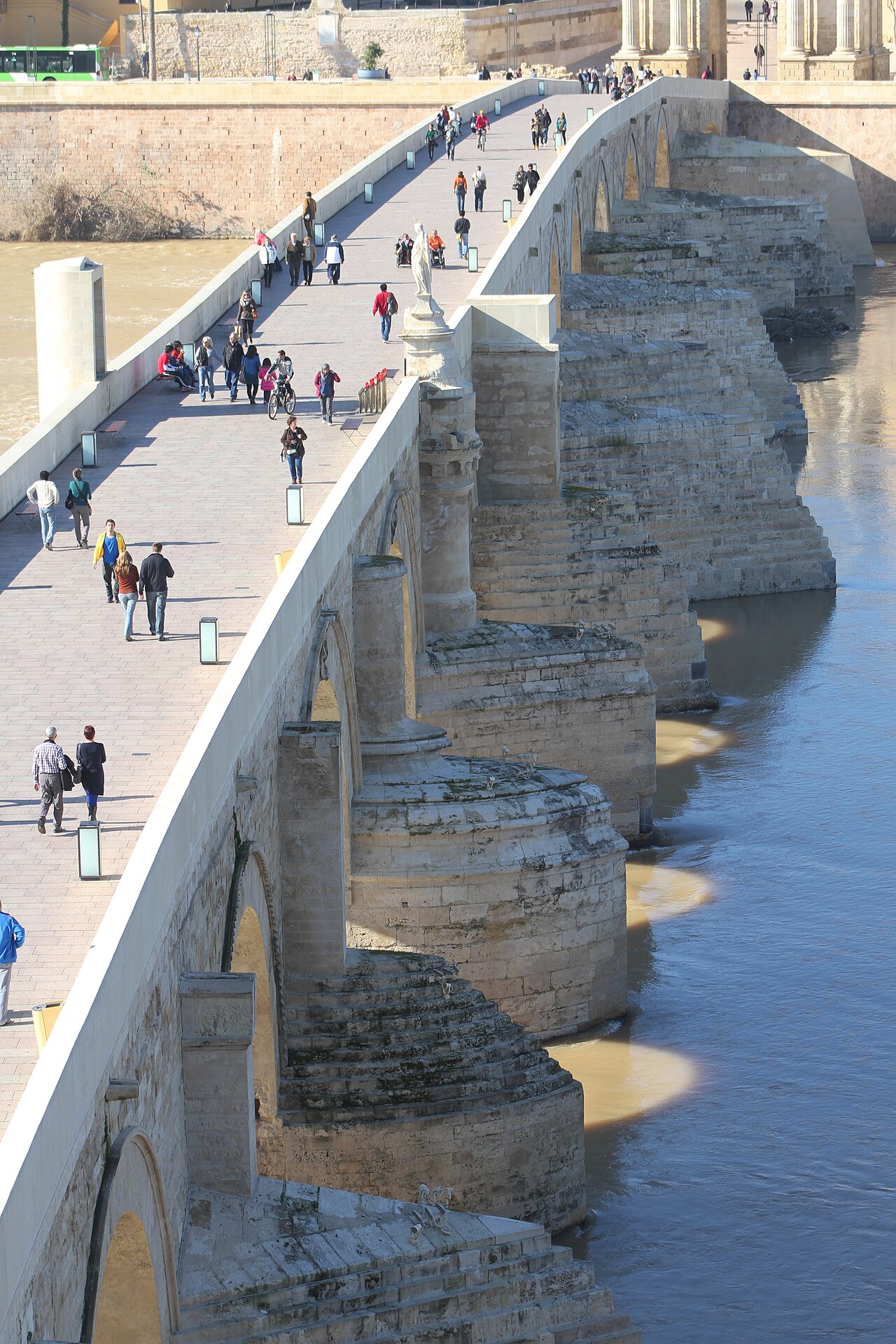
Use the temple as a link between the Roman and the Islamic city. From here it is easy to continue to the Archaeological Museum for the statues, mosaics and the Roman theatre, then to the Roman bridge over the Guadalquivir, which was the main road crossing for centuries.
The hop-on hop-off bus also passes the temple, which makes it a practical stop for those with limited time. For travellers who love history, the combination of the temple, the bridge, the museum and the Alcázar mosaics gives a clear picture of the city that came before the caliphs.
Practical notes
The temple sits beside a busy road, so cross at the lights and be careful with children, there is little shade nearby in summer, and a bench or a nearby cafe makes a good place to rest before moving on.
What to expect
The experience
A free open-air look at the reconstructed columns and podium of a first-century Roman temple, beside a city street.
Best time
Late afternoon or evening, when the stone is warmly lit and the street is calmer.
How long
Ten to twenty minutes.
Tips
Combine it with the Archaeological Museum and the Roman bridge for a short Roman trail.
Quick picks
- Best for
- History lovers and anyone who wants a quick free stop on a walk through the centre.
- Families
- Brief and free; children enjoy spotting the giant columns.
- Couples
- Pretty at dusk, when the columns are lit.
- Pair with
- The Archaeological Museum, the Roman bridge and the mosaics in the Alcázar.
- Time needed
- A quarter of an hour.
Good questions
Where is the Roman temple in Córdoba?+
It is on Calle Claudio Marcelo in the city centre, a short walk from the Plaza de las Tendillas and the town hall.
Is the Roman temple free to see?+
Yes, it is in the open air and can be viewed from the street at any time.
When was it built?+
It dates from the first century and was part of the sanctuary zone of Roman Córdoba. It was rediscovered in the twentieth century and partly rebuilt.
What other Roman sights are there in Córdoba?+
The Roman bridge, the Roman theatre in the Archaeological Museum and the mosaics in the Alcázar are the main ones.
How long should I spend at the temple?+
About ten to twenty minutes, which is enough to see the columns and take photographs.