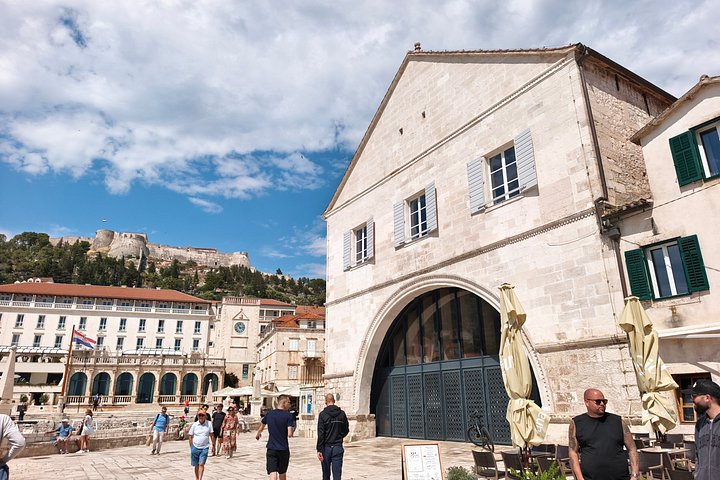
The fortress above Hvar Town, called Spanjola or Fortica locally, is the one climb every visitor should make, and it pays back the effort many times over. A path leaves from the stepped lanes behind the cathedral and zigzags up the hillside through pine, agave and wild rosemary, past a wall that once linked the fortress to the town's defenses. In fifteen to twenty-five minutes at an easy pace you reach the bastions, which stand some hundred meters above the harbour and look over the whole composition: the terracotta roofs, the cathedral tower, the bay full of yachts, the green hump of the nearest Pakleni islands and the horizon line of the open Adriatic. The fortress itself was built under Venetian rule on older foundations and strengthened after the Ottoman threat, with a rugged stone enclosure, a small museum area, a cafe terrace and, in some seasons, exhibits connected to the island's maritime history. It is one of those places where the view is the attraction, and the interior is a pleasant bonus rather than the main event.
Go either early in the morning or in the hour before sunset. The path is exposed, so summer midday is hot, shade is limited and the stone steps reflect heat. Early climbers get cool air, empty bastions and sharp light on the harbour; late climbers get the long golden glow that photographs the town best, though the descent in fading light needs care.
Wear closed shoes with grip, carry water, and bring a hat. The ticket office and cafe hours vary with the season, so check locally before you commit, and keep a little cash for the entrance fee in case card readers are down.
The layout is easy to follow. After the entrance, you pass through the main gate into a courtyard with stairs to different levels of the bastions. The highest point gives the full panorama, and a lower terrace looks directly down on the harbor and the Franciscan monastery. Notice the cannon emplacements facing the sea and the thick walls that taught Hvar's attackers to respect the place, and look for the cisterns that stored rainwater, because freshwater was the island's scarcest resource.
The small exhibit spaces are modest but give useful context on the shipping, fishing and trade that sustained the town.
The fortress combines well with an old town walk. Many visitors climb it right after exploring the lanes so the geography of the walls and harbour makes sense, then descend by the same path and settle into a waterfront table. If you are traveling with young children, the path is manageable but has drops at the edges, so keep them close.
Rain makes the stone slick, and thunderstorms in late summer can arrive quickly, so check the sky before you start. For a quieter option, climb at the end of the day, stay for the sunset, and take a small torch for the walk back to the lanes.
Many visitors combine the climb with a picnic or a cold drink at the cafe near the top, which makes the visit feel less like an effort and more like an outing. If you are staying in a hotel on the harbour, the path starts only a few minutes from your door, so you can easily go twice, once in morning light and once at dusk, and compare the two views. Bring a light layer, because the wind on the exposed bastions can be surprisingly cool even after a hot day, and keep your phone charged for photographs.
What to expect
The experience
A zigzag path climbs through pines to the Venetian fortress, with bastions, cisterns and a panoramic terrace.
Best time
Early morning for cool air, or the hour before sunset for golden light; avoid summer midday.
How long
Fifteen to twenty-five minutes up, plus time on the bastions.
Tips
Bring water and a hat, wear closed shoes with grip, and check opening hours and the entrance fee locally.
Quick picks
- Best for
- Anyone who wants the island's best view for little cost.
- Families
- Fine for school-age children; keep younger ones close at the edges.
- Couples
- Sunset from the bastions, then dinner in town.
- Pair with
- The old town loop and a Pakleni Islands boat day.
- Time needed
- One to two hours including the climb.
Good questions
How long is the climb?+
Allow fifteen to twenty-five minutes at an easy pace from the lanes behind the cathedral.
Is there an entrance fee?+
Yes, a small fee applies; check the current price and hours locally.
Is it worth going at sunset?+
Yes, it is the best light on the harbour, but bring a small torch for the descent.
Is the path suitable for children?+
School-age children manage fine; keep little ones close because the edges drop away.
Can I drive up?+
The usual approach is on foot from the town, though a road reaches near the top for taxis in some seasons.