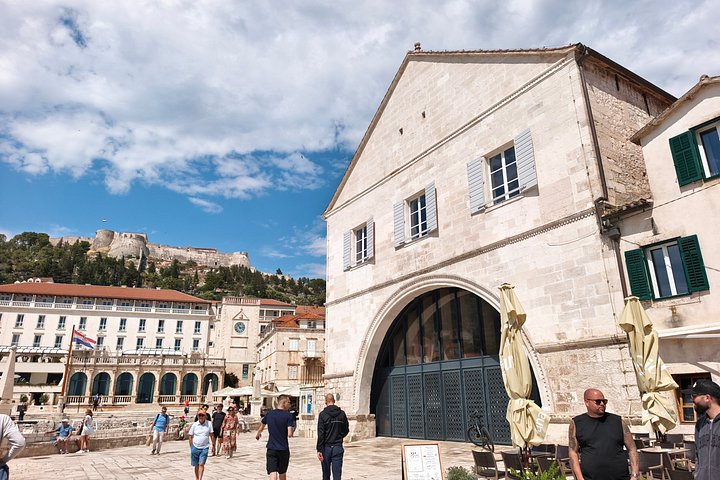
A guided walk through Hvar's old town does something a map cannot: it explains why a small island town has marble streets, coats of arms over doorways and a fortress that looks far too grand for its size. A local guide stitches the quarter together, from the square at the heart of the town to the lanes behind the cathedral and the stepped alleys that climb toward the walls. You hear how Venice used Hvar as a naval stronghold, how the wealth of the salt, wine and fishing trades paid for palaces, and how an island rebellion of commoners against the nobility in the early 1500s shaped civic life. You also hear the less formal stories: where the best bakery stood, which families still live above the shops, how Hvar became a refuge for artists and writers long before it became a yachting stop. Guided groups tend to be small enough to stop in narrow lanes where larger tour parties cannot, and the guide can point out details you would simply walk past, such as a carved Venetian lion on a doorway or a worn mooring ring beside the harbour wall.
Most walks begin near the harbour front and take roughly an hour or a little longer, and they work best early in the morning or in the late afternoon when the stone is cooler. Expect to cover the main square, the cathedral exterior, the arsenal facade and several of the quiet streets behind them, with commentary about Venetian administration, the plague years, the defensive walls and the later Austro-Hungarian period, when a health resort culture first put Hvar on the map as a winter retreat. Because the lanes are steep and polished, the pace is gentle, but you should still wear shoes with grip and bring water in summer.
A guide is especially useful for context that is invisible from the street. The line of the old walls, the position of the former communal buildings, the way the town grew upward from the waterfront, and the way the fortress guarded the harbour all become legible once someone points them out.
If you are traveling with older children, ask the guide for stories about pirates and sieges, which tend to land well. If you prefer a private pace, private versions of walks like this exist, but the group departure is the better value for most travelers and keeps the experience light and social.
Practical points
Confirm the meeting point and the language of the tour when you reserve, arrive a few minutes early, and plan nothing important immediately afterward in case the guide runs over. Many people use the end of the walk as a launch point for coffee on the square or a climb to the fortress while the information is fresh.
In peak summer, mornings are far more comfortable than afternoons, and the tour is a good way to see the town before the day-trippers arrive. If rain is forecast, ask whether the tour operates, because some small operators cancel for weather, and the polished steps become slippery in the wet.
Allow a little extra time before the start for a coffee on the square, and ask the guide for restaurant suggestions at the end, since local recommendations are often better than anything you will find by browsing the harbour front.
What to expect
The experience
A small-group guided walk through the old town with a local guide, covering the square, lanes and harbour.
Best time
Morning or late afternoon; midday summer heat is the main drawback.
How long
About an hour to an hour and a half.
Tips
Confirm the meeting point and language when you reserve. Wear shoes with grip and bring water in summer.
Quick picks
- Best for
- Visitors who want the stories behind the stone on day one.
- Families
- Best for older children who like history; younger ones may tire on the steps.
- Couples
- A quiet morning walk before the heat and the crowds.
- Pair with
- A fortress climb or a coffee on the square afterward.
- Time needed
- About one and a half hours.
Good questions
Is a guided tour worth it for such a small town?+
Yes, because a guide explains the Venetian layout, the rebellion and the later health-resort era, which are invisible from the street.
What language are the tours in?+
English is typical, and some departures add other languages; confirm when you reserve.
Does the walk include entry to the fortress?+
Most old town walks focus on the town streets; the fortress is usually a separate climb and ticket.
How physically demanding is it?+
Easy pace, but the lanes are stepped and slippery. Wear grip shoes.
Can I do it in winter?+
Yes. The town stays walkable in the cooler months, though some cafes and museums have shorter hours.