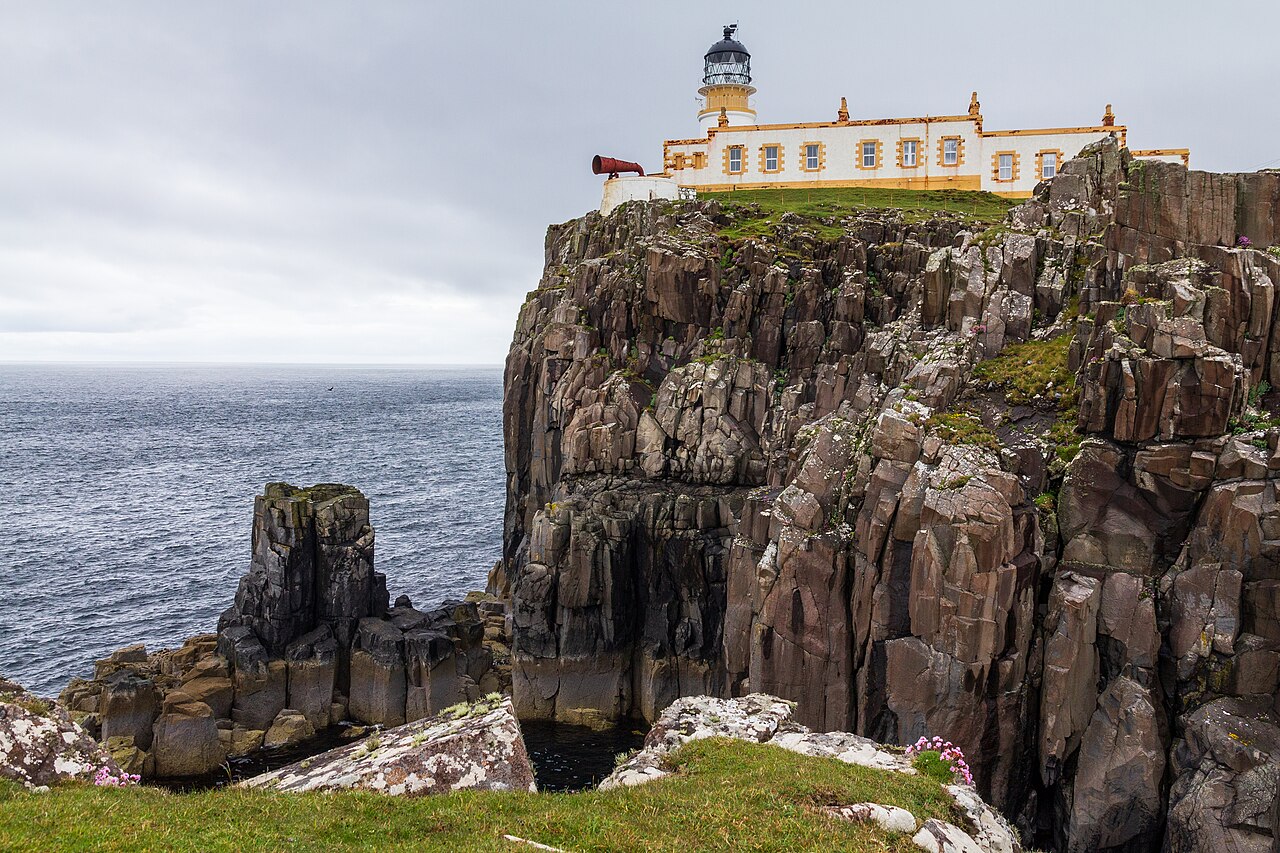
Kilt Rock is one of the easiest big views on Skye. On the east coast of the Trotternish peninsula, between the Old Man of Storr and Staffin, a sea cliff of vertical basalt columns rises above the Sound of Raasay, with bands of paler rock that give it the look of a pleated kilt. Right beside it, Mealt Falls pours from Loch Mealt over the cliff edge and drops straight towards the sea, a fall of around a hundred metres. A fenced viewing platform next to the car park gives the classic view of both, so there is no walk to speak of, which makes it ideal for families, travellers with limited mobility and anyone touring the northern loop by car or on a day tour. It is free and open at all times.
What you see
The cliff is formed of columns of dolerite, a volcanic rock that cooled into regular pillars, sitting on softer layers of sandstone and shale that weather into horizontal bands. Together they produce the pleated pattern that gives Kilt Rock its name. Mealt Falls is fed by Loch Mealt, a small loch just inland, and in wet weather the waterfall is at its most powerful, sometimes blown back up the cliff by strong winds.
On a clear day you can see across the Sound of Raasay to the mainland mountains of Torridon, and the coast in either direction is a line of cliffs and headlands.
Getting there
Kilt Rock is on the A855 coast road, around seventeen miles north of Portree, roughly half an hour by car, and a few miles south of Staffin. The car park is beside the road, with the viewing platform a few steps away, and it is a stop on the circular bus route around Trotternish as well as on many small-group tours of the island. Parking is limited and fills quickly in summer, so arrive early or late in the day, and never stop in passing places or on the verges.
Making the most of it
The viewpoint takes fifteen to thirty minutes, so treat it as a stop on a longer day rather than a destination in its own right. The natural loop runs from Portree to the Old Man of Storr in the morning, then Kilt Rock, Staffin and the Quiraing, and on round the north of the peninsula to Uig and the Fairy Glen.
Staffin also has a small exhibition about the dinosaur footprints found along this coast, and at low tide some prints can be seen on the beach at An Corran nearby. Stay behind the fence, as the cliff edges are sheer and unstable, and keep children close. In wind, listen for the fence: on some days it hums as the air passes through it.
What to expect
The experience
A short stop at a fenced viewing platform beside a roadside car park, looking along a basalt sea cliff and a waterfall dropping towards the sea.
Best time
Early morning or late afternoon, when the car park is quieter, and after rain, when the waterfall is at its fullest.
How long
Fifteen to thirty minutes, as part of a drive round the Trotternish peninsula.
Tips
Stay behind the fence, park only in the car park, and combine it with the Storr and the Quiraing on the same loop.
Quick picks
- Best for
- Anyone touring the north of Skye who wants a big coastal view with no walking.
- Families
- Very easy with children, but hold hands near the fence, as the cliff edge is sheer.
- Couples
- A quick photo stop between a morning on the Storr and a long lunch in Staffin or Portree.
- Pair with
- The Old Man of Storr, the Quiraing and the Fairy Glen on the same northern loop.
- Time needed
- Under half an hour, plus the drive from Portree.
Good questions
Is Kilt Rock free to visit?+
Yes. The viewpoint and car park are free and open at all times, and there is no ticket to buy.
How far is Kilt Rock from Portree?+
Around seventeen miles north on the A855 coast road, roughly half an hour by car.
Is there a walk?+
No. The viewing platform is a few steps from the car park, which makes it one of the most accessible viewpoints on Skye.
Why is it called Kilt Rock?+
The vertical basalt columns and horizontal bands of paler rock in the cliff resemble the pleats and pattern of a kilt.
Can I see the waterfall all year?+
Yes. Mealt Falls flows all year and is most dramatic after heavy rain, when strong winds can even blow the water back up the cliff.