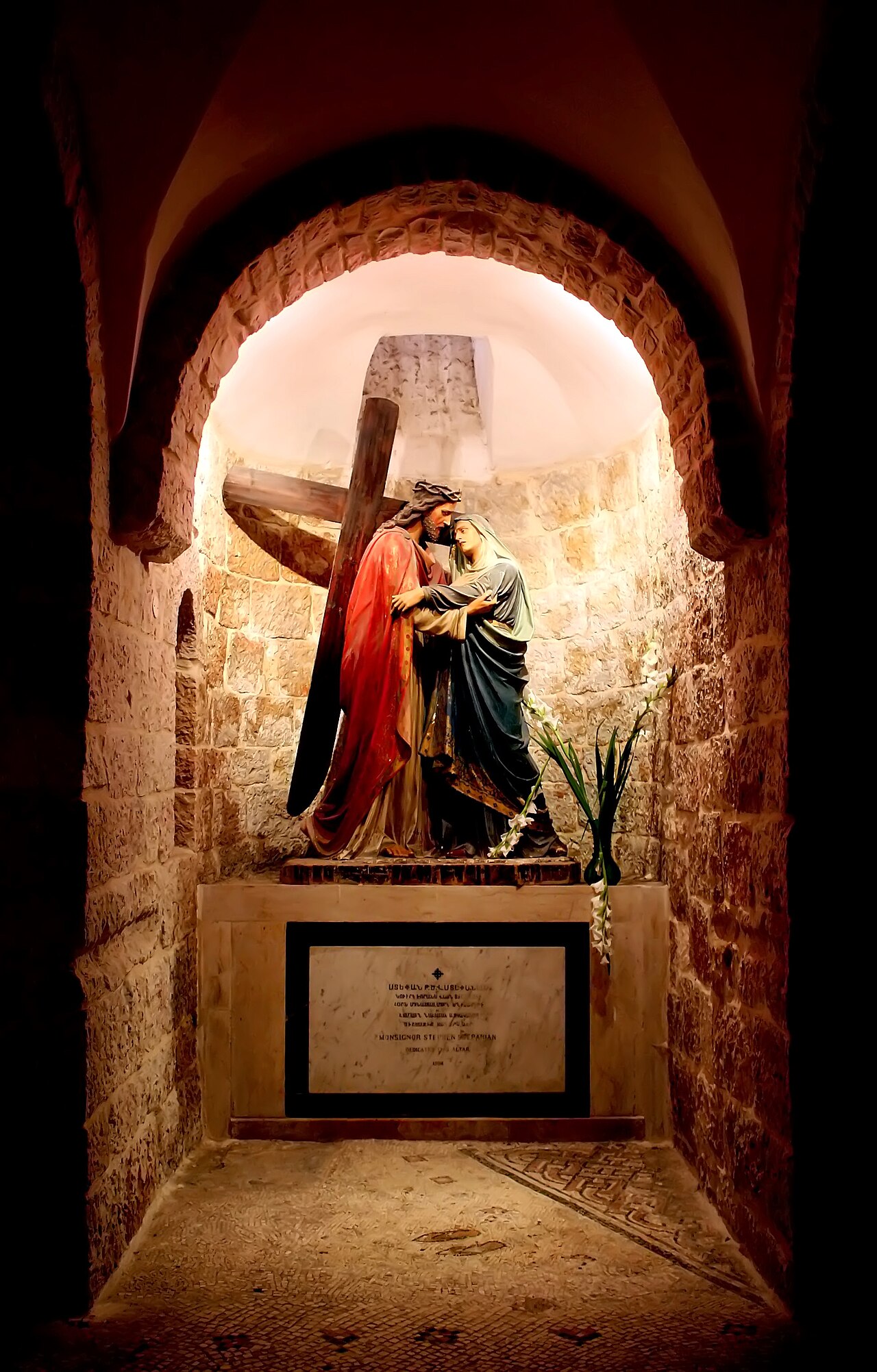
The Via Dolorosa, or Way of Sorrows, is a narrow street through the Old City that Christians follow as the path Jesus took from his trial to his crucifixion. The route has fourteen stations, marked by chapels, plaques and carved numerals on the walls, and the last five are inside the Church of the Holy Sepulchre. The tradition in its present form took shape around the thirteenth century, so it is a route of devotion as much as of archaeology. The street is also a working part of the Old City, with shops, cafés and school children passing the stations, which gives the walk a lively, human feel. Many pilgrims carry a cross or pray at each stop, while other visitors simply enjoy the atmosphere, the arches and the glimpses of daily life along the way.
Why it matters
For Christian pilgrims, walking the Via Dolorosa is a central act of devotion, and the route links the Muslim Quarter, where it begins, with the Christian Quarter, where it ends. Whatever your beliefs, it is a good introduction to how the Old City’s communities live side by side in a very small area.
How to walk it
The route starts near the Lions’ Gate side of the Old City and runs west, turning several times before climbing to the church. It is free and open at all times as an ordinary street, though shops are quieter early and many close in the evening. A Franciscan procession is traditionally held on Fridays, which is moving to watch but also brings crowds. The street is narrow, uneven and busy, so wear sturdy shoes, keep valuables secure and expect to be offered souvenirs politely and persistently.
Pair it with
Finish at the Church of the Holy Sepulchre, then loop back through the covered markets. Many visitors combine the walk with a guided Old City tour, but an audio guide or a printed map of the stations works well too. Allow time to stop for tea or fresh juice at the small cafés, which are a good way to rest and watch the street.
What to expect
The experience
A self-guided walk along a lively Old City street with fourteen marked stations, ending at the Church of the Holy Sepulchre.
Best time
Early morning, before the lanes fill with shoppers and tour groups.
How long
About an hour at an unhurried pace.
Tips
Wear comfortable shoes, carry a map of the stations, dress modestly and keep bags zipped.
Quick picks
- Best for
- Pilgrims and curious first-timers who like to walk through living history.
- Families
- Interesting for older children, though the lanes are narrow and busy.
- Couples
- A slow morning walk followed by coffee is a pleasant shared experience.
- Pair with
- The Church of the Holy Sepulchre and the nearby covered markets.
- Time needed
- Allow about an hour, plus time at the church.
Good questions
Where does the Via Dolorosa start?+
It starts in the northeastern part of the Old City, near the Lions’ Gate side, and ends at the Church of the Holy Sepulchre. Maps and signs mark each station.
How many stations are there?+
There are fourteen. The first nine are along the street and the last five are inside the Church of the Holy Sepulchre.
Is there a charge to walk it?+
No, the route is free. It is an ordinary public street, so shops and cafés along it are open to anyone.
Is there a Friday procession?+
A Franciscan procession traditionally leaves the first station on Fridays and ends at the church. Times can vary, so ask locally to confirm.
Do I need a guide?+
Not necessarily. A map of the stations or an audio guide is enough for most visitors, though a guide adds context on the Old City’s communities.