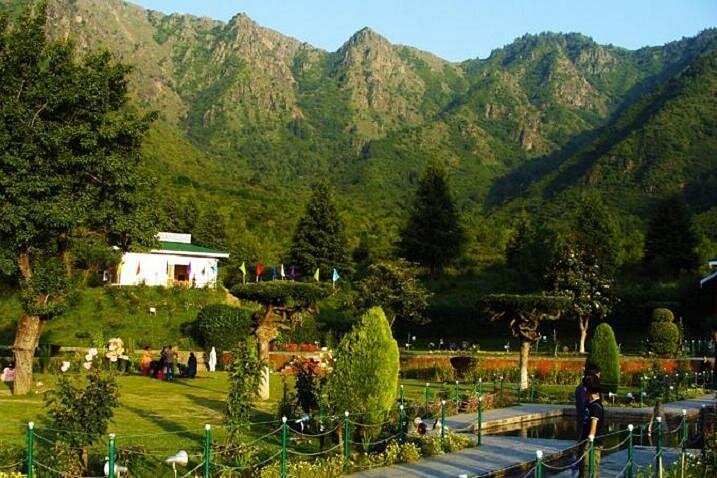
Chashme Shahi, the Royal Spring, is the smallest of Srinagar's Mughal gardens and the one with the most intimate feel. It was laid out in the early seventeenth century around a natural spring that rises on the hillside, with water channelled down three terraces through a narrow garden of fountains, flower beds and shaded pavilions. The spring is known for its clear, cool water, which local people prize and carry home in bottles. Because the garden is compact, it is easy to see in less than an hour, and the views over Dal Lake from the upper terrace are excellent. A little further along the road, Pari Mahal, the Palace of Fairies, is a ruined seventeenth-century terraced complex built on a spur of the hill, traditionally associated with the Mughal prince Dara Shikoh. Its series of arched terraces rises in tiers above the city, and at night the walls are lit, giving it a theatrical presence on the hillside. The setting is very peaceful, with fewer visitors than the larger gardens at Nishat and Shalimar.
The garden at Chashme Shahi follows the same Persian principle as the larger Mughal gardens, with water running through the centre and terraces stepping down from a pavilion at the top. In the pavilion area, the spring emerges into a small basin, and visitors often queue to taste the water. Pari Mahal is more of a ruin than a garden, with arched corridors, rooms and platforms rising in stages, set among lawns and flower beds, and it was reputedly used for study and reflection.
Both sites are small, but they give a quieter, more reflective look at the Mughal legacy than the grander gardens on the lake shore. The longer city tour with lunch linked here includes several such sights in one day, and the high location makes for good late-afternoon light.
Practical advice follows the pattern of the other gardens. Opening hours and fees are modest but can change, so check on the day. Expect some uphill walking and uneven steps at Pari Mahal, with railings in places but not everywhere, and take care with children. Spring brings blossom and tulips, summer is green, autumn brings colour and winter is bare and cold. Bring water and a layer, and wear shoes with grip.
Because the sites sit on the same hillside road as the Shankaracharya Temple and the Tulip Garden, they combine well into a half-day circuit. Take your time at the upper terraces, where the whole of Dal Lake and the houseboat rows open out below, and consider going toward dusk when the lights come on across the city. Remember to respect the plants and the structures, stay on the paths and avoid climbing on ruined walls.
If you are short of time, choose Chashme Shahi for its spring and its compact design, and Pari Mahal for the views and evening lights. Together they show a different side of Mughal Kashmir from the grand imperial gardens: more private, more scholarly, and more closely tied to the hillside. Some visitors enjoy a picnic on the lawns, and local families often do the same. Check whether any area is closed for maintenance, and keep an eye out for the fine details of stone arches, brickwork and terraces that frame the sky and lake.
What to expect
The experience
A compact terraced garden around a natural spring and a ruined arched palace on the hillside, with lake views from the upper levels.
Best time
Late afternoon for soft light and lake views; spring for blossom and autumn for colour.
How long
One to two hours for both.
Tips
Expect steps and slopes, wear grip shoes, bring water and stay on the paths.
Quick picks
- Best for
- Quiet garden lovers and photographers.
- Families
- Small and manageable, though terraces have steps and drops.
- Couples
- Quiet terraces and a view over the lake at dusk.
- Pair with
- Nishat Bagh, Shalimar Bagh and the Shankaracharya Temple.
- Time needed
- Two hours.
Good questions
What is Chashme Shahi?+
It is a small Mughal garden laid out in the early seventeenth century around a natural spring on the Zabarwan slope.
What is Pari Mahal?+
It is a ruined seventeenth-century terraced complex of arches above the city, traditionally linked with the Mughal prince Dara Shikoh.
Can I drink the spring water?+
Locals prize it, but if you are unsure, follow your guide's advice and carry your own bottled water.
Is it crowded?+
It is quieter than Nishat and Shalimar, especially on weekday mornings.
How do I get there?+
By car or on a city tour, since the sites are on a hillside road above the lake.