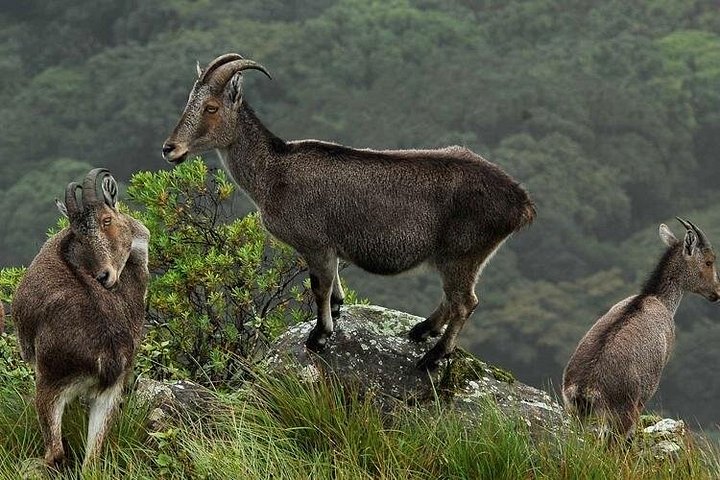
Eravikulam National Park covers about 97 square kilometres of the Kannan Devan Hills, a high-altitude landscape of shola forest and open grassland that feels more like the Scottish highlands than the tropics. It is the protected home of the Nilgiri tahr, the endangered mountain goat of South India, and the Rajamalai area is the part of the park where visitors can see the animals. Kerala Tourism notes that the core and buffer zones are restricted, so Rajamalai is the tourist zone. Anamudi, at 2,695 metres the highest peak in South India, rises in the park’s southern area. The park is also famed for the Neelakurinji, which flowers once every 12 years and last bloomed in 2018, with the next bloom predicted for 2030. Even without a bloom, the views and the chance of seeing tahr make this Munnar’s top nature visit.
How to visit
Eravikulam is near Munnar in Idukki district, and most visitors reach it by road from town. Kerala Tourism says the park closes in February and March each year for the tahr calving season and is otherwise open, so a November visit falls in the open season. Entry is ticketed and run by the forest authorities, with limits on visitor numbers and on how far you can walk, so check arrangements locally and arrive early, as queues build on busy days.
What to expect
Expect open slopes, cool air, often wind and cloud, and tahr that are used to people but still wild. Keep to the permitted path, do not feed or approach the animals, and carry water, a windproof layer and sun protection, because the weather can change quickly at altitude. Plastic restrictions apply in many Kerala parks, so pack light and take rubbish out. The walk is moderate and mostly along a set route, suitable for most visitors with reasonable fitness.
Making the most of it
Go in the morning for the best chance of clear views before cloud builds, and allow half a day including travel. Combine the park with a tea trail walk and a viewpoint at sunset for a full Munnar day. If you hope to see the Neelakurinji, remember the next bloom is predicted for 2030, so a visit now is for the tahr and the scenery. Carry identification in case it is needed at the gate, and follow the guides, who know how to keep animals and visitors safe.
What to expect
The experience
A ticketed walk in the Rajamalai tourist zone of the national park, with the chance to see Nilgiri tahr on open grassy slopes.
Best time
Morning outside the February and March closure, when the air is clear and cooler.
How long
Three to four hours including queuing and the walk; allow half a day with travel.
Tips
Stay on the permitted path, do not feed animals, carry a windproof layer, water and sun protection and check ticket rules locally.
Quick picks
- Best for
- Nature lovers and photographers who want mountain views and wild tahr.
- Families
- Good for children who can walk a moderate route, but cool wind and queues need preparation.
- Couples
- Open skies and misty ridges make a memorable day out from Munnar.
- Pair with
- A Munnar tea trail walk and a sunset viewpoint.
- Time needed
- Half a day including the drive.
Good questions
When is Eravikulam National Park closed?+
Kerala Tourism says it closes in February and March each year for the tahr calving season. It is otherwise open.
What animal is Eravikulam famous for?+
The Nilgiri tahr, an endangered mountain goat of South India. Visitors can see them in the Rajamalai area.
How big is Eravikulam National Park?+
About 97 square kilometres, according to Kerala Tourism. Only the Rajamalai area is open to visitors.
What is the highest peak in the park?+
Anamudi, at 2,695 metres, is the highest peak in South India. It lies in the southern part of the park.
When will the Neelakurinji bloom again?+
The flowers bloom once every 12 years. The last bloom was in 2018 and the next is predicted for 2030.