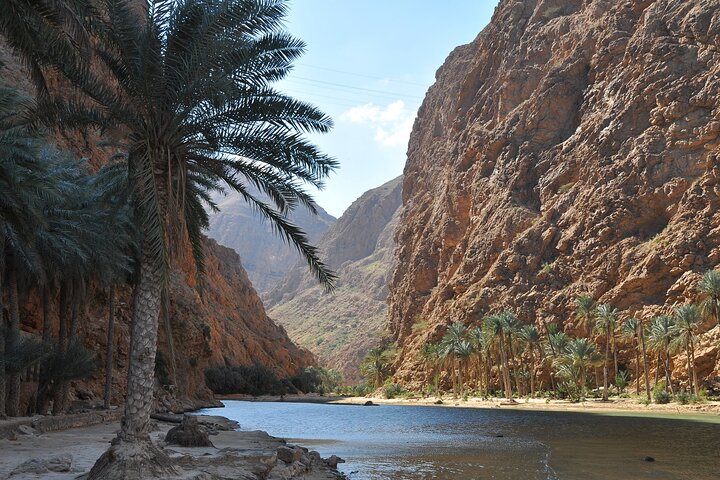
Jebel Shams, the “Mountain of the Sun”, is the highest peak in Oman, rising to a little over 3,000 metres in the western Hajar range. Its great drawing card is not the summit but the edge of Wadi Ghul, a canyon so deep and wide that visitors have long compared it to the Grand Canyon. From the rim the walls fall away for roughly a kilometre, layered in grey and rust-coloured rock, and on a clear morning you can look straight down on the terraces of the tiny abandoned village clinging to the cliff far below. It is wild, silent and humbling, and it feels a world away from the coast. Most visitors come on a full-day trip from Muscat, which is a long day because the plateau is roughly two and a half to three hours from the capital by road, depending on the route and the stops. The drive itself is part of the pleasure: the motorway runs inland past the date groves around Nizwa and Al Hamra, then climbs into the mountains, and the final stretch to the viewpoints is on a rougher track where a four-wheel-drive vehicle is the sensible choice. That is why most travellers go with a driver or a guided tour rather than attempting it in a hire car.
What you do there
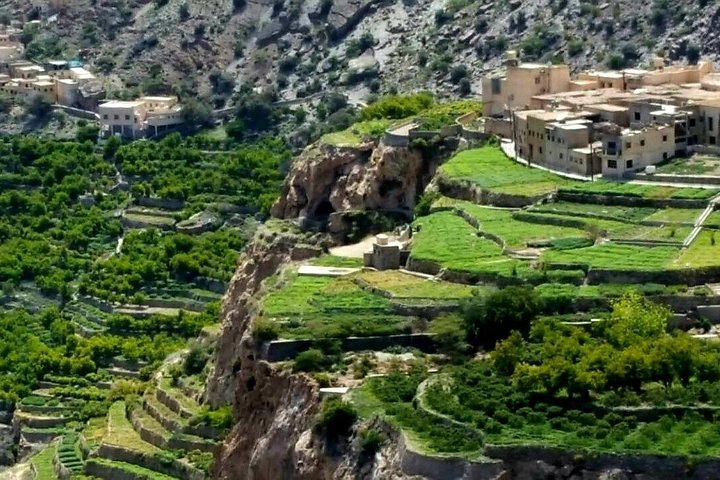
The simplest option is to stop at the viewpoints along the rim, where the canyon opens out below you and the air is noticeably cooler than in Muscat. The classic walk is the Balcony Walk, a path along the canyon wall that heads for the abandoned village, with the drop on one side; it is a real hike, not a stroll, so wear proper shoes, bring water and turn back if you are uncomfortable with heights. A trip that includes Wadi Nakhar and Misfat Al Abriyeen adds the other half of the story: Misfat is a beautifully preserved mountain village of stone houses, narrow lanes and an ancient falaj, the irrigation channel that carries water through terraced gardens of bananas, mangoes and date palms.
When to go
The cooler months, roughly October to April, are the most comfortable, and the plateau is pleasantly cool even when Muscat is warm. In winter it can be cold and windy at the top, so bring a jacket, and in summer the heat on the lower slopes and in the villages is intense, so start early. Clear mornings give the best views, and haze or cloud can hide the depth of the canyon, so it is worth checking the weather on the day.
Practical tips
This is a long day, so leave Muscat early and expect to be back after dark if you add stops. Bring water, snacks, sun protection and a warm layer, and wear sturdy shoes with good grip. There are few facilities at the rim, so eat before you go up or take a packed lunch.
If you want to avoid the long drive, consider an overnight stay on the plateau or in Nizwa, which gives you time for the walk at a relaxed pace and a chance to see the sunrise over the canyon. Dress modestly in the villages, ask before photographing people, and take your rubbish with you.
What to expect
The experience
A full-day drive into the Hajar Mountains with stops at canyon viewpoints, a short walk along the rim and usually a visit to a mountain village.
Best time
Between October and April, starting early so you reach the rim in clear morning light.
How long
A full day of eight to ten hours including the drive, with most of the time spent on the road.
Tips
Bring a warm layer, water, sturdy shoes and a head for heights, and check the weather before you set out.
Quick picks
- Best for
- Travellers who want big mountain scenery and a cool escape from the coast.
- Families
- Best with older children who can handle a long drive; keep young ones well away from the canyon edge.
- Couples
- A dramatic, quiet day out, especially if you stay overnight to watch the light change over the gorge.
- Pair with
- Misfat Al Abriyeen, Nizwa Fort or Jebel Akhdar on a longer mountain itinerary.
- Time needed
- One full day, or two if you add a night in the mountains.
Good questions
How far is Jebel Shams from Muscat?+
It is roughly two and a half to three hours by road, depending on the route and stops, so most visitors treat it as a full-day trip or stay overnight.
Do I need a four-wheel-drive vehicle?+
The last stretch to the viewpoints is on a rougher track, so a four-wheel drive is the sensible choice. Most visitors go with a guide or driver who knows the road.
Is the Balcony Walk dangerous?+
It follows a path along the canyon wall with a steep drop on one side. It is a real hike, so wear proper shoes, take water and turn back if you are uneasy with heights.
When is the best time to visit?+
The cooler months from about October to April are the most comfortable. It can be cold and windy at the top in winter, and very hot on the lower slopes in summer.
Can I combine it with other places?+
Yes. Many trips add Wadi Nakhar and the mountain village of Misfat Al Abriyeen, and some pair the canyon with Nizwa or Al Hamra.