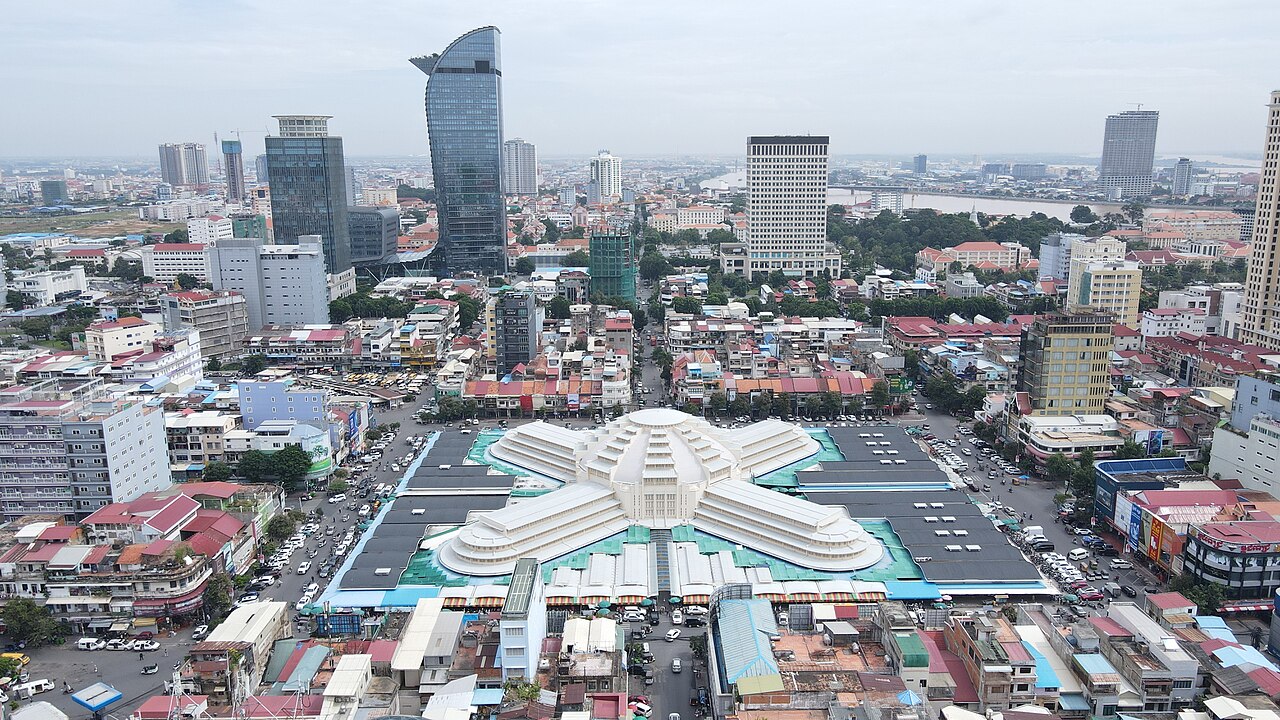
The Central Market, known in Khmer as Psar Thmei, or New Market, is one of Phnom Penh’s landmark buildings and one of its most useful stops. It was built between 1935 and 1937 on a site that had been a swamp, in a dark yellow Art Deco style, with a cross-shaped footprint, a high central dome and four wings radiating from it. Under the dome and in the wings are stalls selling gold and silver jewellery, antique coins and watches. Around the outside, stalls sell checked krama scarves, stationery, household goods, sarong cloth, flowers and second-hand clothes, and the market also has electronics, a fresh food section and inexpensive food stalls on the western side. The Ministry of Tourism’s guide describes it as the market with the widest range of goods in Phnom Penh, and that is a fair summary. It is a busy, working market rather than a souvenir mall, and it is free to walk in. The building itself, a little faded, is worth a look even if you buy nothing, and the cool, airy space under the dome is a pleasant break from the street.
How to visit
The market stands in the centre of the city, close to Wat Phnom, the railway station and the riverfront, which makes it an easy stop on foot or by a short tuk-tuk ride. Go in the morning, when it is cooler and the fresh food stalls are at their busiest, and allow an hour. It is free to enter, and you pay only for what you buy. The hall can be hot and crowded in the middle of the day.
What to look for
Stand under the dome and look up at the cross-shaped structure, then walk down the wings, where the jewellery and watch stalls are packed into glass cabinets. Outside, the krama scarf stalls are the best place to buy a lightweight souvenir, and the western side is the place for an inexpensive lunch. Bargain politely and with a smile, check items carefully and treat imitation designer goods as imitations. Antique coins and jewellery should be bought for fun rather than as an investment.
Making the most of it
The Central Market is a good contrast to the Russian Market, which is more of a souvenir and textile destination in the south of the city. Visit the Central Market when you are in the centre, for example before or after Wat Phnom and the riverfront, and then take a tuk-tuk to the Russian Market on another day if you want a second shopping stop. Keep your bag in front of you and your valuables out of sight, and carry small notes in US dollars or riel.
What to expect
The experience
A self-guided wander through a domed Art Deco market hall and the stalls around it, free to enter.
Best time
Morning, when it is cooler and the fresh food stalls are busiest. The hall gets hot and crowded in the middle of the day.
How long
About an hour, a little more if you shop or eat.
Tips
Bargain politely, treat designer goods as imitations, keep your bag in front of you and carry small notes in US dollars or riel.
Quick picks
- Best for
- Architecture fans, bargain hunters and anyone who wants a quick look at everyday Phnom Penh.
- Families
- Easy and fun, though the aisles are crowded and warm, so keep children close.
- Couples
- A good short stop for scarves and a cheap lunch near Wat Phnom and the riverfront.
- Pair with
- Wat Phnom, the riverfront and the National Museum, all close by.
- Time needed
- One hour.
Good questions
Why is it called the Central Market?+
Its Khmer name is Psar Thmei, or New Market. It is called the Central Market because of its position in the middle of the city.
When was the Central Market built?+
It was built between 1935 and 1937 in a dark yellow Art Deco style, on a site that had been a swamp.
What is sold at the Central Market?+
The wings sell jewellery, antique coins and watches, and the surrounding stalls sell krama scarves, stationery, household goods, sarong cloth, flowers and second-hand clothes.
Is there somewhere to eat at the Central Market?+
Yes, there is a fresh food section and a row of inexpensive food stalls on the western side.
How does it compare with the Russian Market?+
The Central Market is a domed Art Deco hall in the city centre with a wide range of goods. The Russian Market, in the south, is the better stop for silk, silver and souvenirs.