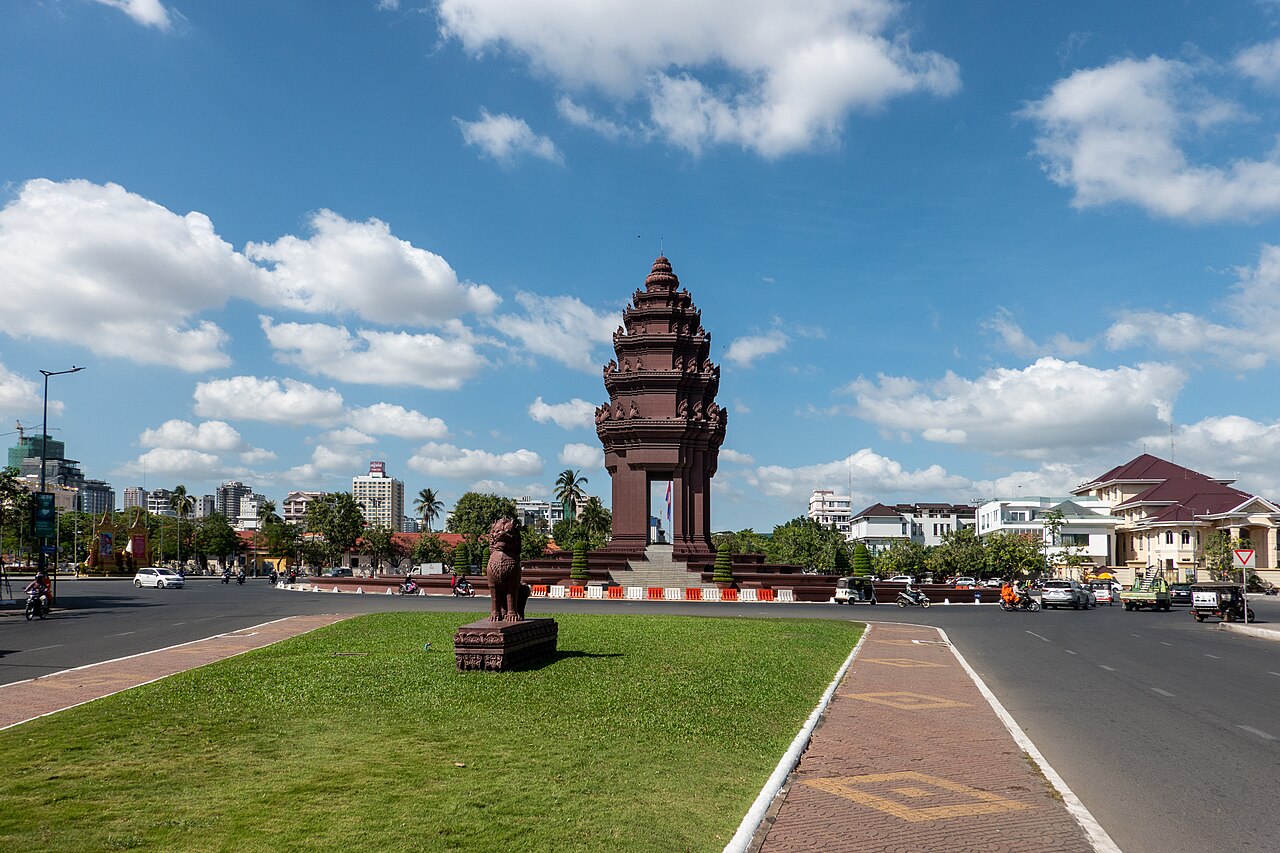
The Independence Monument is the best-known modern landmark in Phnom Penh and a symbol of national pride. It marks Cambodia’s independence from France in 1953 and stands in a large roundabout at the crossing of Norodom and Sihanouk Boulevards, in the heart of the city. It was designed by Vann Molyvann, the Cambodian architect who shaped so much of the capital in the 1950s and 1960s, and it takes the form of a lotus-shaped stupa about twenty metres high, in a style that echoes Angkor and other Khmer monuments. It is also a war memorial for Cambodia’s dead, and it is the focus of celebrations and services on national holidays, when it is decorated with flags and flowers. For visitors, it is a free, quick and rewarding stop, best seen in the early morning or at dusk, when the stone is softly lit and locals gather in the park around it to walk, exercise and relax. It is not a place for a long visit, but it gives you a sense of how the city sees itself.
How to visit
The monument sits in the middle of a roundabout, so you cannot walk straight across the road to it. Use the pedestrian crossings and the park paths around it, or take a tuk-tuk and ask the driver to stop close by. There is no admission fee, and you can see it at any time, although the early morning and the evening are the most pleasant. Take care with the traffic around the roundabout.
What to look for
The lotus shape and the stepped tiers, which show how a modern architect borrowed from the Khmer temple tradition, and the Khmer-style details on the stone. Look too for the offerings of flowers and incense that are sometimes left at the base, and keep your voice low, since this is both a monument and a memorial. On national holidays the area fills with people and flags, and it is a good moment to see the monument as part of local life.
Making the most of it
The monument is close to the Royal Palace and the National Museum, and a short walk from several of the city’s hotels and restaurants, so it fits naturally into an unhurried day. Pair it with a walk along Norodom Boulevard, with a visit to the architecture of Vann Molyvann if you are interested in modern buildings, or with the riverfront in the evening. Bring water, wear sun protection and visit in the cooler hours.
What to expect
The experience
A short, free stop at a lotus-shaped monument in a city-centre roundabout, with a park around it.
Best time
Early morning or dusk, when it is cooler and locals gather in the park around it.
How long
About half an hour.
Tips
Use the crossings to reach it, keep your voice low as it is also a war memorial, and carry water in the heat.
Quick picks
- Best for
- Architecture fans and anyone who wants a quick, free look at a symbol of modern Cambodia.
- Families
- A short, easy stop, though the roundabout traffic needs care with children.
- Couples
- A pleasant dusk stop, combined with a stroll through the park.
- Pair with
- The Royal Palace, the National Museum and the riverfront, all close by.
- Time needed
- Half an hour.
Good questions
Who designed the Independence Monument?+
It was designed by the Cambodian architect Vann Molyvann, in the shape of a lotus-shaped stupa that echoes Angkorian and other Khmer monuments.
What does the monument commemorate?+
It was built to celebrate Cambodia’s independence from France in 1953, and it is also a memorial to the country’s war dead.
Where is the Independence Monument?+
It stands in a roundabout at the crossing of Norodom and Sihanouk Boulevards in central Phnom Penh.
Is there an admission fee?+
No, it is free to see at any time. Early morning and dusk are the most pleasant.
How long should I allow?+
About half an hour is plenty, longer if you want to enjoy the park around it.