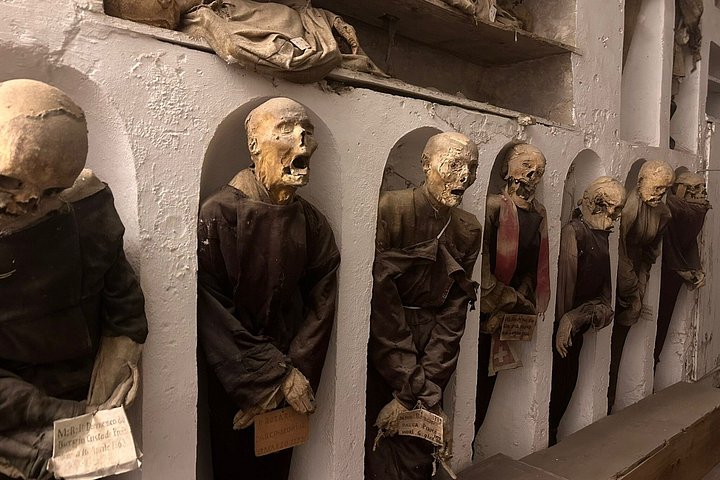
The Catacombe dei Cappuccini lie beneath a Capuchin monastery on the western side of Palermo, and they are unlike any burial place most visitors will have seen. In the late sixteenth century the friars discovered that the dry, stable air of their crypt naturally preserved the bodies laid there. What began as a resting place for the monks grew into a status symbol, and over the next three centuries local families, clergy, professionals and even children were interred in the corridors, many dressed in their best clothes and arranged by rank and profession. Today more than eight thousand bodies are recorded, and the effect is part history lesson, part memento mori. The galleries are divided into sections for men, women, priests, professionals, virgins and children, and walking through them is quiet, strange and surprisingly moving. Among the best known figures is a little girl whose remarkably lifelike preservation has made her one of the most photographed, and discussed, sights in Sicily. The visit is not for everyone, but for travellers drawn to the odd corners of history it is a highlight, and it tells you a great deal about how Palermitans once thought about death, family and social standing.
Understanding what you see makes the visit richer. The friars did not simply leave bodies to dry: they were treated, sometimes with a process of dehydration on racks and sometimes with preserving washes, before being dressed and placed in niches or hung along the walls. Families paid to have loved ones displayed, visited them and even changed their clothes over the years.
The tradition faded in the nineteenth century, and the later burials are more conventional, but the old corridors preserve a way of remembering the dead that feels almost unimaginable today. Guides and audio commentary explain the history, the preservation methods and the stories of particular individuals, which turns a macabre first impression into something more human.
Practicalities
The catacombs sit a short taxi ride or bus journey from the historic centre, near the Norman Palace, so they combine neatly with a morning of sightseeing. Entry is usually timed, and queues can build at busy moments, so booking a ticket or a guided visit in advance is sensible. Photography is not permitted inside, and visitors are asked to behave respectfully, keep voices low and dress modestly, with shoulders and knees covered.
The corridors are underground and cool, so a light layer is useful even in summer, and the floors can be uneven. Check the opening hours for the day you plan to go, since they vary by season.
Who it suits
Curious adults, history and photography lovers and older teenagers who enjoy something different from churches and palaces. It is not recommended for very young children or anyone who finds the subject distressing, and some visitors prefer to skip it entirely, which is perfectly reasonable. If you do go, give yourself time afterwards for a coffee and a walk, perhaps toward the Cathedral or into the markets, because the contrast of lively street life after the quiet of the crypt is part of the Palermo experience.
Pair it with the Norman Palace in the same morning, then finish with a street food tour to restore the spirits.
A note on etiquette and mood
Most visitors fall quiet within a few steps, and that is the right response. The friars still regard the site as part of their heritage, and many of the people here have descendants in Palermo today. Take your time, read the information panels where they are provided and resist the urge to treat the corridors as a spectacle. Many travellers say the visit feels more thoughtful than they expected, and that it stays with them long after the sunlit streets of the old town have swallowed them up again.
What to expect
The experience
A timed visit through the underground galleries of the Capuchin monastery, with optional commentary on the history of the burials and the preservation methods.
Best time
Early in the day, before queues build, and outside the heat of midday since the corridors are cool.
How long
About an hour, a little longer with a guide or audio commentary.
Tips
No photography is allowed inside, so keep your phone away. Dress modestly and expect some uneven floors and stairs.
Quick picks
- Best for
- Curious travellers who like the unusual side of history and want something very different from Palermo's churches.
- Families
- Not suitable for young children; older teenagers may find it fascinating, but use your judgement.
- Couples
- A memorable shared curiosity, followed by a long lunch in the old town to lighten the mood.
- Pair with
- The Norman Palace, Palermo Cathedral and the street food tour.
- Time needed
- One hour on site plus travel from the centre.
Good questions
Are the bodies real?+
Yes, the catacombs hold thousands of naturally and deliberately preserved bodies, dating mostly from the late sixteenth to the nineteenth century. They are displayed in sections by gender, profession and age.
Can I take photographs inside?+
No, photography is not permitted in the galleries, out of respect for the dead. Expect to leave the camera in your bag.
Is it suitable for children?+
It is generally not recommended for young children, and some adults find it unsettling. Older teenagers with an interest in history often find it absorbing.
How long does a visit take?+
About an hour is typical, though a guided visit can run a little longer. Allow extra time for queues and for getting there from the centre.
Is there a dress code?+
Yes, cover your shoulders and knees and keep voices low, since the site is part of an active religious community's heritage.