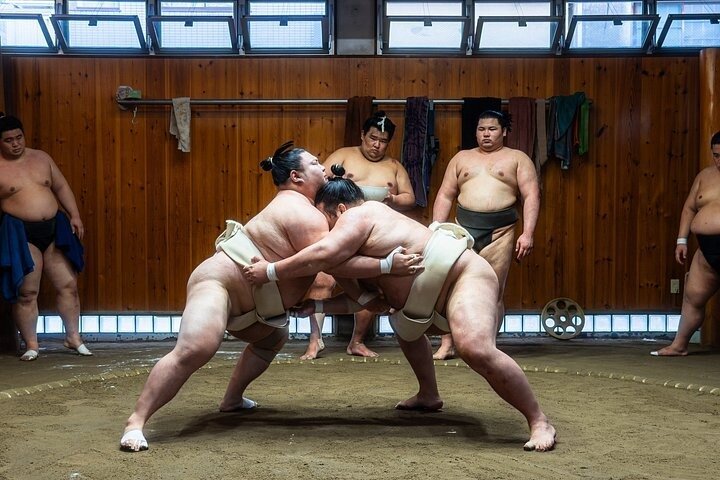
Sumo is a sport, a Shinto ritual and a way of life, and the best way to understand all three is to watch it at six in the morning, when wrestlers train before breakfast in the stables where they live. A stable, or heya, is part dormitory and part dojo: the men sleep, eat, cook and train under one roof, ranked strictly by seniority, with juniors doing the chores. Practice, called asa-geiko, begins with warm-ups, shiko leg-stomps and stretches, moves through sliding drills and bouts in the clay ring, and finishes with a punishing round of repetitions that can leave the youngest wrestlers soaked and gasping. Visitors sit on the floor at the edge of the room, usually in silence, a few meters from men weighing well over a hundred kilos. This booking page is a guided viewing at a stable in Tokyo, with entry to the practice session and a chance for photos with wrestlers at the end, though reviewers say that photo time is sometimes missed when practice runs long. It is one of Tokyo's most unusual and memorable morning activities, and rated 4.2 from 272 reviews.
The rules matter, because you are a guest in someone's workplace. The operator lists a minimum age of 13 and a group size of up to ten. You must be quiet: no eating, loud talking, bright flashes or intrusive sounds. Photography during the training itself is not allowed according to a reviewer, so expect to enjoy it with your eyes.
You will sit on the floor for a long stretch; chairs or stools can be requested but reviewers say they are not guaranteed, so dress for floor sitting and be honest with yourself about your knees.
The experience is not wheelchair accessible. Expect it to last between 60 and 90 minutes, and some reviewers report sessions of up to two hours, so do not book a tight onward schedule.
Scheduling is the quirk to understand. The stable is available on Mondays to Saturdays between 8:00 and 10:00 in the morning, but only during set windows of the year, and the operator lists them: from December 1 to 30, 2026, then January 4 to 10, February 1 to 20, April 6 to May 9, May 31 to June 19, August 3 to September 12, October 4 to 23 and December 7 to 30, 2027.
Outside those windows the stable is unavailable, in part because of the tournament calendar. The exact address depends on which stable can host you and is emailed about a week ahead, so you cannot pick the neighborhood. Date changes are not allowed within three days of the experience, while free cancellation applies up to six days before.
Make the most of it by learning a little first. The ring is a raised clay platform, the dohyo, purified with salt, and a bout is won by forcing the opponent out or touching down with anything but the soles of the feet. Tokyo hosts the grand tournaments at Ryogoku Kokugikan in January, May and September, and the Edo-Tokyo Museum nearby tells the story of the sport's roots in the city.
If you want to see bouts rather than training, buy tournament tickets separately. Combine this with a late breakfast or a chanko-nabe lunch, the hearty stew wrestlers eat, and an afternoon at a nearby museum.
What to expect
The experience
A guided viewing of a professional sumo stable's morning practice from floor seats at the edge of the room. Groups are capped at ten and visitors must be 13 or older.
Best time
Only the windows the operator lists, Monday to Saturday between 8:00 and 10:00, with the stable address emailed about a week ahead.
How long
Sixty to ninety minutes; some sessions run to two hours.
Tips
Arrive on time, stay silent, and do not use flash or eat. Expect floor seating and dress for it. Allow extra time if the session runs long.
Quick picks
- Best for
- Anyone curious about sumo who wants an authentic glimpse of daily wrestler life rather than a staged show.
- Families
- Good for teenagers who can sit still and stay quiet; the minimum age is 13.
- Couples
- A memorable shared morning for couples interested in Japanese culture.
- Pair with
- The Edo-Tokyo Museum, Senso-ji and an unhurried chanko lunch.
- Time needed
- A morning; keep the afternoon flexible.
Good questions
When does the sumo morning practice run?+
The operator lists Monday to Saturday from 8:00 to 10:00 in set windows: December 1 to 30, 2026, then January 4 to 10, February 1 to 20, April 6 to May 9, May 31 to June 19, August 3 to September 12, October 4 to 23 and December 7 to 30, 2027. Dates can change, so check before booking.
Where is the stable?+
Somewhere in Tokyo's 23 wards. The exact address depends on which stable is available and is emailed about a week before your date.
Can I take photos?+
Photography during the training is not allowed according to a reviewer, and flash and noise are forbidden. Photos with wrestlers at the end are included in the booking page, but may be missed if practice runs long.
Is there a minimum age?+
Yes, the operator lists 13 as the minimum, with groups of up to ten. The experience is not wheelchair accessible and requires sitting on the floor for a long time.
Can I cancel?+
Free cancellation applies up to six days before. Date changes are not allowed within three days of the experience, so plan with care.


