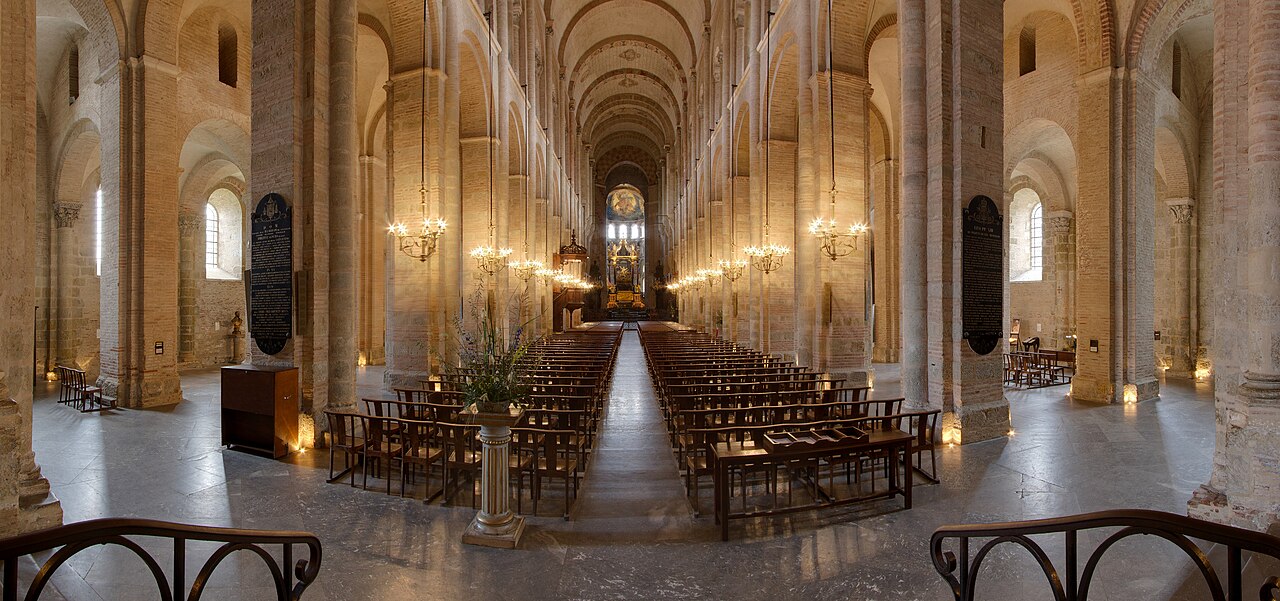
Rising above the northern end of the old town, the Basilica of Saint-Sernin is the building that most visitors remember from Toulouse. It was begun in the 11th century on the site where Saturninus, the first bishop of Toulouse, was buried after his martyrdom in the third century, and it grew over the next two hundred years into a huge pilgrimage church. The result is generally described as the largest Romanesque church still standing in Europe, a long nave with double side aisles, a transept and a ring of radiating chapels around the east end, all built in the pink brick and pale stone that define the city. The octagonal bell tower, with its five receding tiers of arched windows, is a landmark that you can spot from across the rooftops. Inside, the stone is calm and cool, the proportions are impressive, and the crypt and ambulatory hold a rich collection of reliquaries that once drew pilgrims from across Europe. In 1998 the basilica was inscribed by UNESCO among the Routes of Santiago de Compostela in France, as Toulouse was a major stage on the road south.
How to visit
The nave is free to enter, and it is a working church, so dress respectfully and keep voices low during services. Access to the crypt and ambulatory is usually ticketed with a small fee, and it is worth paying for if you are interested in the relics and the older fabric of the building.
Opening hours differ for the nave and for the crypt, and there are breaks around mass, so check the day's times before you set out. Metro line A to Jeanne d'Arc or line B to Compans-Caffarelli are both within walking distance, though the most pleasant approach is on foot from the Capitole along rue du Taur.
What to look for
Outside, study the Porte Miègeville on the south side, whose carved capitals and sculpted figures are among the finest Romanesque work in the region, and the Porte des Comtes. Inside, the proportions of the nave make the biggest impression, and the ambulatory chapels hold relics of many saints. The organ, built in the 19th century by the celebrated builder Aristide Cavaillé-Coll, is famed among organists, and occasional concerts take place in the church, which make a beautiful evening.
The name Saint-Sernin is the local form of Saturninus, and the Occitan form Taur, meaning bull, links to the story that the saint was dragged through the streets by a bull; the street leading here is rue du Taur.
Making the most of it
Combine the basilica with the neighbouring Musée Saint-Raymond and the lively streets of the Arnaud Bernard quarter, which have good cafes and a more local feel than the area around the Capitole. Late morning light on the brick is particularly striking from the square in front of the east end.
If you are walking the whole day, put the basilica at the start of the route, before the heat of the afternoon, and plan on a sit-down lunch nearby afterwards. The basilica is closed to visitors during some religious ceremonies, so a quick check of the schedule avoids disappointment.
Practical notes
The pavements around the basilica are uneven, and the interior is cool even in summer, so a light layer is useful. Visitors with limited mobility can usually reach the nave without steps, though the crypt involves stairs. Respect the rules on silence and photography near people at prayer.
Guided tours in English are sometimes arranged through the tourist office, and they add context on the relics and the pilgrim routes that the building served. The surrounding square has cafes and benches with a direct view of the tower, which makes a pleasant rest stop before the walk back to the centre.
What to expect
The experience
A self-guided visit through the nave, with an optional ticketed visit to the crypt and ambulatory.
Best time
Late morning, when light reaches the east end and the church is calmer than at midday.
How long
45 to 90 minutes, a little longer if you add the crypt.
Tips
The crypt and ambulatory have their own hours and a small fee; confirm the day's times at the entrance.
Quick picks
- Best for
- Romanesque architecture, pilgrimage history and one of the city's great skylines.
- Families
- Children enjoy the climb up the nearby streets and the bull story; keep visits short and quiet inside.
- Couples
- A late-afternoon wander around the apse followed by dinner in the lively Arnaud Bernard streets.
- Pair with
- Place du Capitole and the Musée Saint-Raymond, both a short walk.
- Time needed
- About an hour.
Good questions
Is the Basilica of Saint-Sernin free to enter?+
Entry to the nave is free. The crypt and the ambulatory with its relics usually carry a small entrance fee.
Why is the basilica a UNESCO World Heritage site?+
It is part of the UNESCO-listed Routes of Santiago de Compostela in France, because Toulouse was a major stage on the pilgrim roads and the basilica was a key pilgrimage church.
How old is the Basilica of Saint-Sernin?+
Construction began in the 11th century and continued into the 13th century, and it is generally described as the largest remaining Romanesque church in Europe.
Where is the Basilica of Saint-Sernin?+
It is on the north side of the old town, a ten-minute walk from the Place du Capitole along rue du Taur. The nearest metro stations are on lines A and B.
Can you visit during services?+
The church is in use and may close to visitors during certain ceremonies. Check the day's schedule and keep quiet if you do enter during a service.