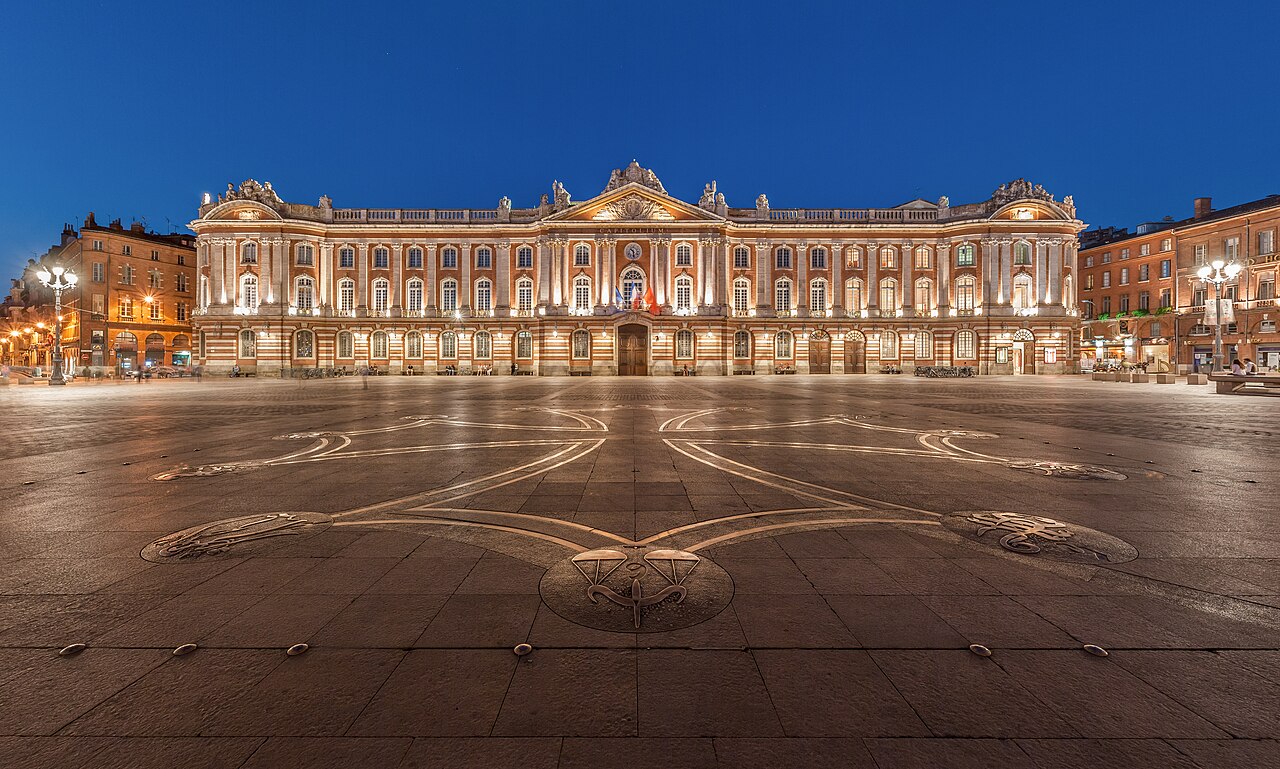
Every visit to Toulouse starts at the Place du Capitole, the grand square that has served as the city's front room for centuries. The long neoclassical facade on the east side, built in the middle of the 18th century, is the Capitole itself, named for the capitouls, the magistrates who governed medieval Toulouse. Eight columns on the facade are said to represent those eight capitouls, and behind the pink brick and white stone you will find both the Hôtel de Ville and the Théâtre du Capitole, the home of the city's opera. The square is paved in warm brick tones, with a large bronze-coloured Occitan cross, the emblem of Languedoc, set into the ground and ringed by the signs of the zodiac. Cafe terraces run along the arcades on the other sides, and in the evening the facade is lit gold and the whole place feels like an open-air salon. This is the starting point for almost every walking route in the old centre, and on most days it hosts a market, a street performance or simply a few hundred people sitting on the steps of the stone fountain edge with an ice cream.
How to visit
The square is free and open at all hours, and the metro stop Capitole on line A puts you directly on it. Entry to parts of the building is also free when no event or council business is under way. The highlight inside is the Salle des Illustres, a grand gallery decorated in the 19th century with large paintings of Toulouse's history and a ceiling that rewards a slow look upwards.
Opening hours for the interior vary by season and by events, so check the tourist office before you plan around it. Bags are usually screened at the entrance.
What to expect
The passage from the square leads into the Cour Henri IV, a quiet brick courtyard that feels a world away from the crowds outside. The square itself changes with the calendar, from the large Christmas market in December to open-air concerts and local markets on selected days. Mornings are calm and good for photographs, midday is busy with office workers and visitors, and the best light on the facade is in the late afternoon, when the brick turns the deep rose that gives Toulouse its nickname, la Ville Rose.
Making the most of it
Use the square as the first stop of a loop. Walk north along rue du Taur to the Basilica of Saint-Sernin, or south into the pedestrian streets of Saint-Étienne and the cathedral quarter, or drop to the Garonne for a river view. A coffee under the arcades is a pleasant way to start, though the cafe prices here carry a premium; the side streets just off the square are cheaper and often better.
If you are staying in the centre, the square is also a good rendezvous point and a handy landmark in a city where the narrow streets can be disorienting. Evening is when the place feels at its liveliest, with the facade glowing and the terraces full.
Practical notes
The square is fully pedestrianised, step-free and easy for wheelchairs and pushchairs, though the surrounding streets are cobbled in places. Public toilets are limited, so use a cafe or the nearby shopping streets. Pickpockets work crowded squares in any big city, so keep bags closed during busy markets and festivals. The Capitole is also the site of civic ceremonies and the opera season runs through the winter, so an evening performance at the Théâtre du Capitole is a memorable way to see the building from the inside.
Tourist information is available a short walk away at the Donjon du Capitole, which is useful for maps, guided tour dates and local tips.
What to expect
The experience
A free walk across the main square and, when open, a look inside the Capitole's decorated halls and courtyard.
Best time
Late afternoon, when the brick glows rose, or in the evening when the facade is lit.
How long
30 to 60 minutes, longer with a coffee on the terrace.
Tips
Interior access can change on event days, so check at the tourist office or at the door before planning around it.
Quick picks
- Best for
- Getting your bearings in Toulouse and seeing the city's most photographed facade.
- Families
- Plenty of room to run around and a pleasant fountain edge to sit on while you decide where to go next.
- Couples
- An evening drink under the arcades with the facade lit up.
- Pair with
- Basilica of Saint-Sernin to the north, Musée des Augustins and the Garonne to the south.
- Time needed
- About 45 minutes.
Good questions
What is the Capitole de Toulouse?+
It is the building on the east side of the Place du Capitole that houses the city hall and the opera house. The facade dates from the middle of the 18th century and is named for the capitouls, the historic city magistrates.
Can you go inside the Capitole?+
Parts of the building, including the Cour Henri IV and the decorated Salle des Illustres, are generally open to visitors when no event is taking place. Hours vary, so check before you go.
What is the cross on the ground in the square?+
It is the Occitan cross, the historic emblem of Languedoc and Toulouse, set into the paving and surrounded by the signs of the zodiac.
How do I get to the Place du Capitole?+
Take metro line A to Capitole station, which opens onto the square. Most hotels in the old town are within a short walk.
When is the Christmas market held on the square?+
A Christmas market is usually held in the square in December. Dates change each year, so check with the tourist office.