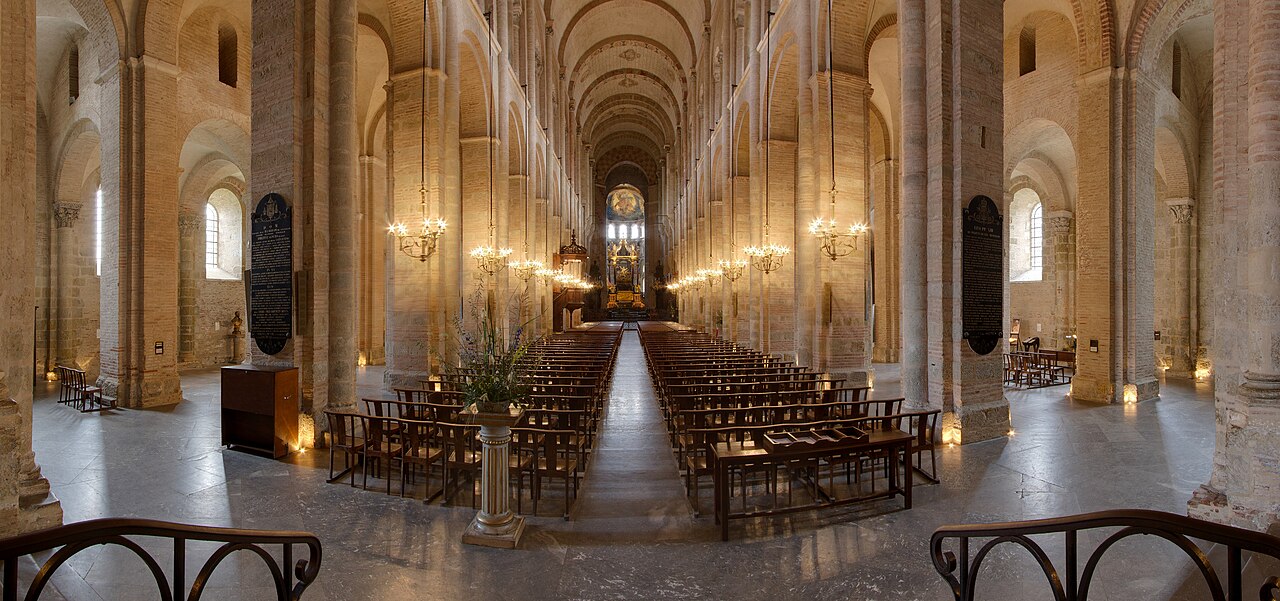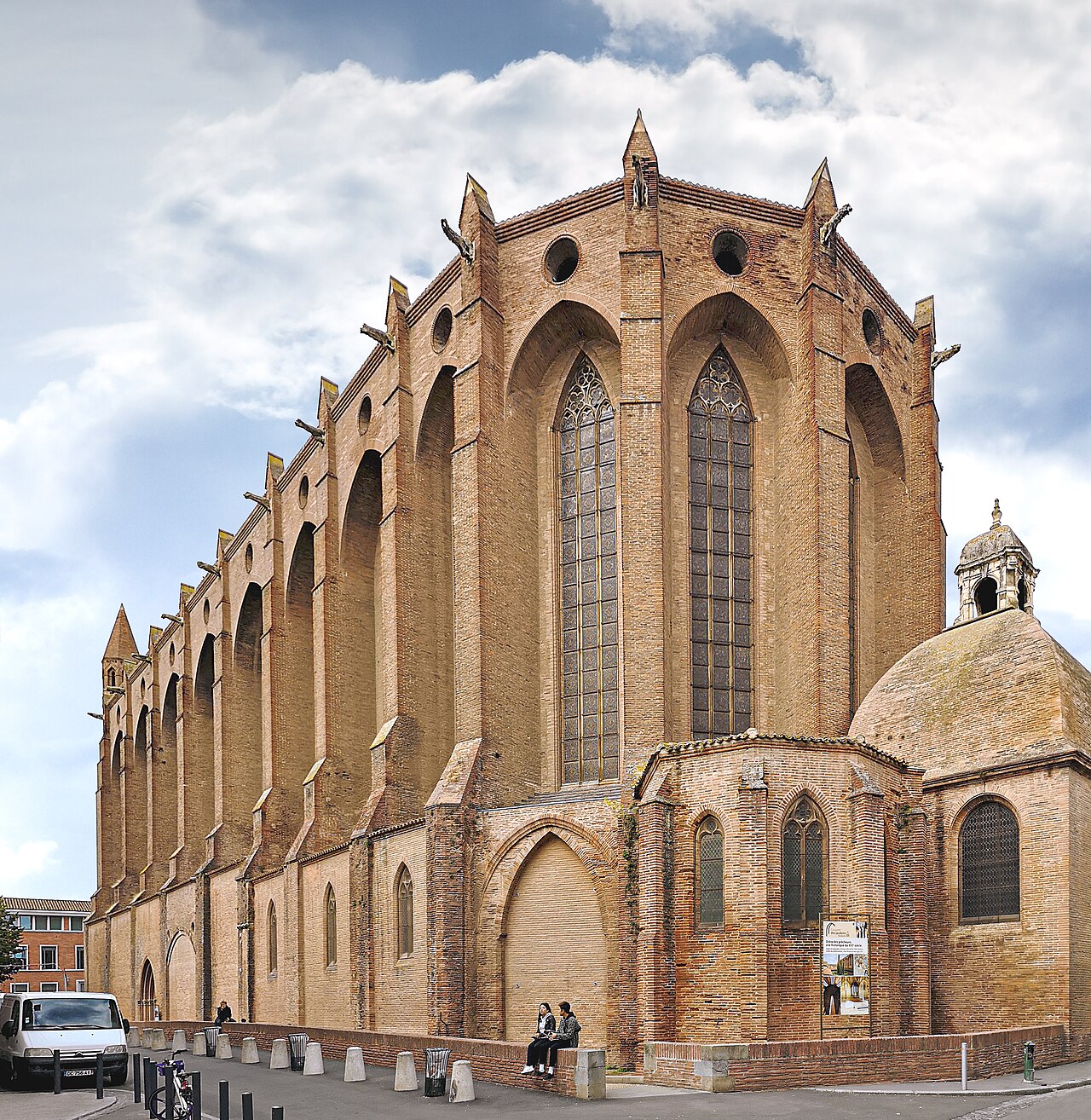
The Jacobins convent is the quietest and, for many visitors, the most moving of the great Toulouse sights. It was founded in the early 13th century by Dominic, who gathered his first preachers in the city to challenge Cathar teaching, and the order built a vast church and cloister in brick that remains one of the masterpieces of southern French Gothic. The church is divided down the middle by a single row of tall columns, and at the east end the central column bursts into a fan of twenty-two ribs, the famous palmier or palm tree, which fills the vault above with light and shadow. Since the 14th century the church has housed the relics of Saint Thomas Aquinas, who was a Dominican, and the tomb sits beneath the high altar. Beyond the church stand the refectory, the chapter house and the peaceful cloister, with arcades of slim paired columns around a small garden. In the former refectory and other spaces, modern exhibitions and concerts take place through the year, and the convent is a favourite setting for classical music festivals.
How to visit
The church and cloister are open to visitors, with a modest fee for some areas, and opening hours change with the season and with concerts and festivals, so look at the schedule before you go. The convent sits a few minutes' walk north of the Place du Capitole, and the nearest metro is Capitole on line A. Allow time to sit quietly in the church: the effect of the palm-tree vault builds the longer you stay, especially when low sun reaches the stained glass.
What to look for
The nave's double aisle, with its slender pillars, gives the interior an unusual sense of height, and the palm-tree vault is best viewed from beneath the central column, looking up. The cloister has a gentle garden, a good place for a rest on a warm day.
Concerts and music events happen here regularly, and the setting makes them memorable, so look for an evening programme if you are staying more than a day. The convent also forms part of the Toulouse story of religion and learning, linking the city's university tradition with the Dominican order.
Making the most of it
Visit in the morning, when the church is quiet, and combine with the Capitole and the Basilica of Saint-Sernin for a day devoted to the city's medieval and Gothic heritage. Combined with a walk along rue des Changes and the old streets around it, the convent makes a compact route. Photography inside is generally allowed without flash, but check at the entrance. Wear shoes that suit cobbled streets, and bring a layer in cooler months as the brick church holds the chill.
Practical notes
The paving in the cloister and church is old and uneven, and some areas involve steps, so wear flat comfortable shoes. The church can feel cold even in summer, and the cloister garden is a good place to warm up on a sunny day. Mobile phones should be silent, and flash photography is generally discouraged.
Guided tours are sometimes organised by the tourist office and bring out the symbolism of the architecture and the story of the Dominicans in Toulouse. If you plan an evening concert, buy tickets in advance, as the popular festival dates sell out and seating is limited.
What to expect
The experience
A self-guided visit to the church, cloister and former convent buildings.
Best time
Mornings, when the church is quiet and sun lights the stained glass.
How long
45 to 75 minutes.
Tips
Concerts and festivals can change opening hours, so check the day's schedule before you set out.
Quick picks
- Best for
- Gothic architecture lovers and anyone who wants a calm, atmospheric break from the busy streets.
- Families
- A short, quiet visit; the palm-tree vault and the tomb of Aquinas make good talking points for older children.
- Couples
- An evening concert in the convent, if one is on.
- Pair with
- Place du Capitole and the Basilica of Saint-Sernin.
- Time needed
- About an hour.
Good questions
What is the palm-tree vault at the Jacobins?+
It is the famous column near the east end of the church from which twenty-two ribs spread out like palm fronds across the vault. It is the most celebrated feature of the building.
Is Saint Thomas Aquinas buried at the Jacobins?+
His relics have been kept in the church since the 14th century, and the tomb lies beneath the high altar.
Is there an entrance fee for the Jacobins?+
Parts of the convent carry a modest fee, while access to certain areas may be free. Confirm current rates and hours before your visit.
Are concerts held at the Jacobins?+
Yes, the convent is a regular venue for classical music and festival concerts, and the church and cloister are especially atmospheric in the evening.
How far is the convent from the Capitole?+
It is a short walk, around five to ten minutes, north of the Place du Capitole through the old streets.