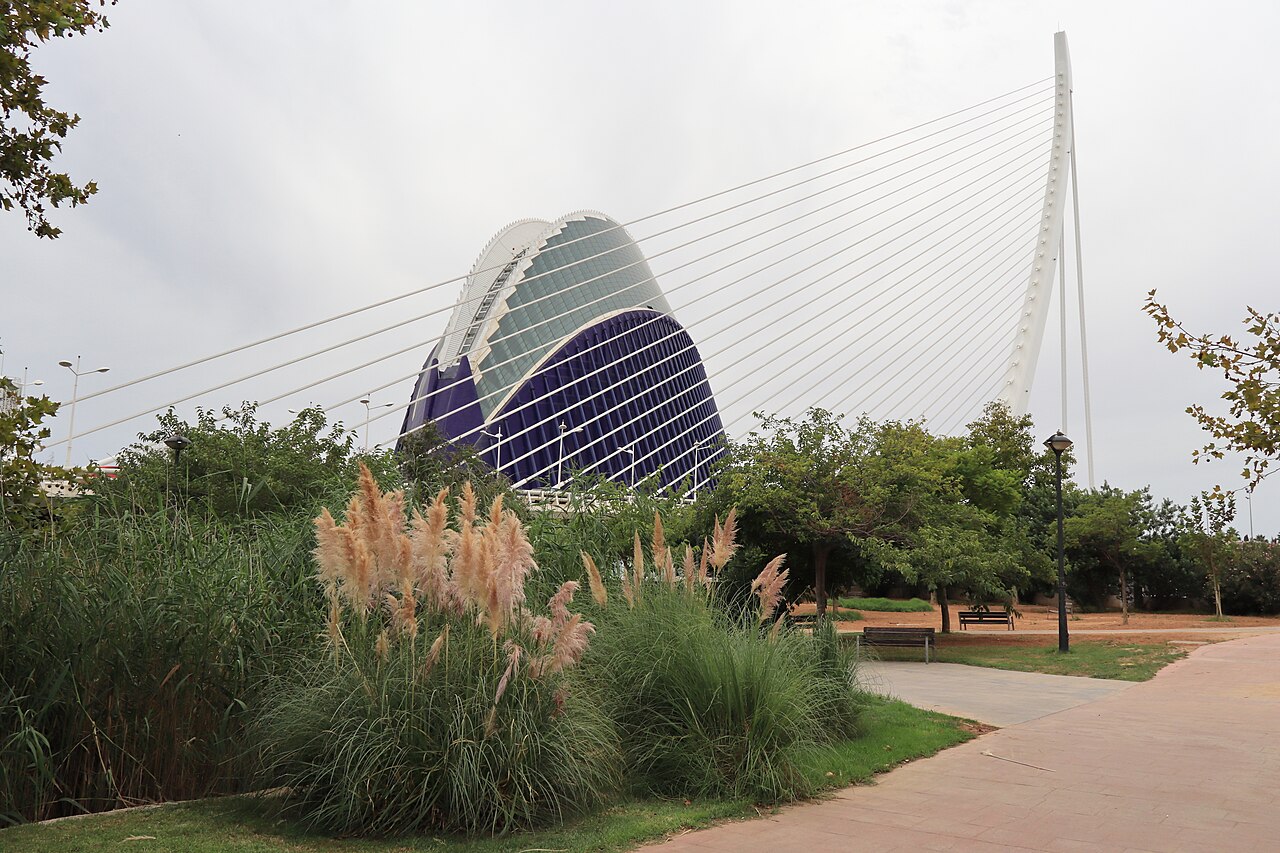
No image says modern Valencia like the City of Arts and Sciences, a line of brilliant white buildings by the Valencian architect Santiago Calatrava rising out of shallow turquoise pools in the old bed of the Turia. The complex grew from the late 1990s and holds several very different venues. The Hemisfèric, shaped like a giant eye whose lid opens over the water, was the first to open, in 1998, and works as a planetarium and large-format cinema. Beside it, the Museu de les Ciències Príncipe Felipe, whose long ribbed hall looks like the skeleton of a whale, is a hands-on science museum with interactive exhibitions on space, genetics, the body and physics, plus live science shows; in 2026 it added a new exhibition on dance and movement. Further along stand the Umbracle, a garden walkway under white arches, the Palau de les Arts opera house and the Àgora, now home to CaixaForum. Walking around the outside of the buildings and along the pools is free at any time, and the museum and the Hemisfèric each need a ticket. Combination tickets for the two, or with the Oceanogràfic, are sold online and are the simplest way to plan a visit.
How to see it: start at the western end by the Palau de les Arts and walk east along the pools, past the Hemisfèric and the Science Museum, to the Umbracle and the Oceanogràfic. Book a Hemisfèric session in advance and build the museum around it, since the films and planetarium shows run at set times. In the museum, the upper floors hold the main interactive exhibitions, and families can easily spend two or three hours pressing buttons and testing gravity.
What to expect: the buildings are spectacular in strong sun but the white surfaces reflect a lot of heat and glare, so summer middays are hard work outdoors. Evenings and blue hour are the photographers’ favourite time, when the buildings light up and reflect in the water. The complex is large, so expect plenty of walking. Hemisfèric programmes change through the year, with documentaries, children’s films and occasional live planetarium sessions in Spanish.
Making the most of it: arrive along the Turia Gardens by bike or on foot, which turns the trip into a scenic approach rather than a bus ride. Pair the Science Museum and Hemisfèric on one day and the Oceanogràfic on another if you have children. For a night out, check the Palau de les Arts programme for opera, concerts and dance, and finish with dinner in nearby Ruzafa.
What to expect
The experience
A free outdoor walk around Calatrava’s buildings and pools, plus ticketed visits to the hands-on Science Museum and Hemisfèric shows.
Best time
Morning for the museum, and late afternoon into blue hour for photos of the buildings reflected in the water.
How long
Three to five hours for the museum, a Hemisfèric session and a walk around the complex.
Tips
Book a timed Hemisfèric session first, bring sunglasses for the glare and come back after dark to see the buildings lit up.
Quick picks
- Best for
- Architecture fans, photographers and families with curious children.
- Families
- The Science Museum is built for hands-on learning, and a Hemisfèric film breaks up the day nicely.
- Couples
- An evening stroll along the lit pools, then a performance at the Palau de les Arts.
- Pair with
- The Oceanogràfic next door and a ride along the Turia Gardens.
- Time needed
- Half a day.
Good questions
Is the City of Arts and Sciences free?+
Walking around the outside of the buildings, the pools and the Umbracle walkway is free. The Science Museum, the Hemisfèric and the Oceanogràfic each require a ticket.
Who designed the City of Arts and Sciences?+
Most of the complex was designed by the Valencian architect Santiago Calatrava. The Oceanogràfic’s entrance building was designed by Félix Candela.
What is the Hemisfèric?+
The eye-shaped Hemisfèric is a planetarium and large-format cinema that opened in 1998. It shows documentaries, children’s films and planetarium programmes at set times.
Is the Science Museum good for children?+
Yes, its exhibitions are interactive and designed for touching and experimenting. Live science shows and workshops run through the year.
Can I combine the museum, the Hemisfèric and the Oceanogràfic?+
Yes, combination tickets are sold for two or all three venues. With children it is best to split them across two days.