Most visitors treat the gardens of Versailles as the place to go after the palace. That undersells them. André Le Nôtre laid out the grounds for Louis XIV as a work of art in their own right, and the way to enjoy them is to plan a route rather than wander until your feet give out. This guide walks you through the gardens in a sensible order, explains how the fountains work and shows where to rest.
The scale
The grounds cover hundreds of hectares, and the walk from the palace terrace to the far end of the Grand Canal is well over a kilometre each way. Add the Trianon estate and the return, and a full garden day can mean eight to ten kilometres on foot. Plan for the distance honestly. If you want to see everything, hire a bike, a golf cart or a rowing boat, or join a guided bike tour, and keep the rest of the day light.
Start on the terrace
Begin behind the palace at the Parterre d'Eau, two great rectangular pools lined with bronze statues. From here the central axis, called the Royal Walk, drops away to the Latona Fountain and then runs on to the Apollo Fountain and the Grand Canal. This is the view the garden was designed around, and it is best before the middle of the day, when the light is soft and the crowds are thin. Take a few minutes here before you go down.
The central walk
Follow the Royal Walk down the long green carpet of lawn. The Latona Fountain tells a story from Ovid, in which peasants are turned into frogs for insulting a goddess, and its tiered basins are the first big water feature you meet. Beyond it the Apollo Fountain shows the sun god rising in his chariot, a symbol that suited a king who took the sun as his emblem. The Grand Canal stretches beyond in the shape of a cross, and in good weather you can hire a boat to row on it.
The groves
On either side of the main axis are the groves, small outdoor rooms hidden behind clipped hedges. Each has its own design, such as a ring of marble columns, a ballroom with stepped cascades or a pool surrounded by statues. They are the best surprise of the gardens, and most of them are quiet because visitors stay on the central walk. Some groves open only on fountain-show days, so check on the day which are accessible. Even when the gate is closed, you can often glimpse the design from the path.
How the fountains work
The fountains run on a complicated water system that cannot supply every jet at once, which is why the Musical Fountains Show exists. On show days, usually weekends in the main season, the fountains are turned on in sequence to a baroque soundtrack, and the Musical Gardens event lets you walk among the groves with music playing. On other days the basins are still, which is a very different, calmer garden. If water is the main reason you come, choose a show day, and note that the gardens may charge admission on those days.
The Neptune Fountain
At the northern end of the gardens, below the palace's north wing, the Neptune Basin is the largest of the fountains and the grand finale of the show. If you only see one fountain in action, make it this one. Arrive early to find a place along the rail, because the final display draws a crowd.
The Orangery and the south parterre
Below the south wing of the palace the Orangery shelters hundreds of orange trees, which are carried outdoors in the warm months and stand in tubs along the terraces. The view down to the Pièce d'eau des Suisses, a large rectangular lake, is one of the most peaceful in the park. It is a good spot to sit after the busy terrace.
The Trianon and the Hamlet
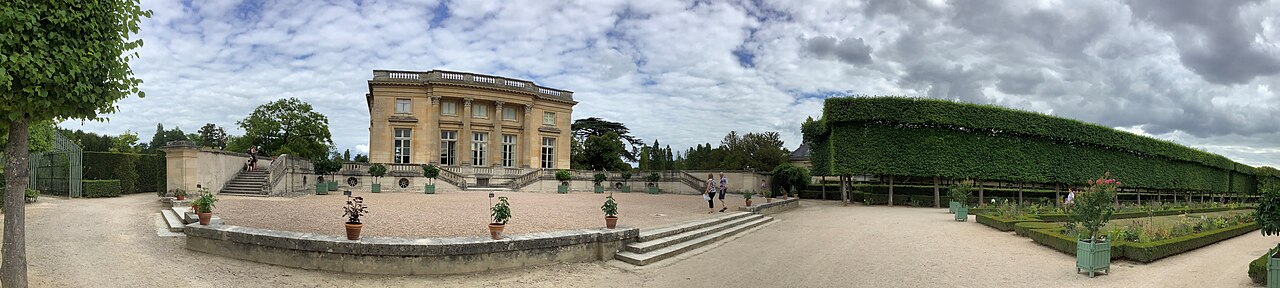
A walk of around twenty-five minutes brings you from the Grand Canal to the Trianon estate, with the Grand Trianon, the Petit Trianon and Marie-Antoinette's Hamlet. The gardens here are more intimate: flower beds, a French pavilion, a belvedere and a farm-style hamlet around a lake. The estate is on its own ticket, so check your pass first. A small electric vehicle or a bike is a good way to link the two halves of the park without losing the afternoon.
A suggested route
Begin at the Parterre d'Eau in the morning and walk down the Royal Walk to the Apollo Fountain. Take a groves detour on the way back, have lunch at a garden cafe or bring a picnic from the Notre-Dame market, then head to the Trianon estate in the afternoon. In the main season, time your arrival for the Musical Fountains Show. In winter, switch the order, since the Trianon opens later in the day, and spend the morning in the palace.
Seasons and weather
Spring brings fresh green hedges and blossom, early summer brings flowers and long evenings, and autumn turns the lime trees gold. Winter strips the colour but also empties the paths, and the gardens are usually free to enter outside the show season. Paths are gravel and can be muddy after rain, so wear sturdy shoes, and bring a windproof layer for the open terraces.
Practical tips
Carry water, because the park is large and kiosks are spread thin. Toilets are located near the palace, the Grand Canal and the Trianon, so use them when you pass. Leave large bags in the cloakroom at the palace rather than carrying them, and respect the rules on picnics, drones and bikes, which are posted at the entrances. Pushchairs are manageable on the main paths but awkward on the gravel of the groves.