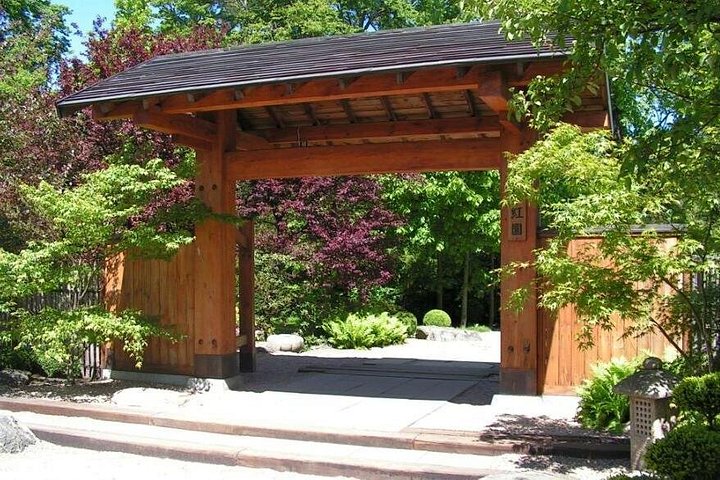
The Japanese Garden in Szczytnicki Park is one of the most peaceful corners of Wrocław. It was created between 1909 and 1913 as an exotic oasis for the Centennial Exhibition, on the initiative of Count Fritz von Hochberg, with the design credited to the Japanese gardener Mankichi Arai. After a long decline, it was restored in the 1990s with Japanese expertise. It has ponds, a stream, a waterfall, a wooden bridge, a gate and a tea house, planted with maples, ginkgo, rhododendrons, golden larch and carefully shaped trees. The garden sits right beside Centennial Hall, so the two make a natural pair, and the surrounding park is a large, mature park with old trees that suits a long, slow walk.
The garden is open seasonally, from 1 April to 31 October, so it is a spring, summer and early-autumn plan rather than a winter one. Admission is charged at a modest level, with reduced rates for some groups and free entry for small children. Within the gardens, the paths wind past ponds with large carp, over the wooden bridge and past the tea house, and the plantings change dramatically through the seasons, with blossom in spring, deep green in summer and the colours of maple leaves in autumn.
Occasional tea demonstrations and events take place, and the pace is slow and contemplative.
The link for this sight is a private city tour that includes the Japanese Garden along with the Panorama painting and other highlights, which is a good option if you want a guide and transport. Most visitors simply walk in, and the garden is about a ten-minute stroll from Centennial Hall and the Pergola. Combine it with the Visitor Centre at Centennial Hall and the Multimedia Fountain in summer for a classic half-day in this part of the city, or with Hydropolis and the zoo for a longer outing on the east side.
Practical advice
Go in the morning on a weekday to enjoy the quiet, wear comfortable shoes, and bring water in summer. In rain, the garden still looks attractive, but paths can be slippery, so take care. Check the opening dates and prices before you set out, because the garden closes outside its season.
If you visit in the colder months when the garden is closed, the surrounding Szczytnicki Park is open and free to walk, with its old oaks, paths and views of Centennial Hall, and is still a pleasant stroll, although the Japanese character belongs to the garden itself.
What to expect
The experience
A slow walk around ponds, a stream, a waterfall, a wooden bridge and a tea house, in the heart of Szczytnicki Park.
Best time
Spring blossom, summer green or autumn maple colour, on a weekday morning.
How long
One to two hours.
Tips
The garden is open only from April to October, so check dates, and wear comfortable shoes.
Quick picks
- Best for
- Couples, families and photographers who want a calm green break.
- Families
- Good for children who like ponds and carp, with reduced rates and free entry for the youngest.
- Couples
- A peaceful, romantic stroll, especially in spring and autumn.
- Pair with
- Centennial Hall and its Visitor Centre, the Pergola and the Multimedia Fountain in summer.
- Time needed
- One to two hours.
Good questions
When is the Japanese Garden open?+
It is open from 1 April to 31 October, so it is closed in winter. Check the current hours and prices before you go.
Who designed the garden?+
It was created between 1909 and 1913 for the Centennial Exhibition, with the design credited to the Japanese gardener Mankichi Arai and the project led by Count Fritz von Hochberg.
Is it free?+
No, admission is charged, with reduced rates for some visitors and free entry for small children. Szczytnicki Park around it is free to walk.
How close is it to Centennial Hall?+
It lies right beside Centennial Hall, so the two are easy to combine, and the Pergola and the Multimedia Fountain are nearby.
What is there to see?+
Ponds with large carp, a stream and waterfall, a wooden bridge, a gate, a tea house and plantings that include maples, ginkgo, golden larch and rhododendrons.