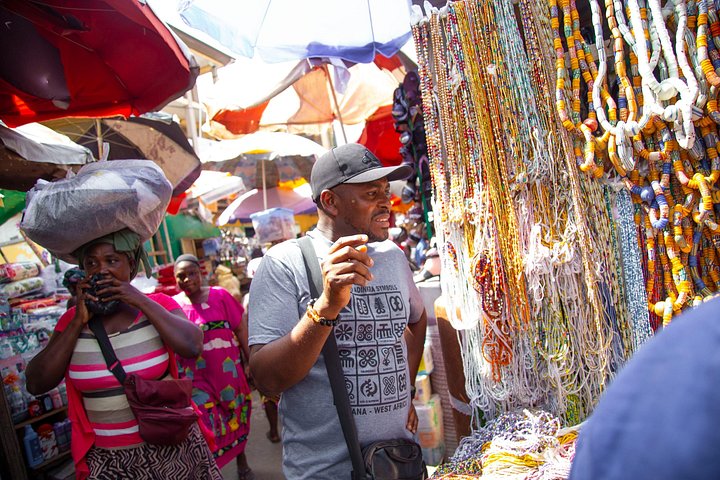
Ghana is a country of makers. Cloth, beads, wood carving, drums and basketry are made in workshops and villages all over the south, and Accra is where they all meet in the shops and markets. This guide explains what to look for, where to see crafts being made and how to buy well.
Kente and woven cloth
Kente is the most famous Ghanaian textile, woven in narrow strips on a loom and stitched together into bold, patterned cloth. The Ashanti and the Ewe each have their own traditions, with different colours, patterns and meanings. Real hand-woven kente is expensive because of the time involved, while machine-printed imitations are cheap and sold everywhere. Ask whether the cloth is hand-woven, look at the back of the strip for neat, even weaving and expect a fair price to reflect the work. Weaving villages such as Bonwire near Kumasi and Agotime in the Volta Region welcome visitors, and some tours from Accra include them.
Adinkra and stamped cloth
Adinkra cloth is printed with symbols that stand for ideas such as wisdom, strength, unity and resilience. The traditional method uses stamps cut from calabash and a dye made from tree bark. A visit to a workshop shows how the stamps are dipped and pressed onto cotton, and you can often try it yourself. The symbols also appear on modern clothing, jewellery and walls, so learning a few makes shopping more interesting.
Batik and tie-dye
Wax-resist dyeing is a popular craft in Accra, and several studios run classes where you design your own cloth. It is an easy way to take home a one-off souvenir, and teachers can show you how to care for it. Afterwards, look for batik scarves, wall hangings and shirts in the Arts Centre and in craft stalls.
Beads and jewellery
The Krobo bead tradition of the Eastern Region produces glass beads made from powdered glass, often recycled from bottles, in a wide range of colours. Bead workshops let you watch the process or make your own piece. When buying, ask whether the beads are hand-made, since hand-made beads vary slightly in shape and colour, while factory beads are uniform. Strings of beads, bracelets and necklaces are light and travel well.
Drums, carvings and baskets
Djembes, talking drums and shakers are sold at craft markets, along with wooden masks, stools and figures. The Ashanti stool is a classic and a meaningful gift. Baskets woven from straw and grass, especially from the north, are strong and decorative. Before buying large items, think about airline size limits and customs rules, and ask the seller about packing and shipping. Avoid items made from endangered woods or animal products, which may be restricted.
Where to shop
The Arts Centre on the High Street has dozens of stalls with a broad range, from masks to textiles, and it is a good place to compare prices. Makola Market is the place for cloth by the yard, beads and household goods, though it is crowded and best visited with a guide. Galleries such as the Artists Alliance Gallery sell fixed-price work, often by established artists, and shops in Osu stock contemporary designs. Craft villages outside the city offer the chance to buy directly from makers.
Bargaining and fairness
Bargaining is normal at markets and craft stalls, but it should be friendly and fair. Ask the price, offer a little less, and settle at a figure that rewards the maker. Do not push so hard that the seller loses on the sale, and be wary of any price that seems too good to be true. Carry small notes to make payment easy.
Pack and travel well
Wrap fabrics and beads separately, keep fragile items in your carry-on and keep receipts for large purchases. A day devoted to a class, a market and a gallery will give you a clear sense of what you like before you spend, and it turns shopping into a way to meet the people who make the things you bring home.
A suggested craft day
Start in the morning with a batik or bead class, break for lunch at a chop bar near the Arts Centre, then spend the afternoon at the stalls, comparing the work you saw being made with what is on sale. End at a gallery to see how contemporary Ghanaian artists use the same colours and symbols in painting and sculpture. Leave room in your bag, take a few photographs of makers with their permission and keep the contact details of anyone whose work you admire, because many artisans take custom orders and can ship pieces after you have gone home.