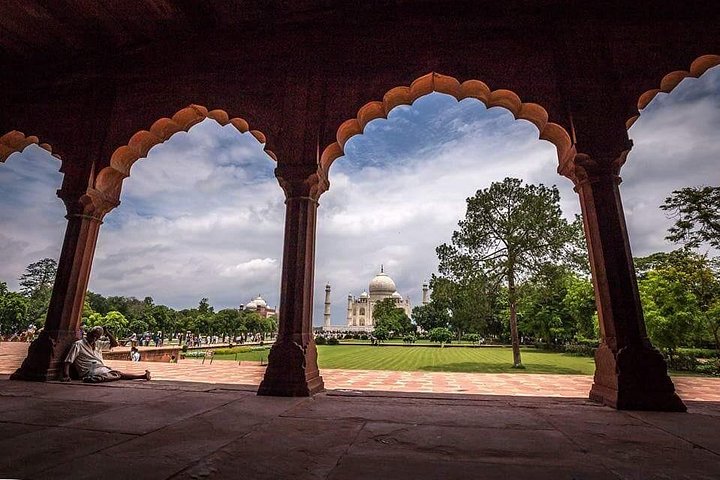
The Jama Masjid of Agra stands opposite Agra Fort and beside the busy lanes of Kinari Bazaar, a large congregational mosque built in 1648 by Jahanara Begum, the eldest daughter of Shah Jahan. It is raised on a high plinth and approached by a flight of steps, and its broad facade of red sandstone is banded with white marble and crowned by three large domes. Unlike many Mughal mosques, it has no minarets, which gives it a low, solid silhouette. The courtyard is wide and calm after the noise of the surrounding market, and the marble prayer hall carries geometric patterns and calligraphy. It is one of the oldest and most important mosques in the city and a good example of the architecture that Shah Jahan and his family sponsored during the same years as the Taj Mahal.
The mosque is still used daily by the local community, so visitors should behave as guests. Dress modestly, covering shoulders and knees, remove your shoes at the entrance, and speak quietly. Women may be asked to cover their heads. Visits are best outside prayer times, and Friday midday, the main congregational prayer, is generally not a good time for sightseeing, so plan to come at another hour. Ask a guide or your hotel about the current rules for non-worshippers, since access and any charge for shoe-keeping or photography can vary.
The mosque sits in the old city, close to Agra Fort and the Agra Fort railway station, so it fits naturally into a walk through Kinari Bazaar. A typical outing combines Agra Fort in the morning, the mosque and the bazaar around midday, and food stops in the lanes nearby.
The streets are crowded and narrow, so go on foot or by tuk-tuk from the fort, keep valuables close and expect plenty of noise. A local guide can show you the details of the facade, the inscriptions and the history of Jahanara, who also funded other buildings in Agra and Delhi.
Photographers will like the strong contrast between the sandstone and marble, the shapes of the domes and the quiet courtyard views, but be discreet around worshippers. Go in the morning for softer light and fewer crowds, and avoid the middle of the day, when the stone courtyard can be very hot underfoot. The visit is short, usually thirty to forty-five minutes, and entry to the mosque is generally without charge, though you may want small notes for shoe-minding and a donation.
The mosque is a useful reminder that Agra's Mughal heritage is not only about tombs and palaces but also about the faith and community life that continue around them. If you are visiting during a religious festival, expect larger crowds and possible restrictions.
Use the visit to understand the old city's rhythm. The mosque sits at the centre of a district that has been a commercial hub for centuries, and the sounds of the call to prayer, the shouts of traders and the clatter of rickshaws are part of the experience. Walking from the mosque into the surrounding bazaars, you pass shops selling bangles, textiles, sweets and spices, and the streets leading toward the fort are lined with older buildings and small shrines.
Keep your bag zipped, hold your phone close in the crowds, and agree a fare before you board a rickshaw. A visit at the end of the day, when the heat has dropped and the bazaar is lively, gives the best sense of the place.
What to expect
The experience
A self-guided visit to the mosque courtyard and facade, usually combined with Agra Fort and a walk through Kinari Bazaar.
Best time
Morning for gentler light; avoid prayer times, especially Friday midday.
How long
Thirty to forty-five minutes at the mosque, longer with the bazaar.
Tips
Dress modestly, remove your shoes, carry small notes for shoe-minding and be discreet with photographs.
Quick picks
- Best for
- Travellers who want to see Mughal religious architecture and old-city life together.
- Families
- A short stop; remind children to be quiet and respectful, and watch for hot stone in the midday sun.
- Couples
- A calm courtyard moment in the middle of a busy bazaar walk.
- Pair with
- Agra Fort and the Kinari Bazaar food walk, all within a short distance.
- Time needed
- About an hour including the walk from the fort.
Good questions
Who built the Jama Masjid in Agra?+
It was built in 1648 by Jahanara Begum, the daughter of the emperor Shah Jahan.
Can non-Muslims visit?+
Respectful visitors are generally welcome outside prayer times. Dress modestly and ask locally about current rules.
What should I wear?+
Cover shoulders and knees, remove your shoes at the entrance, and women may be asked to cover their heads.
Is there an entry fee?+
Entry is generally without charge, though you may want small notes for shoe-keeping or a donation.
When should I avoid visiting?+
Avoid prayer times, especially the main congregational prayer on Friday around midday, and expect crowds on religious festival days.