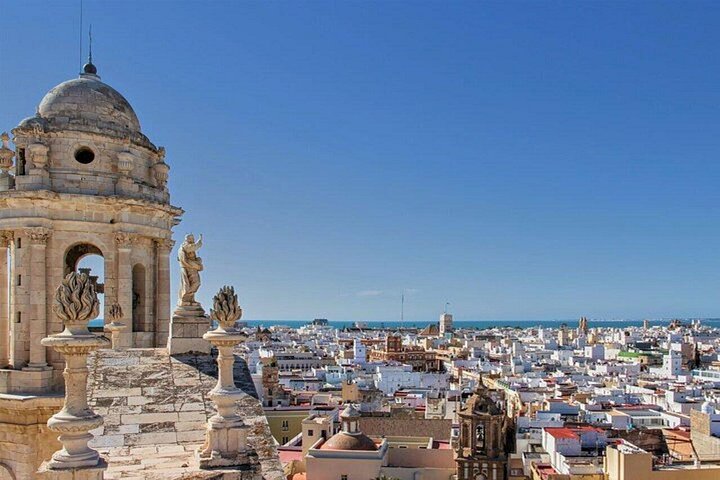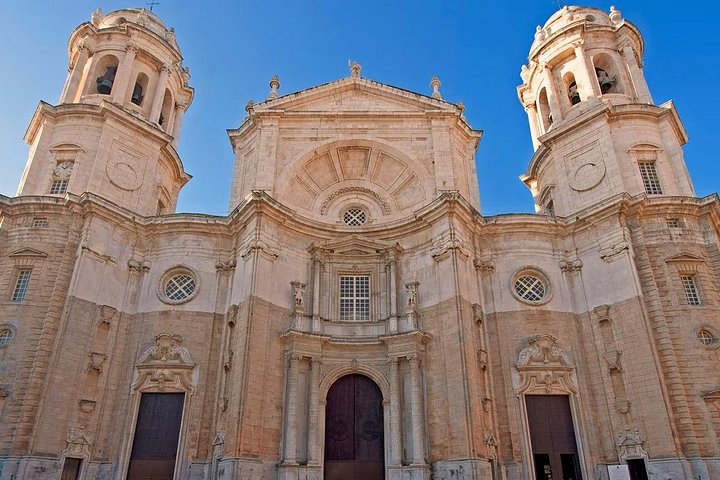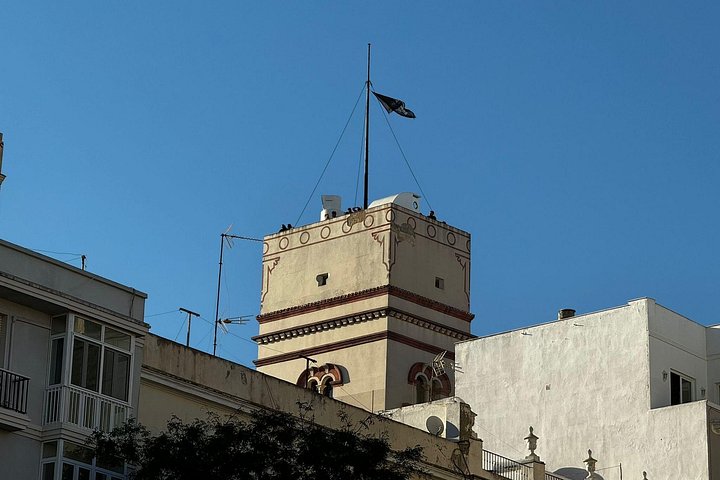
Torre Tavira is the most famous of the roughly 160 lookout towers that merchants built on their town houses in the eighteenth century. In those years Cadiz held the monopoly on trade with the Americas, and shipowners climbed their own towers to spot approaching sails and cargo ships long before they reached the port. The Tavira tower, at about 45 metres above sea level, is the highest point of the old town and was designated the city's lookout in the 1700s, which is why it became the one that visitors can climb today. At the top you get a full circle of terraced rooftops, the cathedral's golden dome, the bay, and on clear days the line of the Atlantic coast.
The main attraction at the top is the camera obscura. A periscope-like lens on the roof captures the live view of the town and projects it, in a darkened circular room, onto a concave white dish. The guide rotates the lens and talks you through the streets, plazas and monuments as they pass across the dish, explaining the history of the watchtowers and the merchant families behind them.
It is a very old optical trick, but seeing pedestrians, gulls and washing lines move across the screen is oddly captivating, and it works best on bright sunny days when the image is crisp.
The product linked here is a Cadiz walking visit that includes the Tavira tower and the camera obscura, so it is one way to see the tower with a guided context. Entry is generally by timed session, so arriving a little early matters in busy months. The climb is a staircase and there is no lift, so those with limited mobility should check access in advance. For photographs, the open terrace at the top gives the best rooftops-and-sea shot in the city, while the camera obscura room itself is for watching rather than filming.
A few practical points will help you get the most from the visit. Sessions are timed, and the camera obscura show runs in a group, so the order you climb and the time you arrive affect your experience. Weekends and school holidays are busier, and a morning arrival tends to be calmer. Because the whole point of the camera obscura is the live image, avoid hazy or rainy afternoons if you can choose, and consider keeping the tower for a clear day while using cloudy days for the museums and food.
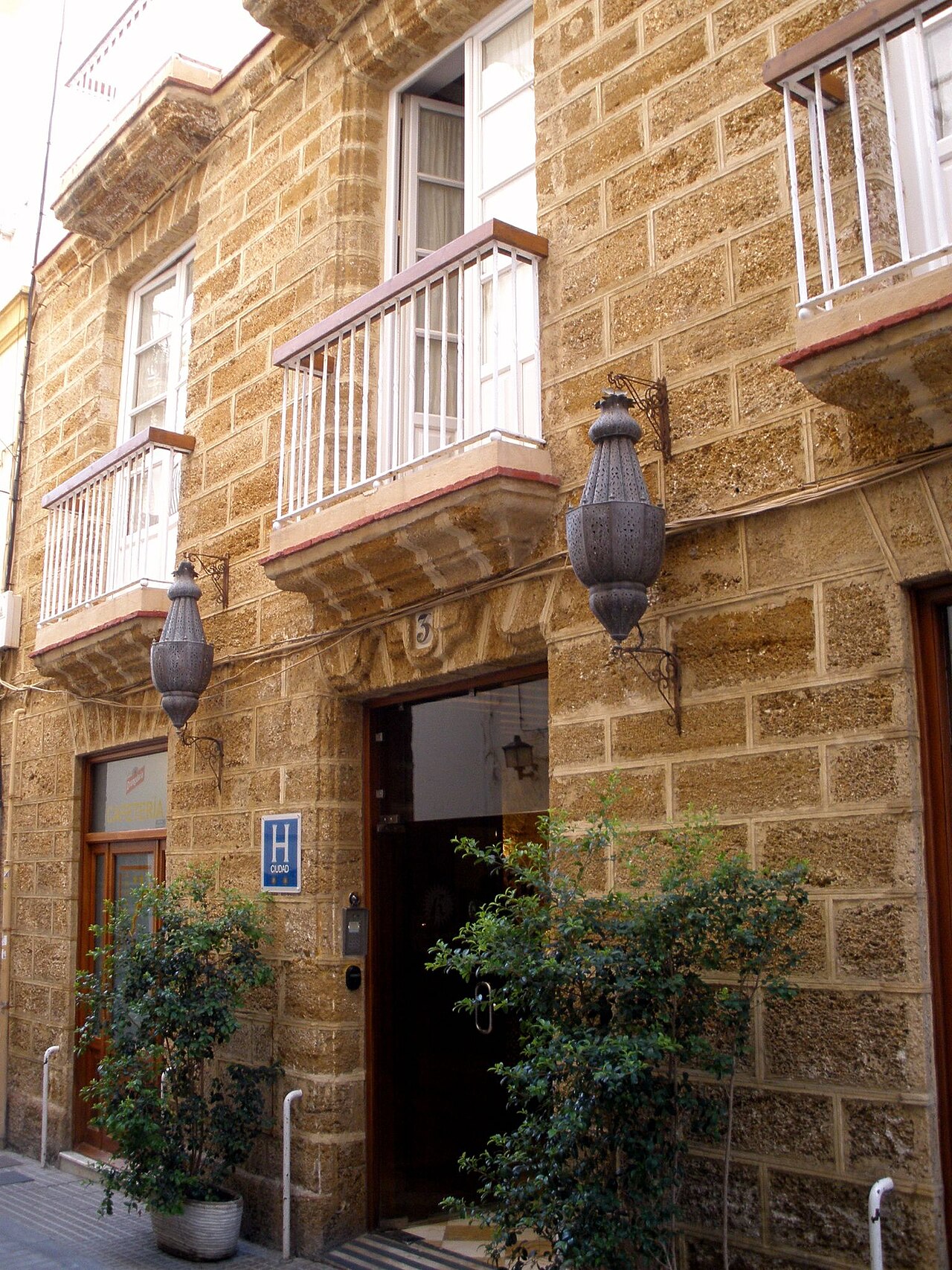
The tower sits in a residential street, so the approach is part of the pleasure: you pass through lanes of small shops and houses, with glimpses of the sea.
Once at the top, take a few minutes to look in all directions. To the north you see the bay curving toward El Puerto de Santa Maria; to the west the Atlantic spreads out beyond the sea walls; and to the south the long city beach glimmers in the distance. Look for the dozens of other rooftop towers, each of which once served a trading family.
Photographers should bring a lens that handles bright sun and avoid shooting directly through the glass in the camera obscura room. Families often make this a first stop, because a short, vivid experience sets the tone for a day of walking.
What to expect
The experience
A timed tower visit: climb the stairs to the terrace for the view, then watch a guide-led camera obscura demonstration in a dark circular room.
Best time
Midday to mid-afternoon for the brightest camera obscura image; early evening for sunset skyline views from the terrace.
How long
Roughly 45 to 60 minutes including the climb and the demonstration.
Tips
Go on a sunny day, since the projection needs strong light. Arrive 10 minutes before your session, and carry a small bag only; the stairs are narrow.
Quick picks
- Best for
- Anyone who likes a good view and a clever old-fashioned gadget.
- Families
- Children usually love the camera obscura, but small ones will need patience on the stairs and in a dim room.
- Couples
- The terrace at golden hour is one of the best rooftop moments in the city.
- Pair with
- The cathedral is a short walk away, as is the Roman theatre and the tapas bars of the Pópulo quarter.
- Time needed
- About an hour, plus a few minutes of waiting before your slot.
Good questions
Why did merchants build these towers?+
They were used to watch for incoming trading ships. Whoever spotted a ship first could prepare the dock, the warehouse, and the buyers. Cadiz still has well over a hundred of these rooftop watchtowers.
Does the camera obscura work on cloudy days?+
It works best on sunny days. Overcast skies produce a duller image, and the operator may reschedule or adjust demonstrations in poor weather.
Is there a lift?+
Typically no. The climb is by staircase, so people who find stairs difficult should plan accordingly.
Can I take photos?+
Yes on the open terrace, which has the best views. The camera obscura room is generally for watching, and flash photography is discouraged.
Is it suitable for children?+
Yes for most children, who tend to enjoy the camera obscura show, but the stairs and the dim room may be tricky for toddlers.