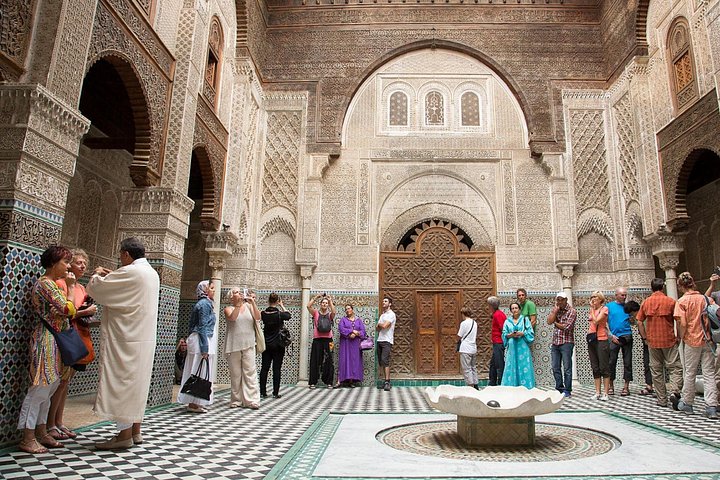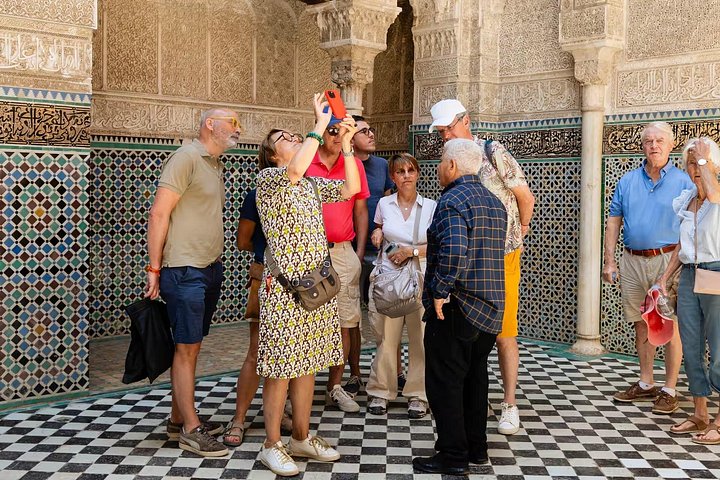
Al-Attarine is the madrasa people remember after they have seen the grander monuments. It is one of the Merenid-era student colleges of Fes el-Bali, built beside the Qarawiyyin quarter and named for the spice and perfume merchants of the adjoining Attarine souk. It is compact rather than monumental, and that is its charm. You step from a lane of sacks, scents and shouted prices into a quiet courtyard where a central basin is framed by zellige tile at waist height, carved stucco above and a lattice of cedar around the upper gallery. Light falls straight down into the court, the sound of the souk drops away and the proportions feel almost domestic. Upstairs, the small student cells still open onto the gallery, and from the roof you can see the green-tiled roof of the Qarawiyyin mosque, one of the best rooftop moments in the old city. Because the building is so small, it rewards a slow ten or fifteen minutes rather than a rushed photograph, and it makes a useful contrast with the larger and more ornate Bou Inania Madrasa elsewhere in the medina.
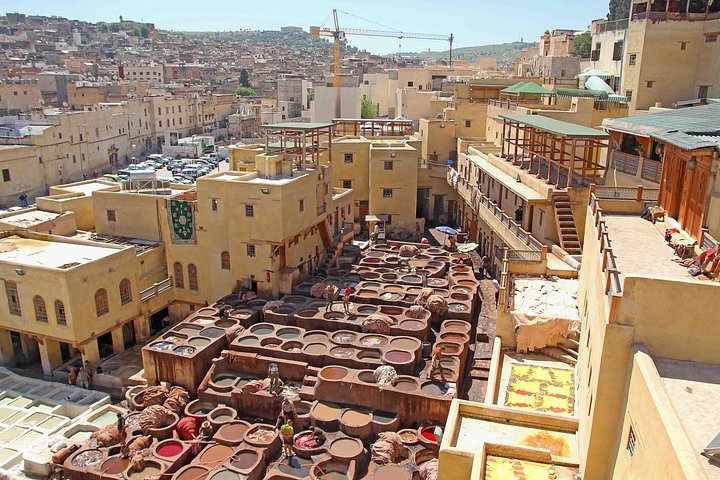
Most visitors reach Al-Attarine on a guided medina walk, and that is a sensible way to do it, because the madrasa sits in a dense part of the old city where lanes branch constantly and the entrance is easy to miss. Tours that name Al-Attarine usually combine it with a museum stop, a viewpoint over the tannery and a pass through the souks, so you see the madrasa as one chapter of a longer morning rather than as a standalone ticket.
Entry to the madrasa itself has traditionally been modest, and the tour products are priced low because the walk is the main service. Check the current arrangements when you book, as opening arrangements for Moroccan monuments can change.
The neighbourhood around it is worth the time. The Nejjarine quarter is close by, centred on a handsome tiled fountain and a former merchants inn that now houses a museum of wooden arts and crafts, with cedar furniture, musical instruments and carved doors, and a small rooftop terrace with views across the medina. Pairing the madrasa with that museum gives you the craft story behind the carving you have just admired: who made it, from what wood, and with which tools.
If you prefer to go alone, remember that non-Muslims cannot enter the Qarawiyyin mosque next door, but its doorways and the surrounding lanes can be seen from outside, and the madrasa gives you an interior to balance that.
Practical advice is simple. Go early in the day, when the courtyard is quiet and the light is good for the zellige and the carved wood. Dress modestly, remove sunglasses and hats if asked, and speak quietly, because this is a heritage building and the neighbourhood is residential. Photography is generally fine in the courtyard, but be discreet around any people at prayer in nearby buildings.
Wear shoes with grip, because the paving is worn smooth, and carry small notes for tips. If you have time for only one madrasa in Fes, many travellers choose Bou Inania for its scale, but if you have time for two, Al-Attarine is the one that feels most intimate.
What to expect
The experience
A short visit to a small Merenid madrasa with a tiled courtyard, carved stucco and cedar, student cells upstairs and a rooftop view, usually as one stop on a guided medina walk.
Best time
Early morning, when the courtyard is quiet and the light drops cleanly onto the tilework.
How long
Thirty to forty-five minutes at the madrasa, longer if you add the nearby wooden arts museum.
Tips
Go with a guide or a map, dress modestly, speak quietly, and carry small notes for tips.
Quick picks
- Best for
- Travellers who want to see how Merenid craftsmen worked tile, stucco and cedar at an intimate scale.
- Families
- Older children enjoy the roof and the cells, but there is little to do for toddlers and the lanes outside are crowded.
- Couples
- Pause in the courtyard for a few quiet minutes, then climb to the roof for the Qarawiyyin view.
- Pair with
- The Nejjarine fountain and wooden arts museum, Bou Inania Madrasa and the Chouara tannery sit on the same side of the medina.
- Time needed
- Allow about forty-five minutes at the madrasa, or half a day as part of a guided medina route.
Good questions
What is Al-Attarine Madrasa?+
It is a Merenid-era student college in Fes el-Bali, named for the spice and perfume sellers of the nearby souk. It is known for its small, richly decorated courtyard and its rooftop views.
Can non-Muslims visit Al-Attarine?+
Yes, the madrasa is a heritage building that visitors can enter, unlike the neighbouring Qarawiyyin mosque. Dress modestly and follow any posted rules.
Is it better than Bou Inania?+
They are different. Bou Inania is larger and grander, while Al-Attarine is smaller and more intimate, so many visitors see both.
Can I see the Qarawiyyin mosque from the madrasa?+
From the roof you can see its green-tiled roof line, though the mosque itself is closed to non-Muslims.
How do I find it in the medina?+
It is close to the Attarine souk beside the Qarawiyyin quarter, in a part of the medina where lanes branch often. A guide or an offline map saves a lot of wandering.