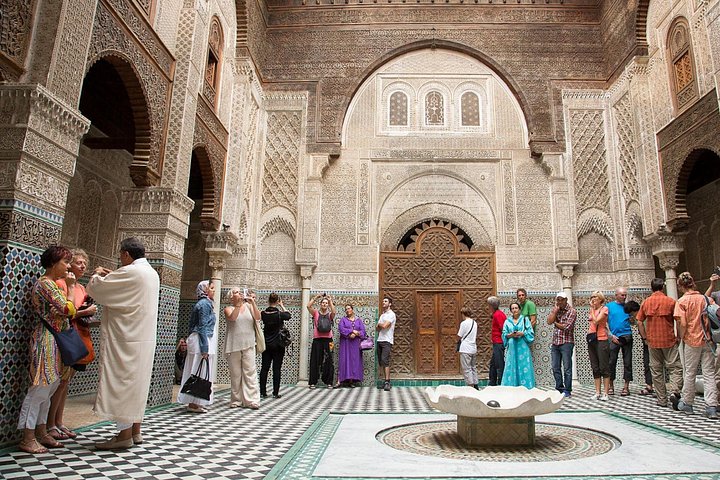
Fes is a city of scholars, and the written word has always had a place of honour in its mosques, madrasas and libraries. A calligraphy workshop turns that history into something you can try with your own hand. A local teacher introduces the Arabic script, explains why it is treated as an art form and shows the pens, inks and papers used to produce it. You then practise strokes and letters, learn how a single name or phrase can be shaped into an elegant composition and finish with a piece you can take away. The experience is calm and absorbing, and it gives real context to the carved inscriptions that you will see on the walls of Bou Inania and Al-Attarine. No knowledge of Arabic is needed, and beginners are welcome. Many sessions also include a lunch or dinner, which makes the workshop a relaxed half-day activity rather than a rushed lesson. It suits couples, solo travellers, families with older children and anyone who enjoys quiet creative pursuits, and it works well as a gentle contrast to an active day of sightseeing. Even if your handwriting is poor, the guidance is patient and the satisfaction of producing something readable is real, so it is worth trying if you want to leave Fes with more than photographs.
The session typically takes place in a traditional house or a riad courtyard, with low tables, ink pots and reed pens laid out. Your teacher will start with a short history of Arabic calligraphy and the main scripts, which include the flowing styles used in Moroccan manuscripts and the more angular forms used in architecture.
You will learn how to hold the pen, how to cut the angle of the tip and how to create thick and thin strokes. Practice sheets help you build up from basic lines to letters and then to a word or your own name written in Arabic.
A good teacher will encourage you to slow down and to treat each stroke as a small act of concentration, and the pace is deliberately unhurried. Many versions of the workshop combine the lesson with lunch or dinner, often a traditional meal with salads, tagine and tea, so check what is included and mention dietary needs when you book.
Wear clothes you do not mind marking with ink, and be ready to sit for a while. Your finished piece will need time to dry, so ask how to carry it safely and whether it can be framed or rolled.
If you enjoy the experience, ask the teacher about books, pens and ink you can buy to continue practising at home. Photography is usually welcome, but check before photographing other participants. The workshop pairs naturally with a visit to a madrasa, where you can compare your own efforts with the inscriptions carved in plaster and cedar, and with an afternoon at a museum of local arts.
Calligraphy also has a spiritual dimension in Morocco, where the Quran has long been copied by hand, and your teacher may touch on that tradition. Ask which phrases are suitable to write and which are best left to experts, and if you are buying a finished piece as a gift, ask the teacher to explain what it says.
What to expect
The experience
A guided calligraphy lesson with reed pens and ink, followed by a lunch or dinner.
Best time
Late morning for a lunch session, or early evening for dinner.
How long
Two to three hours including the meal.
Tips
Wear clothes that can take ink, allow your piece time to dry and mention dietary needs when you book.
Quick picks
- Best for
- Creative visitors and anyone interested in the written heritage of Fes.
- Families
- Older children can enjoy it if they like drawing or lettering.
- Couples
- A quiet, shared creative session followed by a meal.
- Pair with
- A visit to Bou Inania or Al-Attarine madrasa, to see inscriptions in situ.
- Time needed
- Allow around three hours with the meal.
Good questions
Do I need to know Arabic?+
No. Beginners are welcome and the teacher starts with the basics.
Do I keep what I make?+
Normally yes. Ask how to carry it home safely once the ink is dry.
Is a meal included?+
The workshop is offered with lunch or dinner. Check what is covered and mention dietary needs when you book.
Is it good for children?+
Older children who enjoy drawing often do well. Check age guidance when you book.
Where does it take place?+
Usually in a traditional house in or near the medina. Confirm the meeting point when you book.