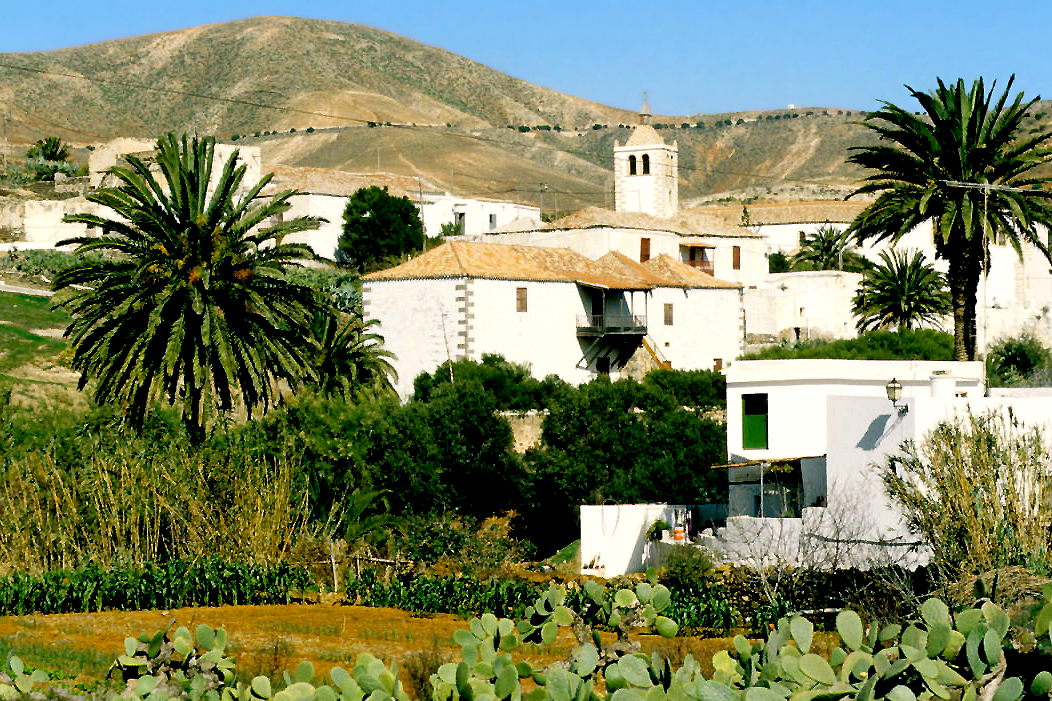
Betancuria is the island’s historic heart. The Frenchman Juan de Bethencourt founded the town at the start of the fifteenth century, and it remained the capital of Fuerteventura until 1834, serving as the political, administrative and religious centre. It lies in a sheltered valley among the island’s oldest mountains, away from the coast, and the whitewashed houses, small squares and quiet lanes feel a world away from the beaches. The town is presided over by the church of Santa María de Betancuria, called the church-cathedral, which was first built in the Norman-Gothic style and rebuilt in the seventeenth century. Inside you can see the choir, the baptistery, a Baroque altarpiece and a Mudéjar coffered ceiling. The town also has the ruins of a convent that belonged to the first Franciscan community in the Canaries, the hermitage of San Diego, a Sacred Art Museum and an Archaeological and Ethnographic Museum.
What to see
Start at the church of Santa María, which is the town’s most important building, and then walk through the small centre to the convent ruins and the hermitage of San Diego. The two museums hold collections of real historical value, from sacred art to the objects and archaeology of the island’s earliest people and later rural life, and are a good way to understand how the island lived.
The town is compact, and a visit takes one to two hours on foot. Check the opening times of the church and the museums on the day, as small sites can close at midday or on certain days.
Getting there
Betancuria is reached by mountain roads from the coast, including the road from the south through the Pájara valley and the road from the north and east. The roads wind through hills with viewpoints, and the drive is part of the pleasure. Parking is limited in the village, so arrive early, and note that tour coaches arrive around midday, when the lanes are busiest. A car gives the freedom to stop at viewpoints, and many visitors combine Betancuria with the Ajuy caves on the west coast.
Making the most of it
The town has small cafés and restaurants serving local dishes, including the island’s goat cheese and goat stew, and lunch here is a highlight. The village is cooler than the coast and can be breezy, so take a light jacket. The island’s patron saint, Nuestra Señora de la Peña, is celebrated in the Romería de la Peña on the third Saturday of September, a folklore festival that fills the valley. In November the village is calm and pleasant, and the light on the hills is soft in the late afternoon.
What to expect
The experience
A self-guided walk through a small historic village, with a church, convent ruins, a hermitage and two museums.
Best time
Arrive in the morning or late afternoon to avoid the midday tour coaches and to enjoy the soft light on the hills.
How long
One to two hours on foot, longer with a lunch stop and the museums.
Tips
Check opening times for the church and museums, park early, bring a light jacket and have lunch in the village.
Quick picks
- Best for
- Visitors who want history, quiet and mountain scenery after a few days at the beach.
- Families
- The village is small and easy to walk, but the museums and church are best for older children.
- Couples
- A slow lunch of local dishes in a quiet valley, then a drive over the mountain viewpoints.
- Pair with
- The Ajuy caves on the west coast and a stop at a cheese farm.
- Time needed
- Half a day, including the drive and lunch.
Good questions
Why is Betancuria important?+
It was founded in the early fifteenth century and was the capital of Fuerteventura until 1834. It was the island’s political, administrative and religious centre.
Is it free to visit Betancuria?+
Walking around the village is free. The church and the two museums may have their own opening times and entry arrangements, so check on the day.
What is inside the church of Santa María?+
It has a choir, a baptistery, a Baroque altarpiece and a Mudéjar coffered ceiling. The church was first built in Norman-Gothic style and rebuilt in the seventeenth century.
How long do I need in Betancuria?+
One to two hours covers the church, the convent ruins and a stroll. Allow longer if you visit the museums or stay for lunch.
When is the best time to visit?+
Go in the morning or late afternoon, when tour coaches are fewer and the light is soft. November is calm and pleasant, though the valley can be breezy.