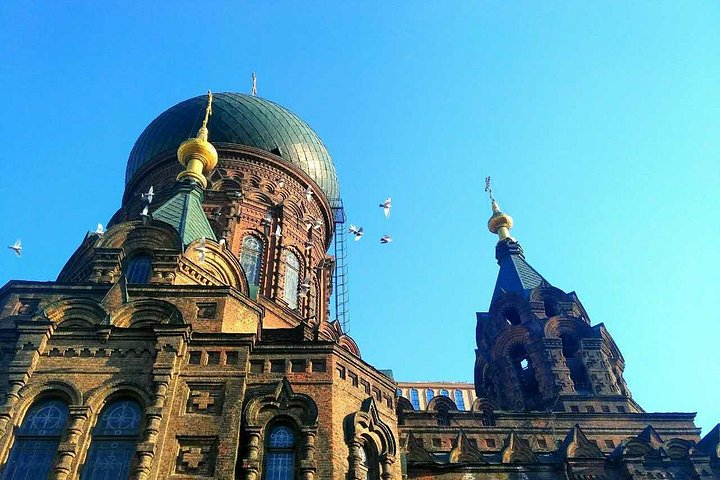
Saint Sophia Cathedral is the building that most often stands for Harbin in photographs, a large Russian Orthodox church in the Byzantine revival style, with red brick walls, a tall green onion dome and a plain, powerful profile that rises above the surrounding streets. The church was built in the first half of the twentieth century for Russian soldiers and railway workers who lived in the city, and it was rebuilt and enlarged over several years, reaching its present form by the early 1930s. It stood unused as a religious building for many decades and later reopened as an exhibition hall dedicated to the architecture and history of Harbin. Inside, old photographs and models tell the story of how a small railway settlement grew into a metropolis, and the interior, with its high central space and soft light, gives a sense of the original church. The cathedral stands on a paved square that is a lively gathering place, with cafes and shops around its edge, and in the evening the lit dome is one of the most photographed sights in the city. Visiting is quick, central and hugely rewarding.
How to visit
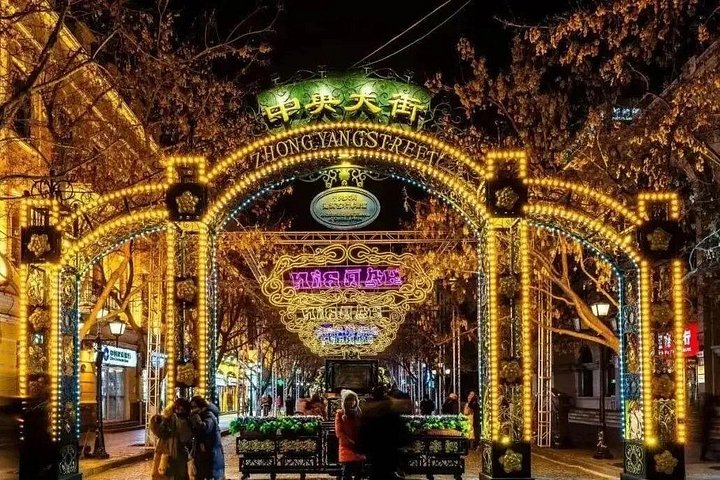
The linked product is a guided city tour covering Zhongyang Street and Sophia Church, so it combines the cathedral with the pedestrian avenue a short walk away. Check inclusions, group size and timings when you book. If you go on your own, entry to the square is open at all hours, while the interior exhibition has an admission fee and set opening hours that can change by season, so confirm before you travel.
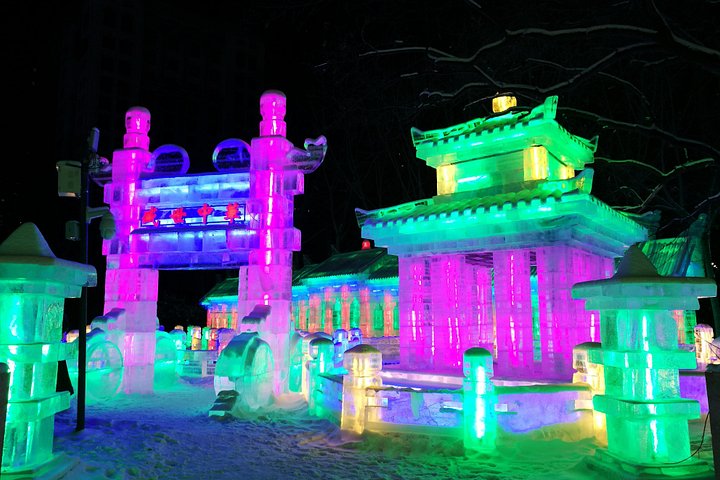
Allow about an hour for the interior and the square. The cathedral looks different with each season: red brick against blue summer skies, golden light in autumn, and a snow-covered dome in winter, when the surrounding square often hosts ice sculptures and festive stalls.
For photographs, the square in front gives the classic frontal view, while side streets offer quieter angles with the dome peeking over rooftops. In summer the square fills with local families and street performers; in winter, dress warmly and take short breaks inside the cafes around the edge. Pair the visit with a stroll on Zhongyang Street and a meal of Northeastern dumplings, and consider returning after dark to see the dome lit.
Context deepens the visit. The cathedral was built on a modest scale at first, as a wooden church for a Russian military garrison, and it was replaced by a much larger brick structure as the population grew and as the congregation, swelled by refugees from Russia, needed more room. Its design draws on Russian church traditions, with a cross-shaped plan, a large central dome and smaller domes at the corners.
Inside the exhibition, look for the photographs of the city at the beginning of the twentieth century, when the cathedral stood almost alone in open ground, and compare them with the dense modern skyline you can see from the square.
If you are interested in architecture, the square outside is also a good place to sit with a coffee and notice how the domes, arches and brick patterns work together. The cathedral is one of the most photographed buildings in China, so be patient for a gap in the crowds.
What to expect
The experience
A visit to a Russian Orthodox-style cathedral and its square, with an interior exhibition on Harbin's architecture and history.
Best time
Morning for fewer crowds; dusk for the lit dome.
How long
About an hour, plus time on the square.
Tips
Check interior opening hours, wear warm layers in winter and add Zhongyang Street.
Quick picks
- Best for
- First-timers, photographers and history fans.
- Families
- Children enjoy the square and the dome; the exhibition is short and easy.
- Couples
- A pretty evening stop with cafes around the square and a lit dome.
- Pair with
- Zhongyang Street and the riverside promenade.
- Time needed
- One to two hours.
Good questions
Can I go inside Saint Sophia Cathedral?+
The building now houses an exhibition about Harbin's architecture and history. It normally has an admission fee and set opening hours, so confirm before you go.
Is it still a working church?+
No. It stopped serving as a church many years ago and now works as a museum-style exhibition space.
When was it built?+
The church was built in the early twentieth century and enlarged over several years, taking its present form by the early 1930s.
What is the best time for photographs?+
Morning for clean light and few crowds, and dusk when the dome is lit. In winter, snow adds a striking contrast with the red brick.
Does the linked tour include entry to the interior?+
The product is a guided tour of Zhongyang Street and Sophia Church. Check whether interior admission is included when you book.