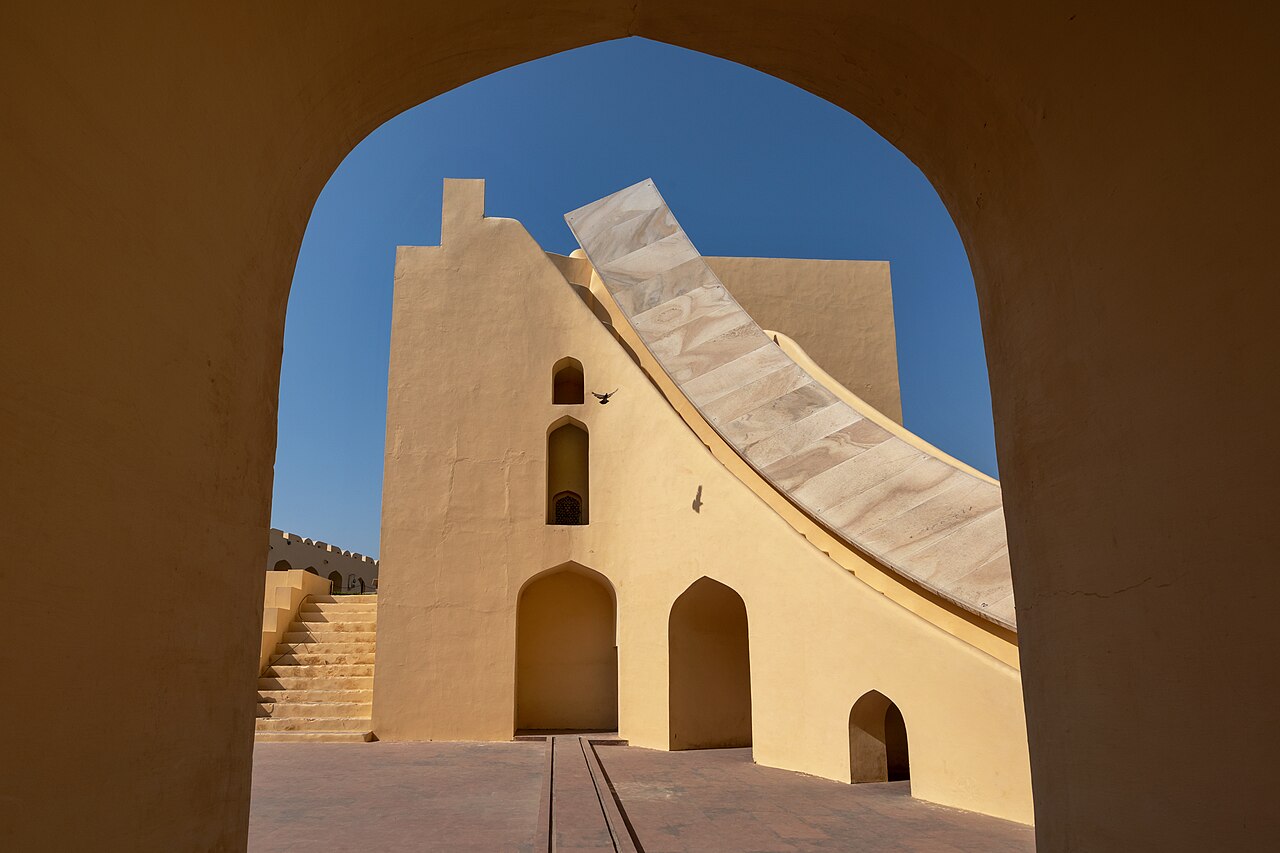
Jantar Mantar is the largest and best preserved of the five astronomical observatories built by Maharaja Sawai Jai Singh II, an astronomer-king who wanted more accurate tables than those inherited from earlier traditions. It stands beside City Palace and was inscribed by UNESCO in 2010. The site contains nineteen fixed instruments, built in stone and marble, for measuring time, tracking the position of stars, predicting eclipses and determining the declination of planets. The largest is the Samrat Yantra, a vast sundial whose gnomon rises to about twenty-seven metres and whose shadow moves visibly across the scale; local time can be read to within two seconds. Others include the Jai Prakash Yantra, a pair of bowl-shaped hemispheres, and the twelve Rashi Valaya instruments, one for each sign of the zodiac. The geometry is strikingly sculptural, and even visitors with no interest in astronomy enjoy the shapes and the shadows. Without explanation, however, the instruments can look like abstract sculpture, so a guide or the interpretation centre is highly recommended.
What you are looking at: Jai Singh built five observatories, in Delhi, Jaipur, Ujjain, Varanasi and Mathura, working from the 1720s and finishing the Jaipur one in the 1730s. They are instruments for naked-eye observation, built on a monumental scale so that the markings could be read more finely. The Jaipur observatory is still used, and during the monsoon season astrologers have traditionally used it for forecasts. A few instruments are especially visual, including the Samrat Yantra, where the shadow edge crawls along a curved scale, and the Rashi Valaya, which you can see in a row.
Visiting tips: the site is open and unshaded, so go in the morning or late afternoon and bring water, a hat and sunglasses. Bright sun also gives the best shadows for the sundials. Photography is easy and rewarding. Tickets are managed by the state, and the foreign visitor rate rose in January 2026; a composite ticket for several monuments can make sense. The site is just next to City Palace, so a combined visit is simple.
Is it worth it? Yes, for curious travellers, children who like science and anyone interested in design. If you want the most from it, hire a guide for the instruments, read the short interpretation panels and try the exercise of reading the time from the Samrat Yantra against your watch. Many city tours, such as the Viator highlights tour on this site, include it with City Palace and Hawa Mahal.
What to expect
The experience
A self-guided or guided walk among large stone instruments in an open compound, with interpretive panels and a small interpretation centre.
Best time
Morning or late afternoon, when the sun is lower and the shadows on the sundials are most dramatic.
How long
About an hour with a guide, forty-five minutes on your own.
Tips
Hire a guide or download the explanations, take water and sun protection, and check the time on the Samrat Yantra against your watch.
Quick picks
- Best for
- Curious travellers, science-minded families and photographers who like geometry.
- Families
- Children like climbing the staircases and finding their own zodiac instrument; the open sun is the one drawback.
- Couples
- Quiet, sculptural and good in late light, paired with City Palace next door.
- Pair with
- City Palace and Hawa Mahal, all within walking distance.
- Time needed
- One hour.
Good questions
What is Jantar Mantar?+
It is an observatory of giant stone and marble instruments built by Maharaja Jai Singh II to track time and the stars. The Jaipur site is the largest of five he built.
Does the sundial really tell the time?+
Yes, the Samrat Yantra can show local time to within a couple of seconds. Its shadow visibly moves along the scale.
Do I need a guide?+
A guide is strongly advised because the instruments are hard to understand unaided. Interpretive panels and a short interpretation centre also help.
Is Jantar Mantar a UNESCO site?+
Yes, it was inscribed as a World Heritage Site in 2010. It is one of several UNESCO-listed places in Jaipur.
How hot does it get?+
Most of the site has little shade, so it can be very warm outside the cooler months. Visit early or late and carry water.