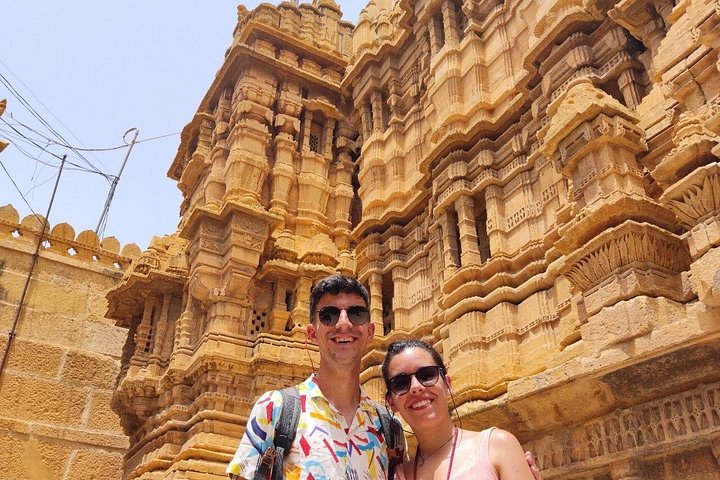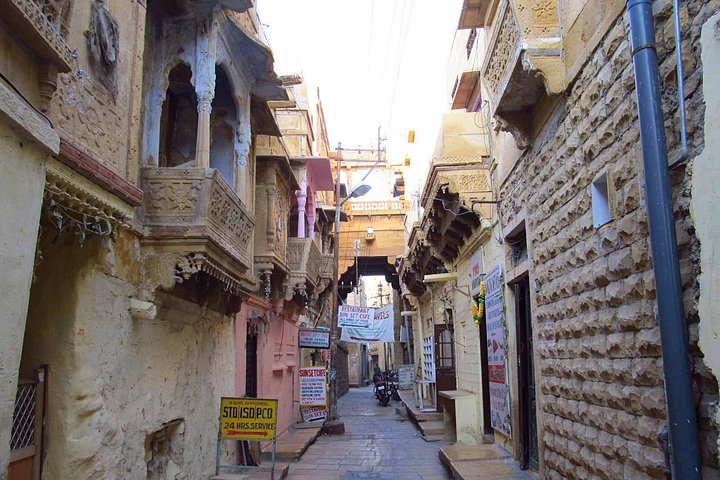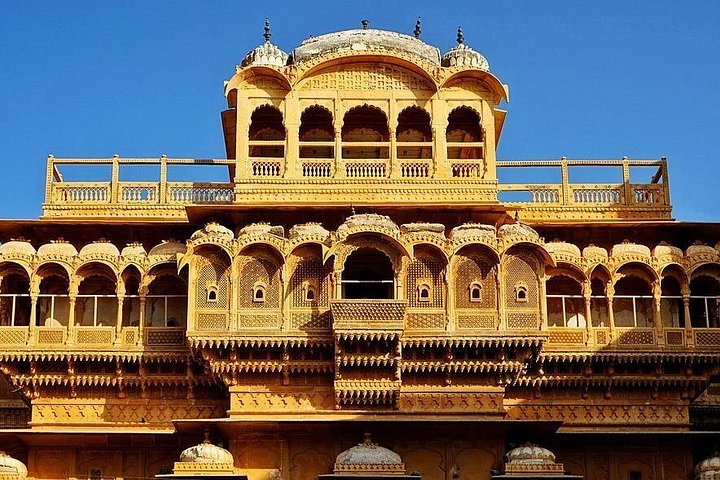
Patwon Ki Haveli is not a single house but a cluster of five mansions built in the nineteenth century by a wealthy family of brocade and jewellery traders for their sons. The carved sandstone facades, with their layered jharokha balconies, floral brackets and lattice screens, look as though the stone has been worked like lace. Inside, small museums and displays show how a merchant family lived, with painted walls, mirror work, period furniture, textiles and household objects. For many visitors this is the first place that makes the wealth of the old desert trade routes tangible, and the narrow lane in front is one of the most photographed streets in Jaisalmer.
The story behind the mansions explains their scale. Jaisalmer sat on caravan routes that carried silk, opium, spices and textiles between Central Asia, Sindh and the Gujarat ports, and merchants who handled that trade built fortunes. They spent those fortunes on houses, and rival families competed to carve the most elaborate facade.
The craftsmen who worked on the Patwon havelis came from the local community of stone carvers, and the soft yellow sandstone allowed a degree of detail that harder rock could not. Look closely at the balconies and you will see repeating patterns, animals, flowers and tiny doorways built to the scale of a child.
Different parts of the complex are open to the public and run by different bodies, so what you see depends on which entrance you choose. Some rooms are arranged as museums, with household items, costumes, coins, manuscripts and brass vessels, while others show wall paintings and mirror inlay.
Ask at the entrance what each ticket covers, and be prepared for small fees at each stop. A guide can explain the way the mansions were organised, with public reception rooms at the front and private family quarters behind, and the way the roofs were used for sleeping in hot weather.
The roof terraces are worth the climb. From the top of the main haveli you can see the neighbouring facades at close range, the fort rising above the lanes and the flat rooftops of the old city stretching away. Morning light shows the carving at its sharpest, while late afternoon makes the stone glow and softens the heat. Because the lane is narrow, it can fill with tour groups, so an early start helps with both photographs and breathing room.
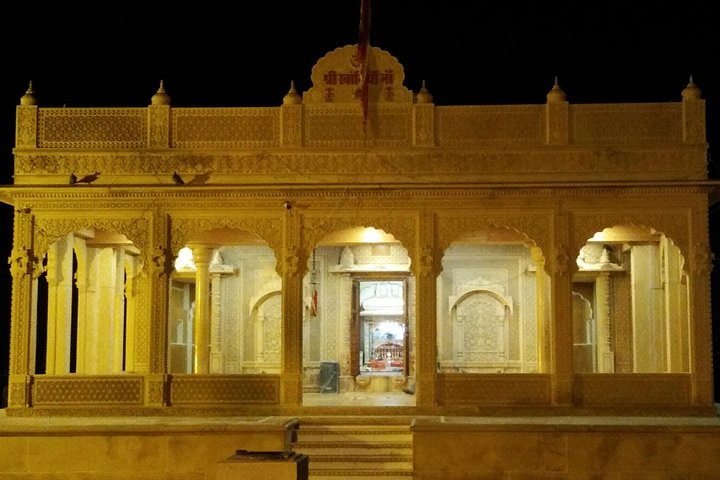
Respect the fact that parts of the complex are still lived in. Keep your voice down, do not wander through private doors, and ask before photographing people. Shoes may need to come off in some rooms. A haveli walking tour that links Patwon Ki Haveli with the other great mansions and a Jain temple is the most efficient way to connect the dots, and it handles tickets and directions in a town where signs can be vague.
Plan around an hour for the main haveli and its museum, longer if you visit several of the five. Pair it with Nathmal Ki Haveli and Salim Singh Ki Haveli to see three very different answers to the same question: how do you show off a fortune in stone? The three together make a compact and rewarding morning of heritage walking, and they are all within a short stroll of one another.
What to expect
The experience
A group of carved sandstone mansions with museum rooms, painted interiors and rooftop terraces, visited on foot with separate small tickets.
Best time
Morning for sharp carving detail and fewer groups; late afternoon for warm stone.
How long
One to two hours for the main haveli and museum rooms.
Tips
Ask what each ticket covers, keep to public areas, and combine with other havelis on a guided walk.
Quick picks
- Best for
- Architecture lovers, photographers and first-timers.
- Families
- Older children enjoy the roof and the tiny carved doors, but rooms are fragile.
- Couples
- A quiet morning stroll with a rooftop view of the fort.
- Pair with
- Nathmal Ki Haveli, Salim Singh Ki Haveli and the fort.
- Time needed
- Up to two hours.
Good questions
Who built Patwon Ki Haveli?+
A wealthy merchant family of brocade and jewellery traders built the five mansions in the nineteenth century, one for each son.
Is it one building or several?+
It is a cluster of five mansions. Different sections are open to visitors and some are run as small museums.
Can I climb to the roof?+
In the main sections yes, and the terrace gives close views of the carved facades and the fort.
What is the best time to visit?+
Morning is best for light on the carving and fewer visitors in the narrow lane.
Is a guided tour worth it?+
A walking tour that links the major havelis and a Jain temple saves time and explains the history behind the carving.