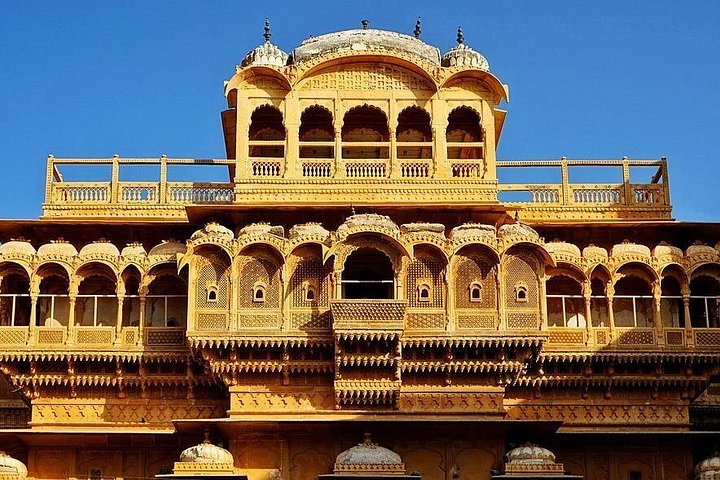
Salim Singh Ki Haveli is easy to recognise from a distance. Its upper storey is crowned by a curving, arched roof with projecting balconies, a shape that guides compare to a peacock with its tail spread. The mansion is associated with Salim Singh, a powerful prime minister of Jaisalmer in the early nineteenth century, who had a reputation for harshness and for building a house that stood out. Narrow at the base and wider at the top, the haveli seems to lean over the lane, and carved brackets and balconies cover almost every surface. It is one of the most distinctive buildings in the city, and a photograph from the street below is a classic Jaisalmer image.
The Salim Singh story is part of the haveli's appeal. Jaisalmer's prime ministers wielded enormous power in the nineteenth century, and Salim Singh is remembered in local tales as a ruthless figure who taxed heavily and pushed back against the nobility. Some stories connect him to the abandonment of the village of Kuldhara, though historians treat the folklore with caution. Whatever the truth, the haveli expresses the confidence of a man who wanted his house to dominate the skyline.
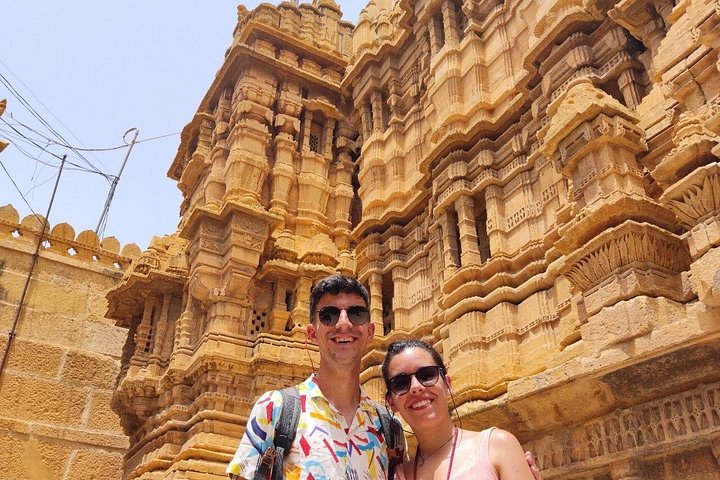
The building has a famously unusual shape. The lower floors are comparatively modest, but the upper levels step out and the arched roof, supported by carved brackets, projects over the street. Look for the many small balconies, the delicate stone trellis work and the intricate floral and geometric patterns. Part of the interior is open to visitors, with rooms that show painted walls, old furniture and views over the lanes, though access can vary from season to season and some rooms are private.
The best view of the haveli is from the street below, where you can see the whole outline against the sky. For a closer look, step inside and climb to the upper levels if they are open, because the viewpoints over the lane and towards the fort are rewarding. Photographers usually prefer the afternoon, when the stone warms up, and they should bring a wide lens for the street view.
Combine this stop with the other great mansions in a heritage walk through the old city. A short guided walk covers the main mansions, a Jain temple and a few of the lanes between them, and costs little compared with the value of the stories you hear along the way. If you walk on your own, use a map offline, as the lanes twist and signs are scarce.
Allow forty-five minutes to an hour, including time for photographs. Wear shoes that handle stairs and uneven stone, carry water, and dress modestly. If you hear stories about curses or ghosts, enjoy them as part of the character of the city, and ask your guide which legends are folklore and which are documented. The haveli rewards slow looking more than long hours, and it pairs naturally with a tea break in a nearby rooftop cafe.
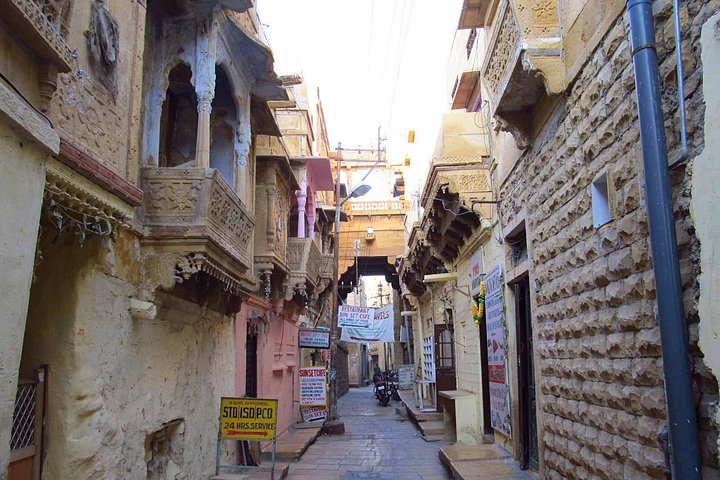
For a fuller picture, walk the streets around the haveli rather than looking only at the building. The lanes nearby hold small workshops, shrines and doorways with painted gods, and they show how a neighbourhood of merchants and craftspeople fitted around a powerful minister's home. Early in the morning, the street is quiet enough to stand back and take in the whole outline, and you will hear the sounds of daily life, from temple bells to pots clinking in kitchens, which add a human layer to the stonework.
What to expect
The experience
A hillside mansion with an arched roof, many balconies and open rooms, best seen from the lane and from upper levels when open.
Best time
Afternoon for warm stone and clear views from the street.
How long
Forty-five to sixty minutes.
Tips
Bring a wide lens for the street view, wear shoes for stairs and ask which stories are legend.
Quick picks
- Best for
- Photographers and architecture fans.
- Families
- Children like the unusual roof shape and balconies.
- Couples
- A scenic lane and rooftop view stop.
- Pair with
- Nathmal Ki Haveli, Patwon Ki Haveli and Gadisar Lake.
- Time needed
- Under an hour.
Good questions
Why is the roof so unusual?+
The arched, projecting roof is often compared to a peacock's tail and was designed to make the mansion stand out.
Who was Salim Singh?+
He was a powerful prime minister of Jaisalmer in the early nineteenth century, remembered in local stories for his harsh rule.
Can I go inside?+
Parts of the haveli are open to visitors, though access can vary and some rooms are private.
What is the best photo spot?+
The lane below gives the best view of the full outline, ideally in afternoon light.
Is it near the fort?+
Yes, it is within walking distance of the fort and other major havelis.