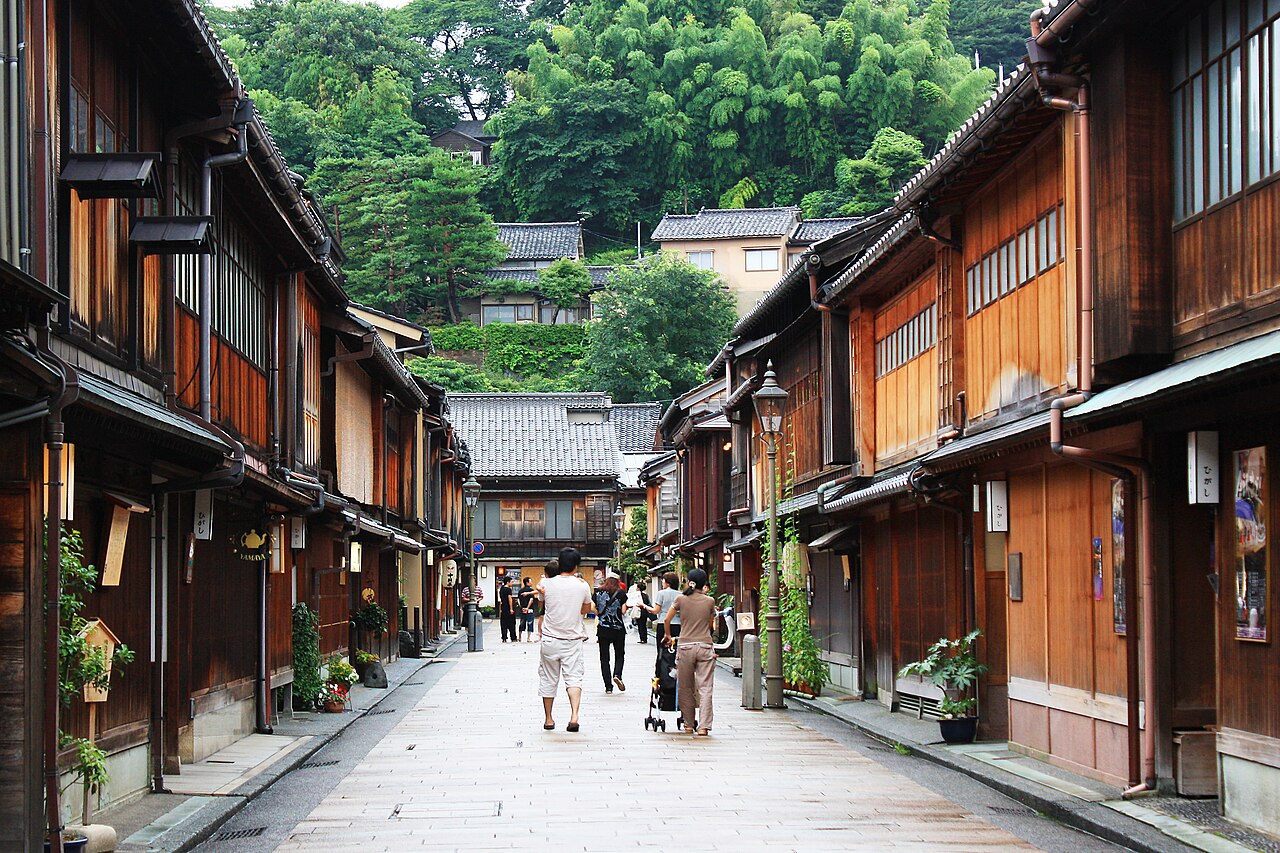
Kanazawa has three chaya districts, the old entertainment quarters where geisha performed for the Kaga lords and merchants: Higashi Chaya, Nishi Chaya and Kazuemachi. Higashi Chaya is the famous one, with tour groups and gold leaf ice cream. Kazuemachi is its calmer neighbour, set along the Asano River a short walk across the water, and it is the one to choose when you want the atmosphere without the crowd. It is small, with narrow alleys lined with latticework facades, and it is protected as an Important Preservation District for Groups of Traditional Buildings. Walking it takes about an hour at an unhurried pace. Two lanes are worth finding on purpose: Akari-zaka, the Bright Alley, and Kuragari-zaka, the Dark Alley, which make a small lesson in how light and shadow shaped the district. The area still has traditional ryokan and teahouses, and the old buildings turn a deeper colour at dusk, when the lights come on and the sound of shamisen sometimes drifts out of an upper window. Nothing here is a ticketed attraction. The experience is the lanes, the river and the quiet.
What to see
Kazuemachi Ryokusuien, a small riverside green space near Nakano Bridge, shows part of the restored inner moat of Kanazawa Castle, a reminder that this district grew up in the shadow of the castle. It has benches and public toilets, which makes it a useful pause. The author Kyoka Izumi, whose writing often used this neighbourhood as a setting, is remembered by a small museum nearby, which is worth a look if you enjoy literature.
Between the river and the lanes you will find a handful of cafes and small shops, and several of the old houses are still working teahouses, so remember that private doors are private.
Getting there and timing
It is about ten minutes by car from Kanazawa Station and roughly a five-minute walk from the Hashiba-cho bus stop, served by the Kanazawa Loop Bus and other local buses. Most travellers combine it with Higashi Chaya, crossing the river on foot, and the two districts together make a lovely late-afternoon route.
Go in the last hour of daylight and stay until the lamps are lit, when the district is at its best and the day-trip crowds have gone. In winter the lanes can be icy, and in the rainy months the wet lattice and stone give a lovely, moody light for photographs.
How it compares
Higashi Chaya is larger and busier, with open teahouses you can enter and a gold leaf workshop nearby. Kazuemachi is more residential and reserved, which suits couples and photographers who prefer stillness. If you only have time for one district, choose Higashi Chaya for the activities; if you have two hours, add Kazuemachi for contrast. Be a good guest by keeping voices down, staying out of doorways and not photographing people who have not agreed to it, and avoid blocking the narrow lanes with tripods.
A short walking route works well
Cross from Higashi Chaya over the river, drift along the water towards the lanes, pause at the small green space, then loop back through the alleys before dusk. Cafes and small shops open at modest hours, so do not plan a meal here, and finish with dinner in Korinbo or back near the station. Visit once in the daytime for details of the lattice and the old wood, and once more near sunset if you have a second chance, because the two experiences feel quite different.
What to expect
The experience
A self-guided stroll through a few lanes of preserved teahouse architecture beside the river, with no tickets and no fixed hours.
Best time
The last hour of daylight into dusk, when the lamps are lit and the lanes are quiet.
How long
About an hour, or two if combined with Higashi Chaya.
Tips
Keep voices low, treat private doors as private, ask before photographing people and wear shoes with grip in rain or ice.
Quick picks
- Best for
- Travellers who want a quieter, more atmospheric teahouse district than Higashi Chaya.
- Families
- An easy, flat walk, but there are no activities, so it works best as a short add-on.
- Couples
- A very good dusk stroll along the river, followed by dinner nearby.
- Pair with
- Higashi Chaya across the river, and the gold leaf workshop.
- Time needed
- About an hour.
Good questions
What is Kazuemachi?+
It is one of Kanazawa's three chaya districts, along with Higashi Chaya and Nishi Chaya, a protected group of traditional teahouse buildings along the Asano River.
Is there an entry fee?+
No. It is an open neighbourhood, so you can walk the lanes freely, though individual teahouses and ryokan are private.
How long does it take?+
About an hour is enough for the lanes, the riverside and the small green space near Nakano Bridge.
What are Akari-zaka and Kuragari-zaka?+
They are two small lanes, the Bright Alley and the Dark Alley, that are among the district's most photographed spots.
How is it different from Higashi Chaya?+
It is smaller, quieter and more residential, with fewer visitor activities, which is exactly why many travellers like it.