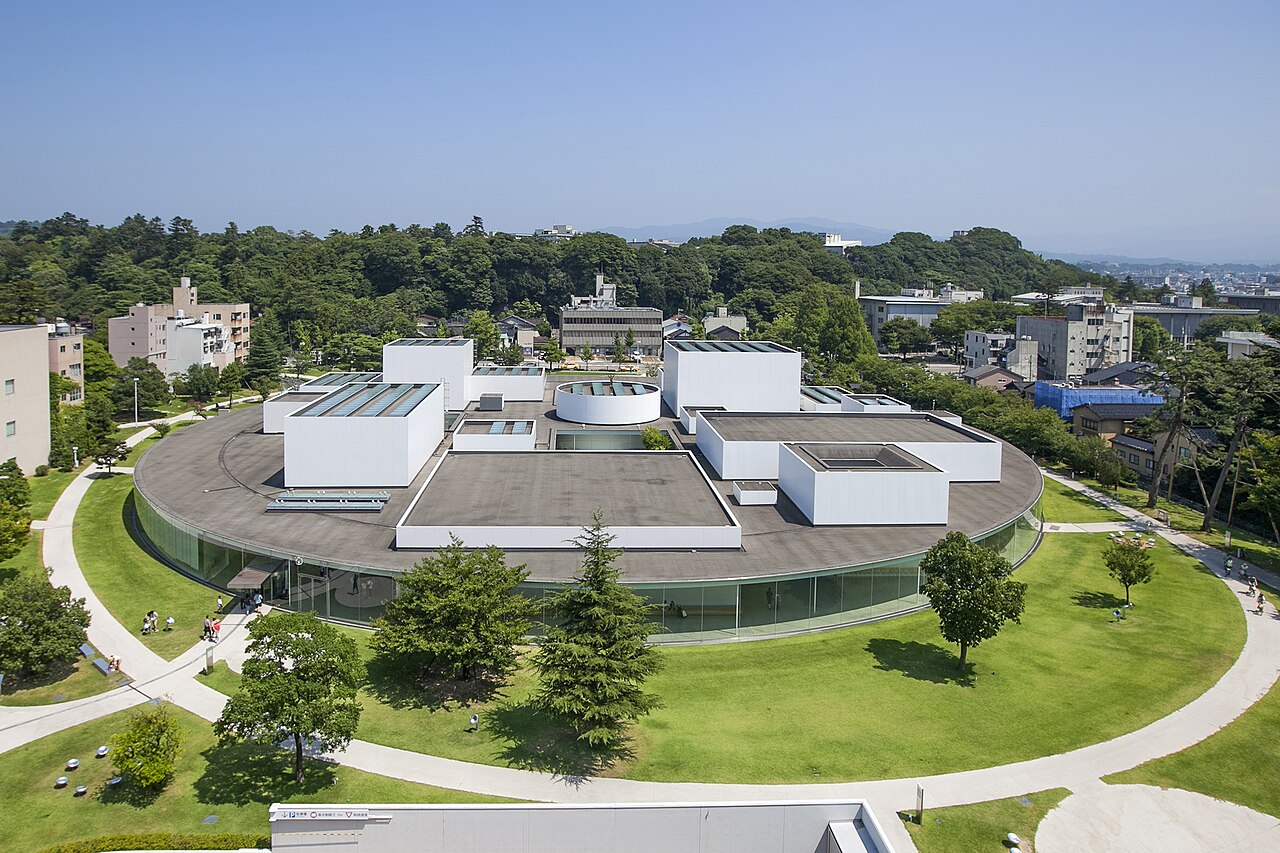
The 21st Century Museum of Contemporary Art, Kanazawa, opened in 2004 and instantly became the city's modern counterpart to its historic gardens. The building is a low, disc-shaped glass pavilion with entrances on every side, designed so that people can wander in from any direction, and its interior is a maze of galleries, courtyards and corridors. The museum shows experimental contemporary art, and much of it invites participation, so you may find yourself sitting on, walking through or touching the works. The best known is Leandro Erlich's The Swimming Pool, an illusion in which visitors appear to stand underwater at the bottom of a pool while others look down from above, and it sits in the free area, along with a large green wall by Patrick Blanc. The paid galleries host special exhibitions and the permanent collection, and the museum also has a shop, a library and a cafe. It is lively, photogenic and friendly for families, and it is a refreshing contrast with the samurai and tea culture elsewhere in Kanazawa.
Planning your visit around the free and paid zones is the key. A big part of the museum, including the Swimming Pool and public courtyards, is free to enter and open late, including on days when the galleries are closed, so even a short visit pays off. The paid exhibitions have separate tickets that vary by show, and the permanent collection costs a few hundred yen, so decide on arrival whether you want just the highlights or a full gallery visit. Check what is on before you go, because special exhibitions change through the year.
Hours and logistics
The galleries open in the morning and close in the evening, with later closing on Fridays and Saturdays, and they are closed on Mondays, or the next day when Monday is a national holiday. The museum also closes for the year-end and New Year period.
It is about a one-minute walk from the Hirosaka bus stop and roughly three minutes from the Kenroku-en gate, and the city bus day pass gives a discount on admission. There is limited parking for cars, none for large vehicles, and facilities include wheelchair loans, an accessible elevator and a nursing room.
Making the most of it
Arrive when the doors open to see the Swimming Pool without a queue of photographers, and allow an hour for the free zone and two to three if you take in the galleries. Children usually love the interactive works, and teenagers and adults who think they dislike modern art are often won over. It pairs naturally with Kenroku-en, the castle and the D.T. Suzuki Museum, and a rainy day is a good excuse to spend longer inside.
What to expect
The experience
A circular glass museum with a large free zone, interactive installations and paid galleries for exhibitions and the collection.
Best time
At opening for the Swimming Pool without queues, or on a Friday or Saturday evening when the galleries stay open later.
How long
One hour for the free zone, up to three with galleries.
Tips
Remember the galleries close on Mondays while the free zone stays open, check the current exhibition and use the bus day pass discount.
Quick picks
- Best for
- Art lovers, architecture fans and anyone who wants a playful break from temples and teahouses.
- Families
- Excellent: interactive works and the Swimming Pool delight children, and much of it is free.
- Couples
- A fun, photogenic hour followed by coffee in the cafe or a stroll through Kenroku-en.
- Pair with
- Kenroku-en, Kanazawa Castle Park and the D.T. Suzuki Museum.
- Time needed
- Allow two hours with a gallery or two.
Good questions
Is the museum free?+
A large zone including the Swimming Pool is free to enter, while the exhibition galleries charge admission that varies by show. The permanent collection has a low fixed fee.
When is it closed?+
The galleries close on Mondays, or the following weekday when Monday is a holiday, and during the year-end and New Year period. The free zone stays open on Mondays.
What is The Swimming Pool?+
It is a permanent artwork by Leandro Erlich that looks like a full pool but is a shallow layer of water over glass, with a room beneath so that people below appear to be underwater. It is the museum's most photographed work.
Do I need to book?+
Tickets for galleries are bought on arrival and usually need no reservation. Check the museum's current guidance for any timed entry for special shows.
How do I get there?+
It is a one-minute walk from the Hirosaka bus stop on the sightseeing loop and about three minutes from a Kenroku-en gate. It is also an easy walk from the castle.