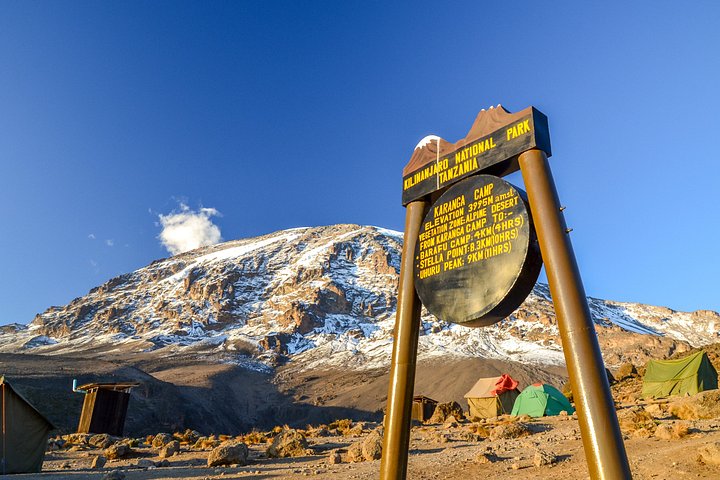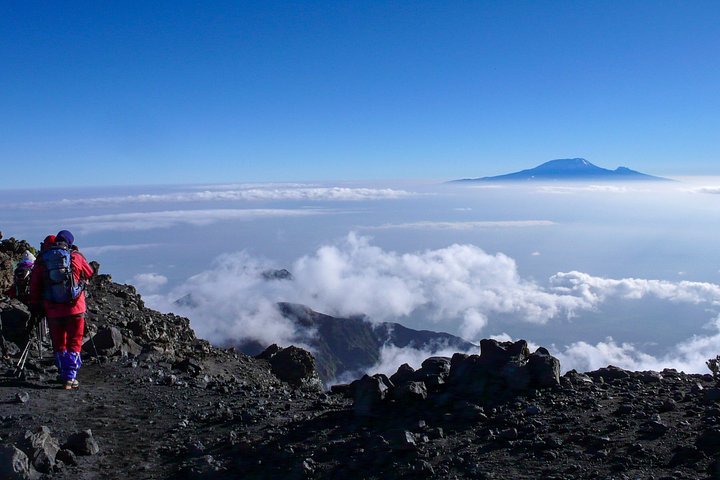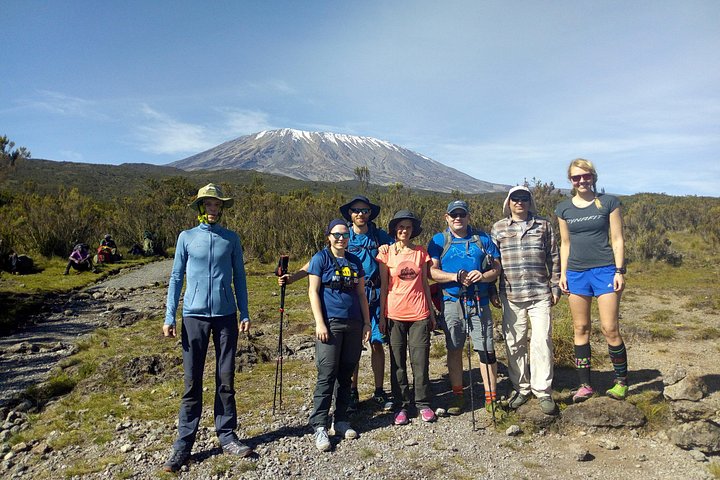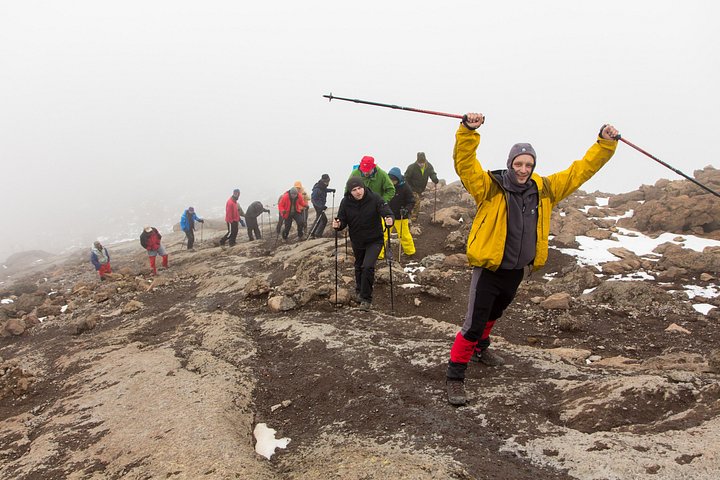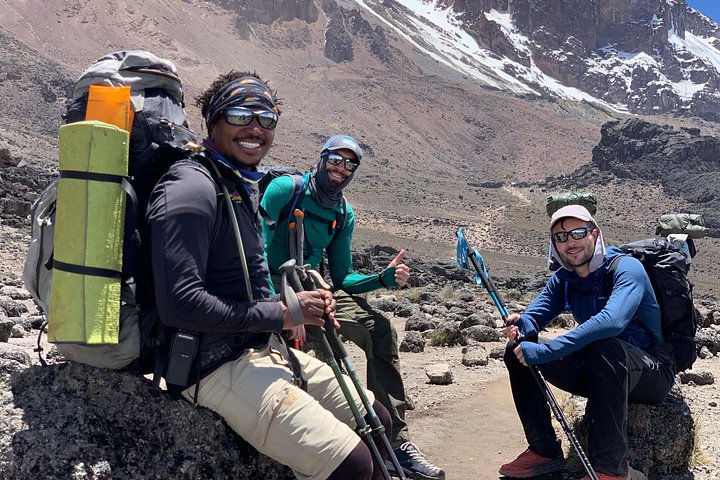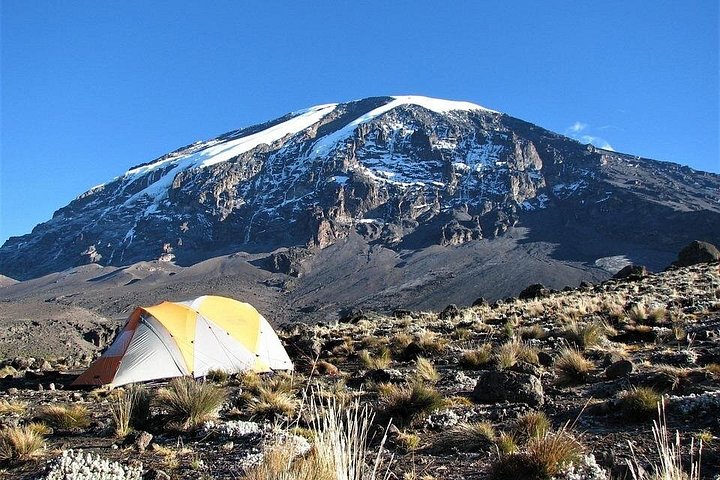
The Rongai route is the only major path up Kilimanjaro that starts on the northern side of the mountain. It begins near the Kenyan border at Nale Moru, a long drive from Moshi that skirts the base of the volcano and passes farming country, and then climbs gently through pine plantations and forest into open moorland. Because it sits in the rain shadow of the mountain, Rongai tends to be drier than the southern routes, and it is a common choice in the rainy months when other paths are slippery and wet. The gradient is gentle and the days are relatively short, so this route is often recommended for people who want a less crowded experience. The scenery has a different character: wide, open views north across the plains toward Kenya, then a traverse east beneath the jagged peak of Mawenzi, and finally a move across the saddle to Kibo Hut. In the evenings the sky is often clear above the cloud layer, and the camps feel remote and calm. The route usually takes six or seven days. The seven-day version adds an extra night to allow a short acclimatization hike to Mawenzi Tarn, which improves your odds of reaching the top. Summit night begins at Kibo Hut around midnight, and from there the route joins the same final climb used by Marangu, on the steep scree up to Gilman's Point and along the rim to Uhuru Peak.
Descent is by the Marangu route, so you finish at Marangu Gate rather than back on the northern side. That makes arrangements a little more complex, since your vehicle must meet you at a different place from where you started, but it also gives you views of the forest and huts on the way down. Camping is used on the ascent and the huts at Kibo and Horombo are used on the way down, or the whole route may be camped, depending on the operator.
Rongai is not the easiest route in every way. It does not offer the climb-high-sleep-low pattern of Machame, and the gain in altitude on the upper section is steeper than the lower trail suggests. That means a seven-day itinerary is strongly recommended if you want to give yourself the best chance of success. Dust and sun can also be strong on the northern slopes, so good sun protection, a hat and plenty of water are essential.
Wildlife is occasionally seen on the lower slopes in the early morning, including colobus monkeys and small antelope, although sightings are limited. The real attraction is the solitude: on a quiet date you may share the trail with only a few other groups, which feels very different from the busier southern routes.
Compare operators by how they handle the logistics of a one-way route. Ask who meets you at the end, how long the drives are on each side and whether park fees and camping fees are included. For cultural time after the climb, the Moshi villages and Chagga experiences here make good pairings, and the Materuni and Chemka days on our Arusha pages are easy to add.
A word on pacing
The northern slopes lull many walkers into going too fast on the easy early days. Guides will repeat the phrase pole pole, Swahili for slowly slowly, and it is the best advice on any route. Keep your heart rate low, sip water constantly and eat even when you do not feel hungry, because appetite fades with altitude.
What to expect
The experience
A guided trek starting at Nale Moru on the north side, climbing to Kibo and descending by the Marangu route.
Best time
Good in the drier months and a useful choice in the rainy season, when the north is often drier than the south.
How long
Six or seven days; seven gives better acclimatization.
Tips
Choose the seven-day plan, protect yourself from the sun and confirm how the one-way transfers are handled.
Quick picks
- Best for
- Trekkers who want fewer people and a gentle, drier approach.
- Families
- Suitable for fit teenagers on a longer schedule, with the usual summit-night caution.
- Couples
- The remote camps and big skies suit a quieter adventure.
- Pair with
- A Chagga village day or coffee tour on the Moshi side.
- Time needed
- Eight to nine days including arrival and recovery.
Good questions
Why is Rongai drier?+
It lies on the northern side of the mountain, which receives less rain than the southern slopes.
Is it easier than Machame?+
The gradient is gentler, but it has fewer acclimatization options, so the seven-day plan is still wise.
How do we get back?+
Most itineraries descend via the Marangu route, so your transport meets you at Marangu Gate.
Will I see many other people?+
Usually fewer than on the southern routes, until the final summit approach, where routes converge.
Do I camp?+
Often yes, though some operators use huts on the descent. Ask when you book.