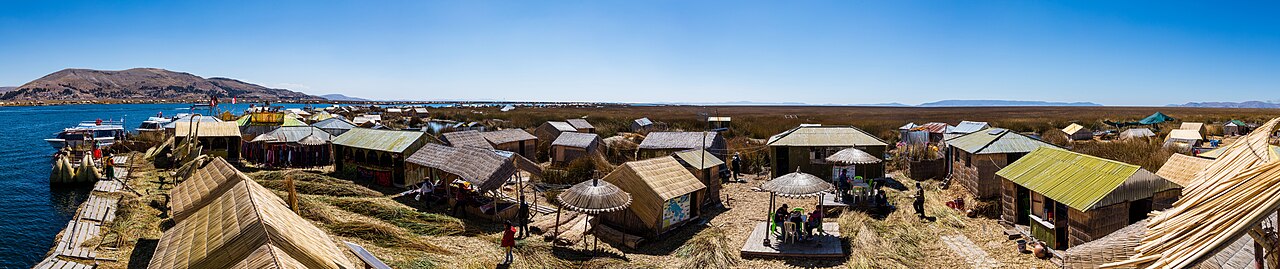
The Uros Floating Islands sit in the sheltered Bay of Puno, a short boat ride from the city, and they are the single most visited sight on Lake Titicaca. Each island is a thick raft of totora reed, the tall green sedge that grows in the shallows, layered and lashed together and anchored to the lake bed with ropes and stakes. Families live on the islands in reed houses, cook on small fires set on stone bases, and still build the curved reed boats, called balsas, that have carried the Uru people for centuries. Walking across an island feels like stepping on a firm, springy mattress, and the reeds must be topped up with fresh layers as the lower ones rot away. The islands are a living community and a tourism economy at once, and the best visits acknowledge both.
How the visit works
Boats leave from the Puno harbor and take roughly half an hour to reach the islands, passing through channels cut in the reed beds. You are usually welcomed onto one island, where a community leader demonstrates how the islands are built, with a model showing the layers of reed and root blocks. You can then step into a reed house, look at embroidered textiles and handicrafts laid out for sale, and take a ride on a decorated reed boat for a small extra fee.
Different boats visit different islands in rotation, so the experience is similar but never identical. A half-day tour is the simplest option and fits neatly between breakfast and lunch, while the Uros are also the first stop on most full-day and overnight island trips.
Making it a better visit
Bring small notes in Peruvian soles for the boat ride, for handicrafts and for tips, because there are no cash machines on the water. Ask before photographing people, and buy something directly from a family if you can, since the sales are a real part of their income. The sun at this altitude is intense and reflects off the water, so carry a hat, sunglasses and sunscreen, and add a windproof layer even on a bright day.
Mornings are usually calmer on the water, and the light is clearer for photographs. If you want a quieter and more personal experience than the standard group stop, look at the kayaking and overnight homestay options that visit less crowded islands.
Honest expectations
Some visitors find the busiest islands commercial, and the reality is that tourism now underpins life on many of them. The islands closest to the harbor receive the most boats, while those farther out feel calmer. Going early, choosing a small-group or community-run tour and spending time listening rather than only photographing makes a big difference. The Uros are not a substitute for Taquile or Amantani, which are real farming islands, but they work well as an introduction and as the first stop on a longer lake day.
Respect and responsibility
The most helpful thing you can do is slow down. Take a moment to ask your host how the islands are anchored, how often the reed is replaced and how children get to school on the water, because these everyday details are what make the stop memorable.
Choose tours that rotate boats between islands so that income is shared more evenly, and avoid pressing for photographs of children. If you are traveling in a group, agree beforehand how much to spend on handicrafts so that you can support families without feeling rushed at the stalls.
What to expect
The experience
A guided boat trip from the Puno harbor to one or two floating islands, with a demonstration of how the reed islands are built and time to walk, shop and ride a reed boat.
Best time
Mornings, when the water is calmer and the light is clear, in the dry season from May to October.
How long
Two to three hours for a half-day tour, or the first stop of a full-day or overnight trip.
Tips
Carry small soles for the reed boat ride and handicrafts, wear a hat and sunscreen, and bring a windproof layer.
Quick picks
- Best for
- Anyone with only a morning to spare, and a natural first stop before Taquile or Amantani.
- Families
- Children enjoy the springy ground and the reed boats, though keep a close eye near the edges of the islands.
- Couples
- Choose an early departure for soft light, or add a sunrise or kayak option for a quieter angle.
- Pair with
- Sillustani in the afternoon, a Puno city walk, or a full-day trip that continues to Taquile.
- Time needed
- Half a day, or a full day when combined with Taquile.
Good questions
How far are the Uros Islands from Puno?+
They lie in the Bay of Puno, about half an hour by boat from the harbor. Tours handle the transport.
Are the islands really floating?+
Yes. Each is a raft of layered totora reed and root blocks, anchored in place, and it feels springy underfoot. Fresh reed is added regularly as the lower layers decay.
Do I need cash?+
Yes, bring small notes in soles for the reed boat ride, handicrafts and tips. There are no cash machines on the islands.
Is a half-day or a full-day trip better?+
A half-day trip is enough for the Uros alone. If you also want Taquile or Amantani, choose a full-day or two-day lake tour that includes the Uros on the way.
Can I stay overnight?+
Yes, some families offer overnight stays on the islands, which is a very different experience from the day visit. See the Uros overnight stay entry for details.