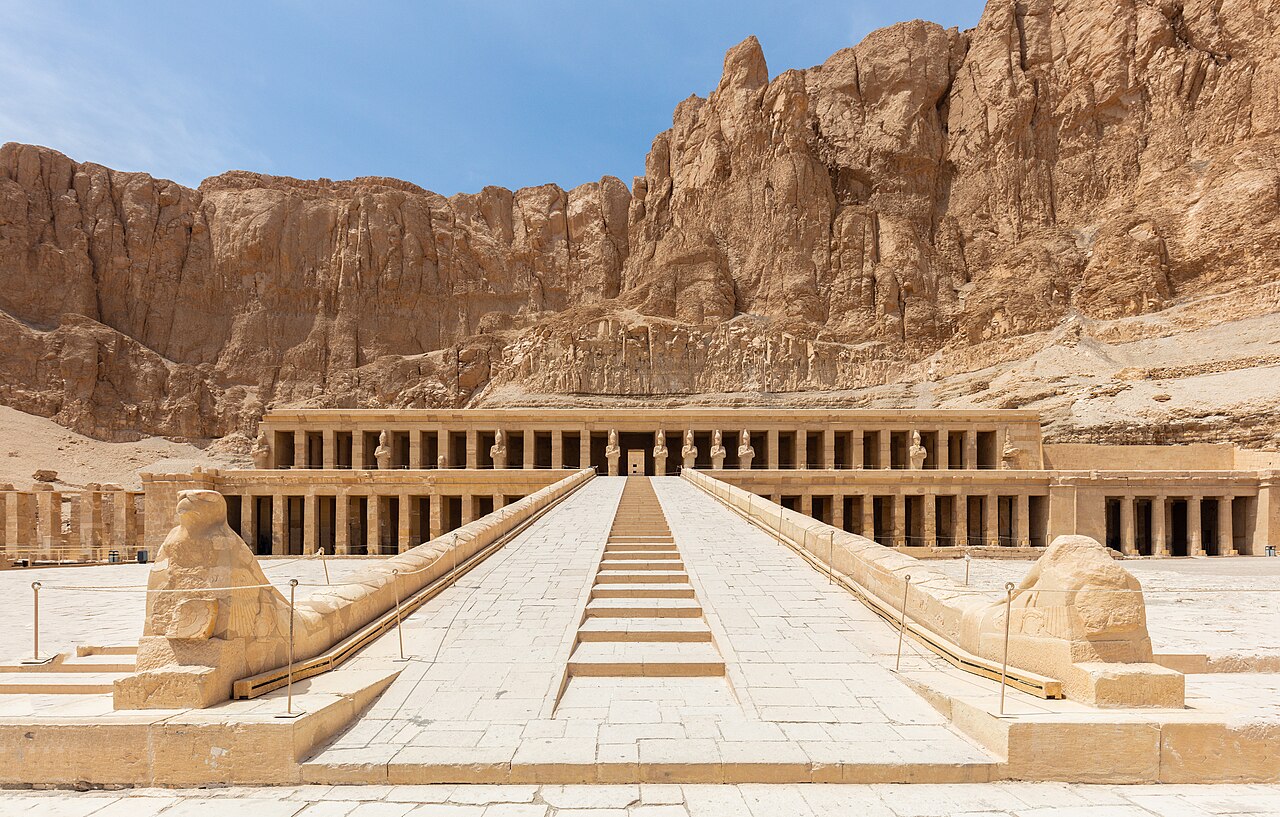
Hatshepsut's mortuary temple at Deir el-Bahari is one of the most striking buildings in Egypt, and one of the easiest to love. Rising in three broad terraces connected by long ramps, its clean colonnades of pale limestone echo the great amphitheatre of cliffs behind it so closely that the architecture seems to grow from the rock. It was built in the fifteenth century BC for Hatshepsut, who took the throne as regent for her young stepson Thutmose III and then ruled as pharaoh for around two decades, a period of peace, trade and monumental building. The design is credited to her steward Senenmut, and it was inspired in part by the older temple of Mentuhotep II that stands beside it. The reliefs on the colonnades record her divine birth and an expedition to the land of Punt, bringing back incense trees, gold and exotic animals. On the upper terrace are shrines to Hathor and Anubis, and a sanctuary cut into the cliff. After her death, many of her images were defaced, apparently on the orders of Thutmose III, which adds a human drama to the walls. The temple is open, well signed and easy to visit, with a shuttle from the car park to the entrance.
Why it works: unlike many Egyptian temples, which are low and enclosed, Hatshepsut's is open to the sky and designed to be seen from a distance. Standing in the forecourt and looking up the ramps, you see a symmetry and scale that feel strikingly modern. The upper terraces give wide views across the desert edge to the Nile and the East Bank. It is also a wonderful place for photographers in the early light, when the cliff glows and the shadows between the columns are sharp.
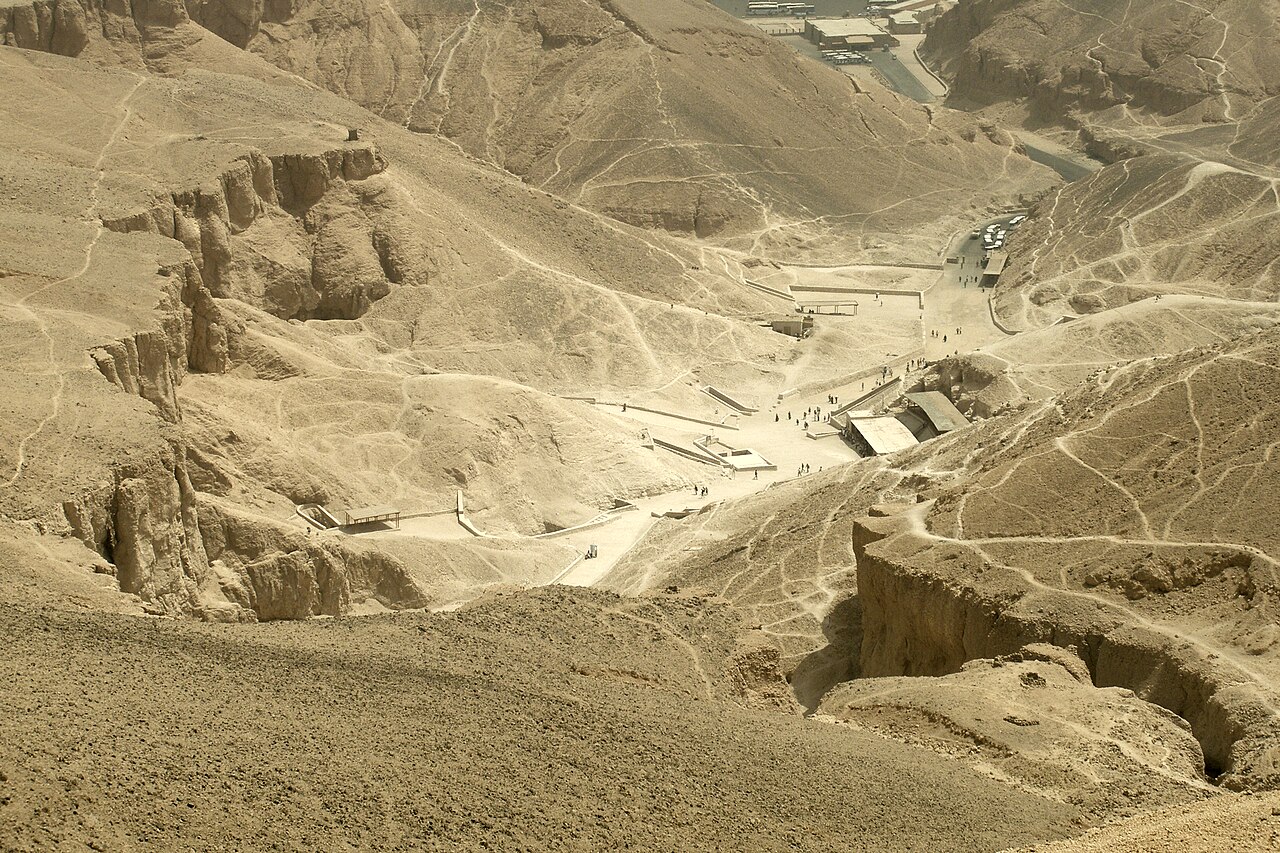
Visiting: most people see it with the Valley of the Kings on a West Bank morning, and Tiqets sells private tours that combine Hatshepsut's temple, the Valley and the Colossi of Memnon. Little shade exists outside the colonnades, so go early or late, and bring a hat and water. A shuttle runs from the entrance area to the temple, and the walk up the ramps is gentle compared with many sites. Reliefs are best appreciated with a guide who can point out the Punt expedition and the birth scenes.
Context: a short drive away you will find the Ramesseum, Medinet Habu and the nobles' tombs, if you have a second West Bank day. For a first visit, Hatshepsut's temple is the ideal companion to the Valley of the Kings, offering light, space and a different kind of ancient Egyptian ambition.
What to expect
The experience
A self-guided or guided walk up three colonnaded terraces, with reliefs of the Punt expedition and shrines to Hathor and Anubis.
Best time
Early morning, when the cliffs are lit and the air is cool.
How long
About an hour, or ninety minutes with a guide.
Tips
Take the shuttle from the entrance, wear a hat, and look for the Punt reliefs on the lower colonnades.
Quick picks
- Best for
- Architecture lovers and anyone drawn to the story of a woman pharaoh.
- Families
- Open and easy to walk, with ramps instead of steep stairs, so it suits children well.
- Couples
- Early light on the cliffs, then breakfast back across the river.
- Pair with
- The Valley of the Kings and the Colossi of Memnon on a single West Bank morning.
- Time needed
- One to two hours.
Good questions
Who was Hatshepsut?+
She was a pharaoh of the Eighteenth Dynasty who ruled in her own right for about two decades after first serving as regent. She is remembered for trade expeditions and ambitious building.
Why were her images defaced?+
Many of her images were chiseled out after her death, most likely under Thutmose III. Historians still debate the exact reasons.
How long does the visit take?+
About an hour is enough to see the terraces and reliefs, and ninety minutes if you linger. It pairs easily with the Valley of the Kings.
Is it open all day?+
Yes, it keeps daytime hours, with the early morning being the best time. Check current opening times and ticket rules before you go.
Is the temple accessible?+
The ramps are gentler than most sites, and a shuttle runs from the entrance area. The surface can still be uneven, so assistance may be needed.