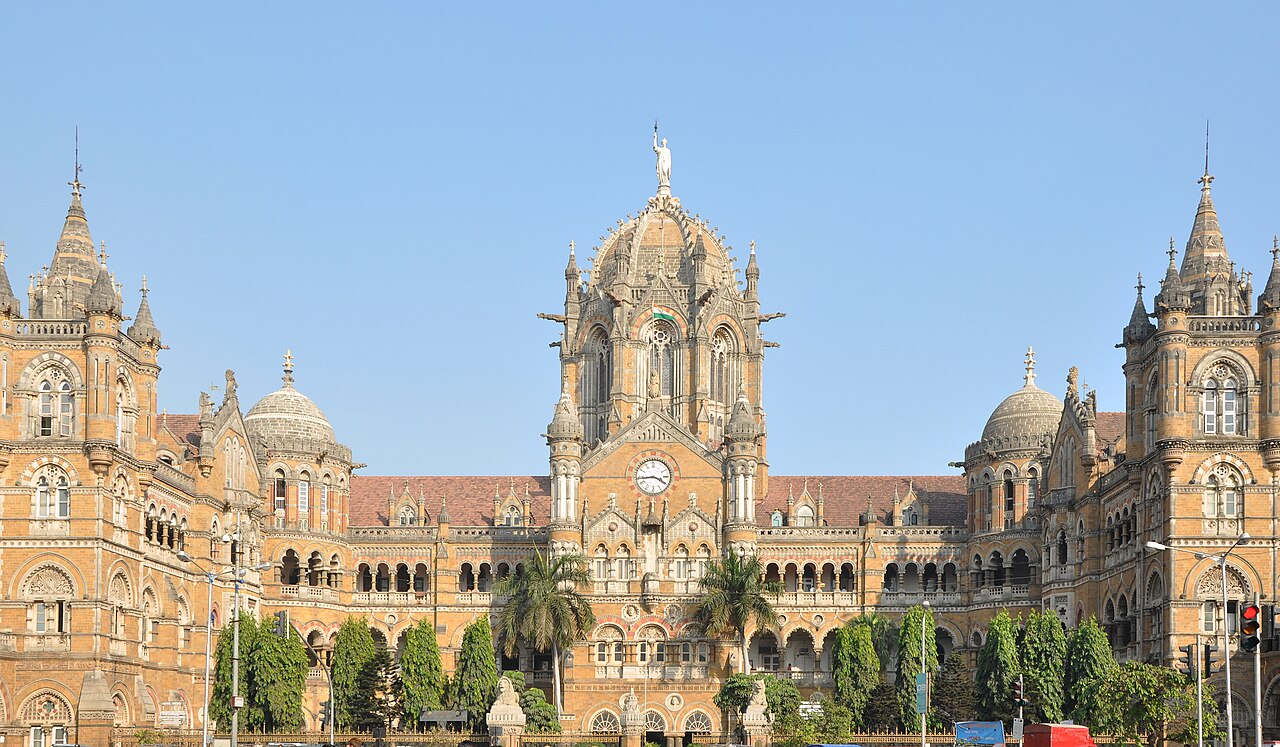
Chhatrapati Shivaji Maharaj Terminus, still widely called Victoria Terminus or VT, is the most extravagant railway station in India. The British architect F. W. Stevens designed it, and construction ran for about ten years from 1878. UNESCO describes it as a fusion of Victorian Italianate Gothic Revival and Indian traditional architecture, with a stone dome, turrets, pointed arches and an irregular plan that recalls an Indian palace. Carved peacocks, lions, tigers and gargoyles crawl over the facade, and a figure of Progress stands atop the dome. The building is no museum: more than three million commuters pass through it daily, so you see it working, packed with ticket queues, vendors and trains. That living quality is the point. UNESCO has recognised it as an outstanding example of late nineteenth-century railway architecture, and standing across the road at dusk, with the facade lit, it is one of the best sights in the city.
How to visit
CSMT is in the Fort district of South Mumbai, with its own suburban and long-distance platforms and a metro and taxi stand beside it. Seeing the building costs nothing. The best views of the facade are from the pavement and the traffic island opposite, near the Brihanmumbai Municipal Corporation building, another Stevens Gothic design.
What to expect
The concourse and main entrance can be explored if you are travelling or are accompanied by a ticket holder, but this is an active station, not a heritage visitor centre, so respect the commuters, avoid peak rush hours and keep your belongings secure. Photographing the exterior is fine; be discreet around platforms and security staff.
Inside, look up at the vaulted ceiling, the carved stone and ironwork, and the old booking hall details. Some visitors join a heritage walk for the stories, but you can see the highlights independently in under an hour.
Making the most of it
Visit in the late afternoon, when the stone warms up, and stay for the lighting after sunset. Combine it with the nearby Crawford Market, the Fort district’s Victorian buildings and a walk to the CSMVS museum. If you want to see how Mumbaikars actually live, board a suburban train for a stop or two outside the peak hours.
What to expect
The experience
A free, self-guided look at the facade from across the road, plus a respectful walk through the working concourse.
Best time
Late afternoon for warm stone and good photographs, then after sunset when the building is lit.
How long
Forty-five minutes to an hour and a half, depending on how long you linger outside.
Tips
Avoid the weekday rush hours, keep valuables close in the crowds and ask permission before photographing people.
Quick picks
- Best for
- Architecture lovers, photographers and anyone curious about colonial-era Mumbai.
- Families
- Free and fascinating for children who like trains, though the crowds mean staying close.
- Couples
- Striking at dusk, with the lit facade and the street life around it.
- Pair with
- The CSMVS museum and Crawford Market, both a short taxi ride or a longer walk away.
- Time needed
- An hour, or part of a half-day heritage walk in the Fort district.
Good questions
Is Chhatrapati Shivaji Maharaj Terminus the same as Victoria Terminus?+
Yes, it is the same station, built as Victoria Terminus and renamed in honour of the Maratha king Shivaji. Locals often still say VT or CST.
Can tourists visit CSMT without a train ticket?+
You can admire the exterior freely from the street and the traffic island opposite. Entry to platforms normally requires a ticket, so a short look at the concourse is the usual limit.
Is there an entry fee for CSMT?+
No, seeing the building from outside is free. It is a working station rather than a ticketed museum.
What is the best time to photograph CSMT?+
Late afternoon and the hour after sunset give the warmest stone and the lit facade. Early mornings are quiet but the light is flatter.
Why is CSMT a World Heritage Site?+
UNESCO recognises it as an outstanding example of late nineteenth-century railway architecture that blends Victorian Gothic Revival with Indian traditional design, and as a symbol of Mumbai as a trading port.