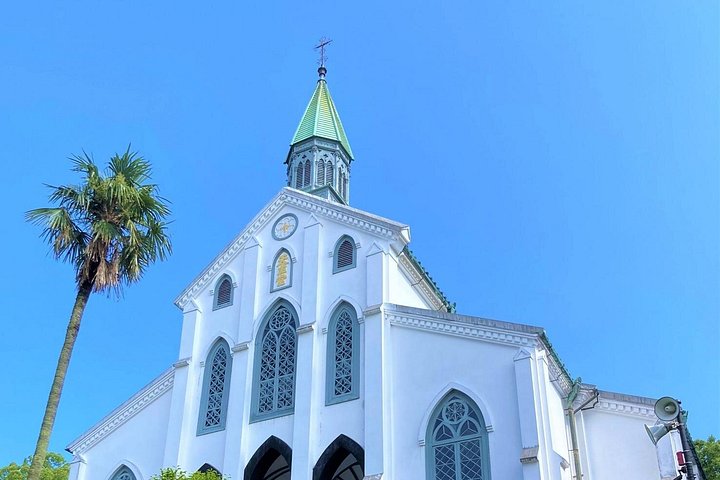
Urakami was the centre of Catholic life in Japan long before 1945. After centuries of persecution, hidden Christians emerged here in the nineteenth century and built a large cathedral on a hill above the valley. When the bomb fell, the building was almost totally destroyed, and thousands of parishioners died. The cathedral was rebuilt after the war, and today it stands as a bright, quiet church with a bell that rings in memory. A walking route through Urakami links the cathedral, the remains of the old wall, the hypocenter park and smaller memorials that are easy to miss without a guide. Private walking tours cover this district in about half a day, often combining it with the Atomic Bomb Museum and Peace Park, and are well suited to anyone who wants to understand the human geography of the area as well as the monuments.
Start at the cathedral, a twin-towered church of brick-coloured stone that dominates its hillside. Inside, the atmosphere is calm and the stained glass strong. Outside, in the grounds, you can see the surviving statues and the angelus bell that was recovered from the rubble. Please remember this is an active place of worship, so dress modestly, speak softly and respect services. Visitor hours are limited and vary, so check ahead.
From the cathedral the route runs downhill to the hypocenter, passing remnants of the old Urakami Cathedral wall, the Shiroyama Elementary School site, and small shrines and monuments tucked behind houses. A guide can point out the details that tell the story of this neighbourhood: a shrine gate with one pillar toppled, a camphor tree scorched but still alive, and the Urakami River, where so many survivors sought water. Each of these places tells a piece of the human story, and a good guide ties them together.
This is a walk of moderate length with some hills, best done in the morning or late afternoon. Wear comfortable shoes and bring a hat and water in warm months. Combine it with the Atomic Bomb Museum and the Peace Park for a full day, or keep it as a separate quieter morning if you have already seen the main sites. The district also has small cafes and bakeries where you can rest and reflect.
Allow time for the small things. In the cathedral grounds, look for the statues of saints with their heads blown away, which survivors left in place as testimony, and for the memorial to the thousands of parishioners who died while waiting to take part in a feast-day service. Local guides will tell you which of these stories are well documented and which are family memories, and they will often ask for a moment of silence at points where it feels right.
If you prefer to go on your own, the route is easy to follow with a map and the tram stops at Urakami-Ekimae and Hamaguchi-machi.
A few practical points help the walk go smoothly. The district is residential, so keep to pavements and avoid blocking narrow lanes. Toilets and cafes are limited between the cathedral and the hypocenter, so use facilities when you find them. In summer begin early, as the slopes offer little shade, and in the rainy season carry a compact umbrella.
If you plan to attend a service, check the parish schedule, and remember that photography inside the church may be restricted. The walk ends close to the tram line, so it is simple to continue to the museum or head back to the city centre.
What to expect
The experience
A private guided walk through Urakami, linking the cathedral, hypocenter and smaller memorials.
Best time
Morning or late afternoon, outside services and the hottest part of the day.
How long
Three to four hours at an easy pace.
Tips
Dress modestly for the cathedral, wear comfortable shoes and check visiting hours in advance.
Quick picks
- Best for
- History-minded travellers who want to understand the neighbourhood as well as the monuments.
- Families
- Best for older children; the route has hills and serious content.
- Couples
- A thoughtful half day with space for conversation.
- Pair with
- The Peace Park, the Atomic Bomb Museum and a cafe stop in Urakami.
- Time needed
- Half a day.
Good questions
Can I enter Urakami Cathedral?+
Visitors are welcome at set times outside services, with respectful dress and behaviour. Hours vary, so check before you go.
Why is Urakami important?+
It was the heart of Japan's Catholic community, and the bomb exploded almost directly above it, destroying the cathedral.
Is the walk difficult?+
It is moderate, with some slopes and steps. Wear comfortable shoes.
Do I need a guide?+
Not strictly, but a guide reveals many small memorials and stories you would otherwise miss.
How do I get there?+
Take a tram to Hamaguchi-machi or Urakami Station area, then walk. A guide will usually meet you at a set point.