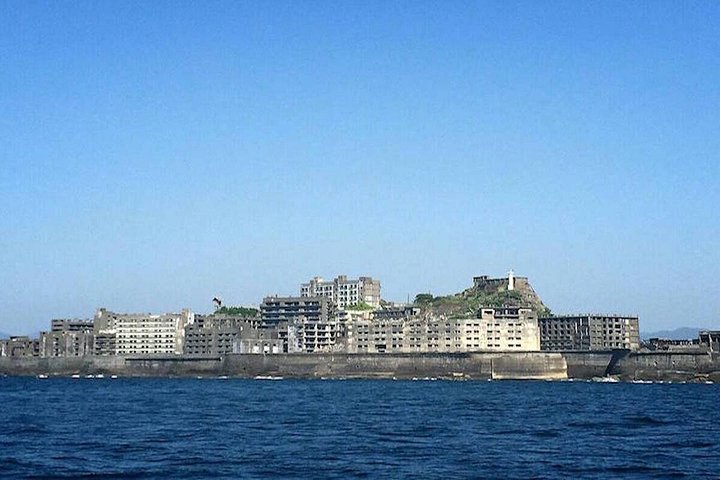
Gunkanjima, named Hashima, lies about 15 kilometres off the coast of Nagasaki. Mitsubishi developed the tiny island as a coal-mining community from the late nineteenth century, packing thousands of workers and families into a densely built complex of concrete apartment blocks, a school, a hospital and shops. The mine closed in 1974 and the island was abandoned, leaving a spectacular ruin that earned the nickname Battleship Island for its silhouette. It is now part of the UNESCO World Heritage inscription for Japan's Meiji industrial revolution sites. Tours depart from Nagasaki harbour, sail for roughly 40 minutes, circle the island and, if the sea allows, land at a safe viewing area where a guide explains the island's history. The story includes pride in industrial achievement and the hard, sometimes forced, labour of Korean and Chinese workers, and a good tour presents both sides.
Landing is only possible in calm weather, and operators cancel or reroute the cruise when waves are high. On days when landing is not allowed, the boat still circles the island, which offers its own dramatic view of the collapsing apartment blocks. Check the cancellation policy before you buy, build some flexibility into your itinerary, and avoid choosing the last day of your visit if you can.
On the island, visitors walk a fixed path with a guide. You can see the skeletal remains of the apartments, the old shafts and the sea wall, but not the interiors, which are unsafe. The guide points out the layout, from the school to the rooftop gardens, and explains how families lived in a place with no soil and constant sea spray. A short stop at the exhibition on the quay on the mainland side often completes the visit.
Practical tips
Wear sturdy shoes and sun protection, since there is little shade, and bring a light jacket for the boat. Carry passports or ID if the operator requests them, and expect a safety briefing and life jackets. Allow around three hours for the whole trip, and note that landings are limited by wind and tide. Photographers will want to be at the rail as the island approaches. After the trip, a bowl of champon or a harbour-side walk in Nagasaki makes a good counterpoint.
Understanding the history makes the sight more powerful. At its peak the island housed several thousand people on a patch of land barely the size of a few football fields, one of the most densely populated places on earth. Residents had a cinema, a school and gardens on rooftops, yet depended entirely on the mine.
After oil replaced coal in Japan, the closure came quickly, and families left within months. The World Heritage status recognises the industrial achievement, and Japan has also agreed to present the full history, including the experiences of forced labourers during the war, so a balanced guide and the information centre in Nagasaki are worth your attention.
Plan the rest of the day around the cruise. Morning departures often have calmer seas, and returning by early afternoon leaves time for the Peace Park or a harbour-side lunch. Seasickness tablets are a sensible precaution for anyone prone to motion sickness, since the open water can be choppy even on days when landing is allowed.
Hats and sunscreen help on the exposed deck, and a light waterproof layer is useful for spray. Photography from the boat is excellent, but keep equipment secured and avoid leaning over the rails. Tickets often sell out in peak seasons, so reserve early.
What to expect
The experience
A guided boat trip from Nagasaki harbour that circles Hashima and lands for a walk on the island when conditions allow.
Best time
Calm days from spring to autumn. Typhoon season and winter winds raise the chance of cancellation.
How long
About three to four hours including sailing time.
Tips
Choose a flexible day, wear sturdy shoes, bring sun protection and a light jacket, and read the weather policy before buying.
Quick picks
- Best for
- Photographers, industrial-history fans and anyone drawn to ruins.
- Families
- Good for older children; young children may find the long boat ride tiring.
- Couples
- An adventurous half day with striking views.
- Pair with
- A harbour walk, champon lunch or an evening at Mount Inasa.
- Time needed
- Half a day.
Good questions
Can I always land on Gunkanjima?+
No. Landing depends on sea conditions, and operators may cancel or only circle the island. Check the policy before you book.
How long is the boat ride?+
The crossing takes roughly 40 minutes each way, and the whole tour runs around three to four hours.
Can I go inside the buildings?+
No. Visitors stay on a fixed path because the buildings are unsafe.
Is the island on the World Heritage list?+
Yes, as one of the Meiji industrial revolution sites in Japan.
Is the tour suitable for young children?+
It can be, but the boat ride and walking on uneven ground suit older children better.