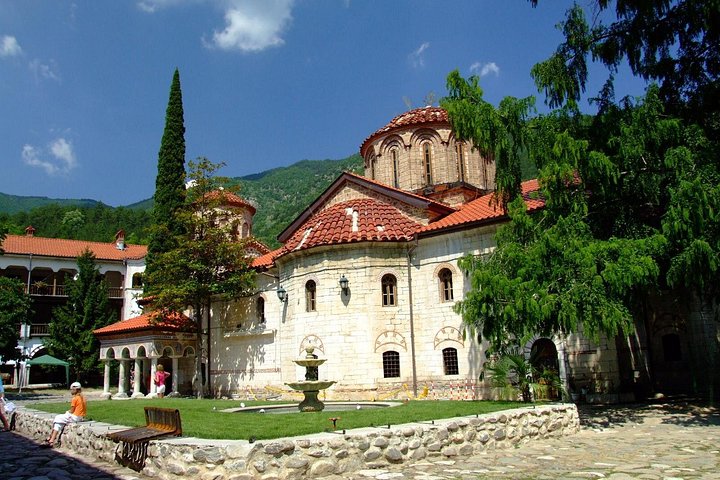
Rila Monastery is the spiritual heart of Bulgaria and the country's most visited cultural landmark. It lies in a deep forested valley in the Rila Mountains, about three hours by road from Plovdiv, and from the moment you step through the gate you are inside a walled courtyard of arcaded galleries in red, black and white stripes, with wooden balconies, carved doorways and a central church whose exterior is covered in colourful murals. The monastery was founded in the tenth century around the hermitage of Saint John of Rila, who is the national patron saint, and it grew into a centre of learning and faith that helped keep Bulgarian language and culture alive through centuries of foreign rule. Most of the present buildings date from the nineteenth century, after a major fire, but the stone tower that stands in the courtyard is much older and gives a sense of the monastery's medieval roots. Entry to the grounds is free, and you can wander the courtyard, step inside the main church and walk the galleries. A small museum holds church treasures and the famous carved wooden cross, and has its own ticket. This is a living monastery, so dress modestly with covered shoulders and knees and speak quietly in the church.
The main church, dedicated to the Nativity of the Virgin, is the visual centrepiece. Its porch and walls are covered in nineteenth-century frescoes that include scenes of saints, angels and apocalyptic visions, painted by some of the leading artists of the Bulgarian Revival. Inside, an ornate carved and gilded iconostasis fills the front of the church, and the air is dim and fragrant with incense.
Photography rules inside are usually strict, so follow the signs. Outside, the courtyard is surprisingly large, with a fountain, a clock tower, and wooden balconies where monks and visitors once stayed. The tower from the fourteenth century is the oldest surviving building, and it is a reminder of the monastery's status as a fortress as well as a place of prayer.
Beyond the walls
The setting is as important as the architecture. The valley is wooded and quiet, with the river running alongside the road, and there are short walks to the hermit's cave and the chapel associated with the saint, which are well worth the extra time if you have it. A bakery near the entrance is known for fresh warm bread and pastries, which make a good snack.
Because the site is popular, visit early in the day or later in the afternoon to avoid the tour buses, and note that the main stretch of the day is busy from late spring to early autumn. In winter the monastery under snow is magical but cold, and the road should be checked before you set out.
Getting there from Plovdiv
The distance means this is a long day, and it works best as an early start with a driver or guide, or as part of an overnight trip that also takes in the Rila Lakes or Sofia. Private day tours from Plovdiv are available, and public transport is possible but involves a change and takes much longer. Pair the monastery with the Bachkovo Monastery, which is closer to Plovdiv, if you want to compare two very different Bulgarian monasteries, and treat it as a highlight of any longer stay in the country.
What to expect
The experience
A visit to a working monastery: walk the arcaded courtyard, step inside the frescoed church, see the medieval tower and, if you wish, pay for entry to the small museum.
Best time
Early morning or late afternoon, outside the middle of the day when tour buses arrive. Spring and autumn are the most comfortable, winter is quiet and cold.
How long
Allow one and a half to two hours at the monastery, plus about three hours each way from Plovdiv.
Tips
Dress modestly with covered shoulders and knees, follow the photography rules inside the church and check road conditions in winter.
Quick picks
- Best for
- First-time visitors to Bulgaria and anyone who wants a single unforgettable cultural landmark.
- Families
- Children enjoy the colourful courtyard and the nearby bakery, but the church is a place for quiet voices.
- Couples
- A beautiful forest setting; add the short walk to the hermit's cave for a quiet moment together.
- Pair with
- Bachkovo Monastery for contrast, the Seven Rila Lakes for a mountain day, or an overnight stay in the area.
- Time needed
- A full day, or an overnight.
Good questions
Is there an entry fee for Rila Monastery?+
Entry to the grounds and the main church is free. The museum has its own ticket.
How far is it from Plovdiv?+
About three hours each way by road, so it is a long day. Many visitors make an early start or stay overnight in the area.
What should I wear?+
Cover your shoulders and knees, and wear comfortable shoes. Quiet voices are expected in the church.
Can I take photographs?+
Outside, yes. Inside the church, rules are usually strict, so follow the signs and ask if you are unsure.
Is it open in winter?+
Yes, the monastery is a living community and the grounds are open year round, but mountain roads can be snowy, so check conditions before you set out.