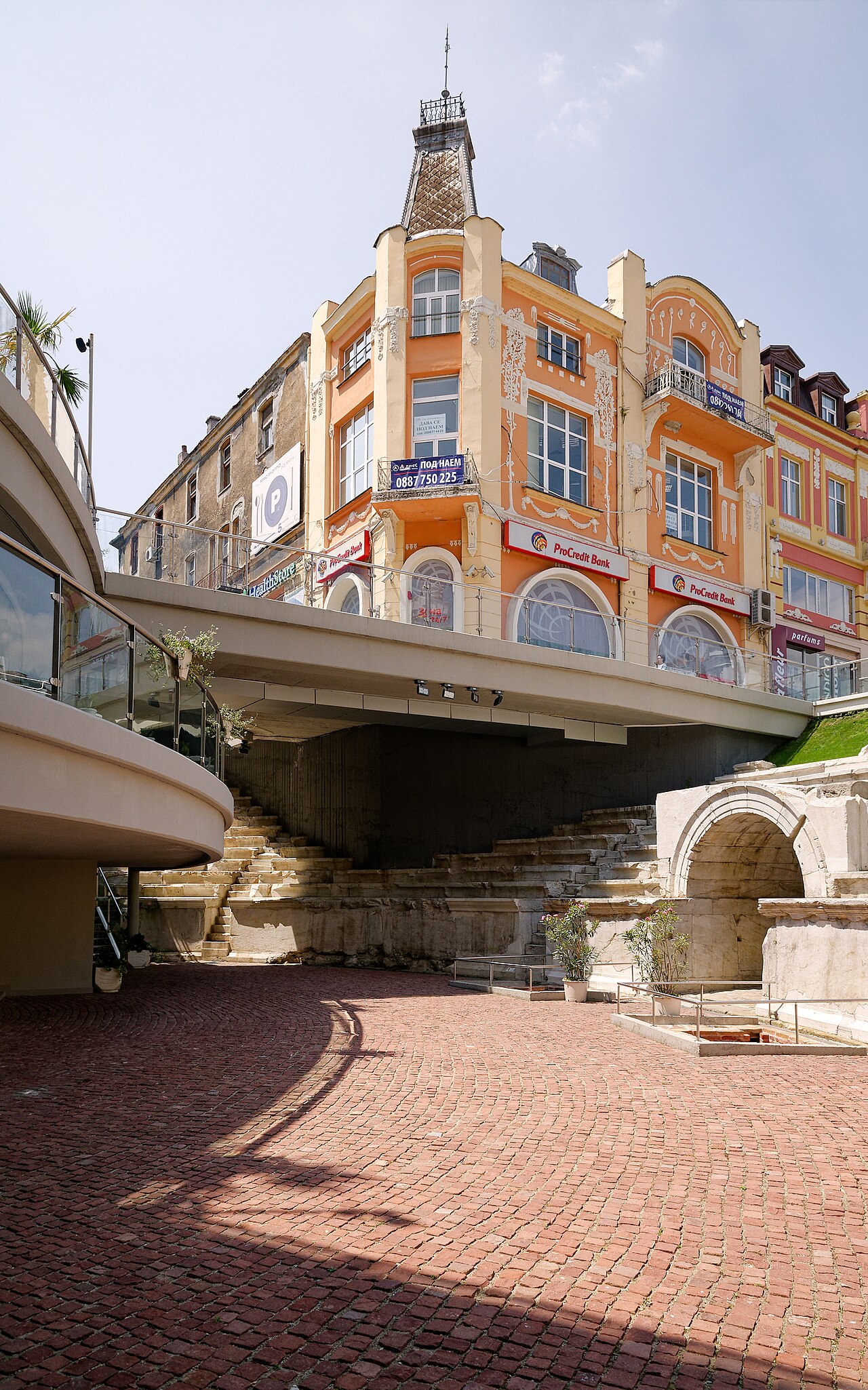
The Roman Stadium is the most surprising sight in central Plovdiv, because it hides in plain sight. It lies at Dzhumaya Square, beside the Ottoman Dzhumaya Mosque, below the level of the busy main pedestrian street, and you reach it by stepping down into a sunken arena of stone seating. Built in the Roman period, the stadium was a vast structure that once held around thirty thousand spectators for athletic contests and games, and it ran far along what is now the main street. Only the northern end has been exposed. The rest lies beneath the shops and buildings of the modern city, so what you see is a curved section of seats, parts of the entrance and a section of the fortified wall that later cut across it. A memorial plaque records the passage of the Olympic flame through the city in 1980, and the remains of a hydraulic clock were found at the central entrance. Viewing is part of the open public space, with cafes along the edge, so it costs nothing and takes ten to twenty minutes, which makes it an easy stop between the Old Town and Kapana. A tourist information centre sits nearby for maps and tours.
Seeing the stadium takes a little imagination, and the most satisfying way to do it is to walk its length above ground. The stadium was oriented roughly along the line of today's main pedestrian street, so as you stroll from Dzhumaya Square toward the other end, you are walking above the track. The scale only hits you when you realise the arena was designed for tens of thousands of people in a provincial Roman city, a clue to just how important Philippopolis was.
Context
The Roman city was laid out around three hills, with the Forum at their southern foot, the Theatre between two of the hills and the Stadium on the flat ground to the north. The stadium was used for athletic competitions and public spectacles and later fortified when the city came under threat. When you stand in the exposed section, look at the stonework, the rows of seats and the arch of the entrance, and then look up at the cafes and shop windows above, a reminder that the modern street is a layer on top of the ancient one.
Nearby, a statue of Milyo on the pedestrian street is said to bring luck in love if you rub his knees.
Visiting tips
The stadium is open as part of the public space, so you can drop in at any hour and linger at a cafe table overlooking it. It is especially pleasant in the evening when it is lit. It pairs naturally with the Roman Theatre, a short uphill walk away, and with the Dzhumaya Mosque next door.
Wheelchair users can see it from the upper level, though stepping down into the arena may involve stairs. Because it is a short stop, it works well as a rest from the hills with a coffee, rather than a long visit in its own right.
What to expect
The experience
A free look at the exposed northern end of the Roman stadium, sunk below street level at Dzhumaya Square and visible from the surrounding cafes.
Best time
Any hour of the day, with the evening lighting being especially atmospheric once the shops have closed.
How long
Fifteen to thirty minutes, longer if you linger over a coffee beside the stands.
Tips
Walk the length of the pedestrian street above the track to appreciate the scale, and look for the memorial plaque for the 1980 Olympic flame.
Quick picks
- Best for
- Anyone passing through the centre who wants a quick, free dose of Roman history.
- Families
- A short, easy stop with room to walk and a statue to rub for luck, so children are rarely bored.
- Couples
- A relaxed evening coffee beside the lit stands before dinner in Kapana.
- Pair with
- Dzhumaya Mosque, the Roman Theatre and Kapana, all within a few minutes on foot.
- Time needed
- Fifteen to thirty minutes.
Good questions
How big was the Roman Stadium?+
It held roughly thirty thousand spectators and ran along the line of the modern main street. Only the northern end has been uncovered.
Is there an entrance fee?+
No. The visible section is part of the public space at Dzhumaya Square and can be seen for free.
Where exactly is it?+
At Dzhumaya Square, below street level beside the mosque, at one end of the main pedestrian street.
What else can I see there?+
A section of the later fortified wall, the remains of a hydraulic clock at the central entrance and a plaque marking the 1980 Olympic flame.
How long do I need?+
Fifteen to thirty minutes is enough, longer if you stop at a cafe overlooking the stands.