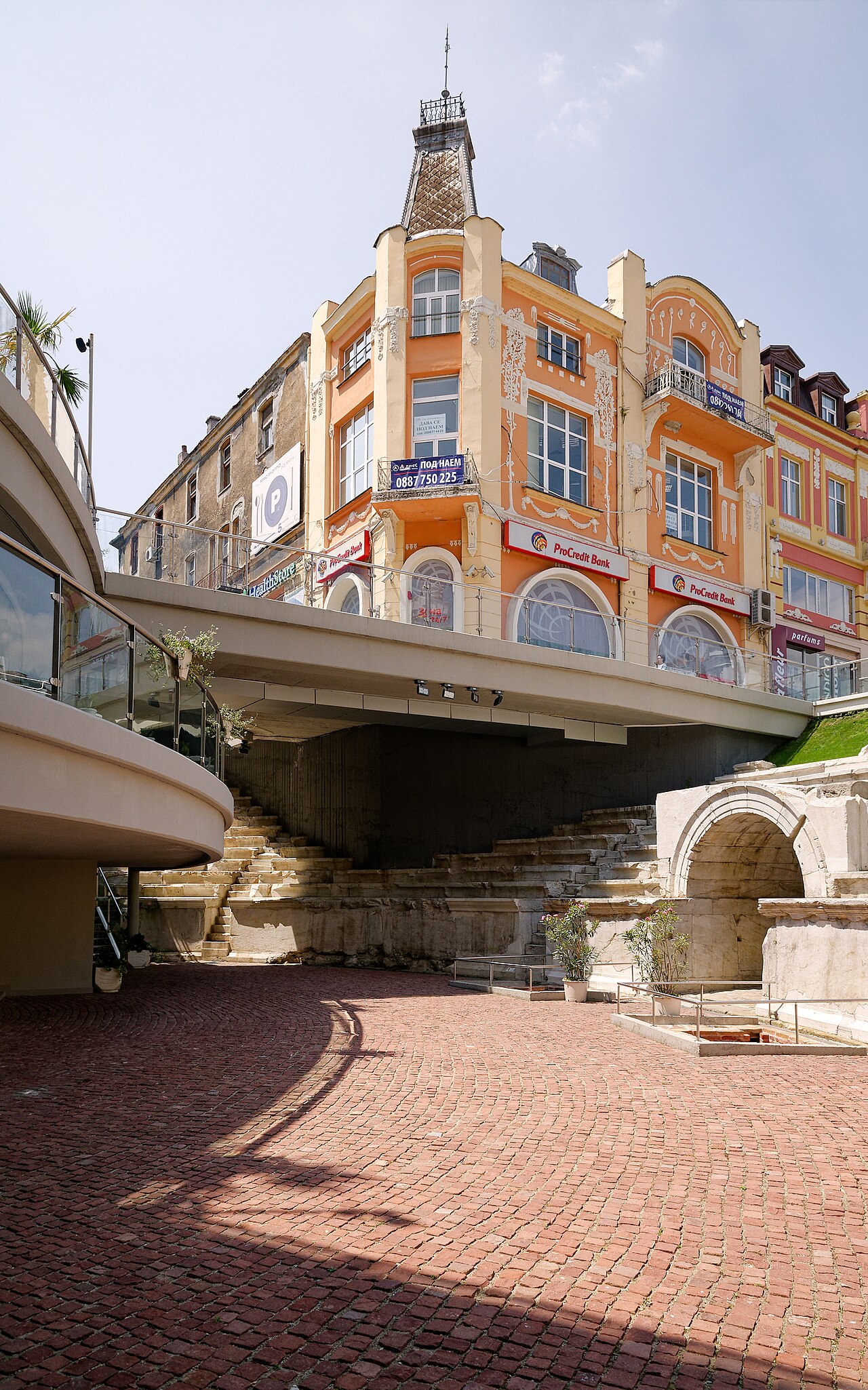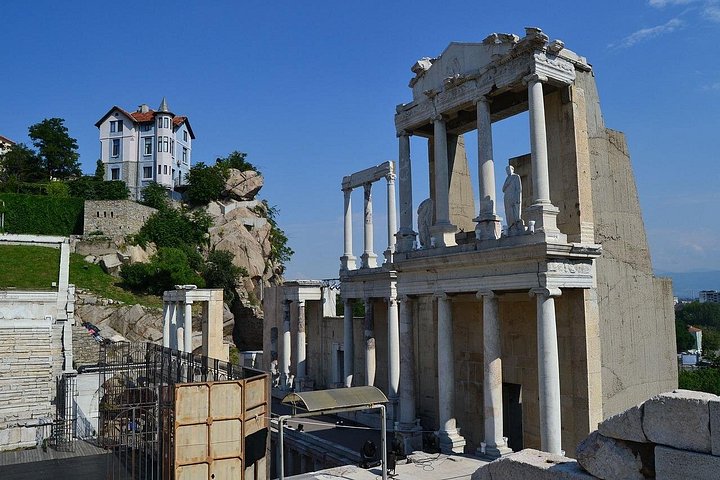
The Ancient Theatre is the sight that makes people fall for Plovdiv. Built when the city was the Roman town of Philippopolis, it is set into the hillside between the Old Town's hills, so its curved rows of stone seats face a stage with a backdrop of rooftops, the plain and, on a clear day, the distant mountains. Excavated in the late 1960s and 1970s after its remains were uncovered, it was restored in the following decades and today is a working venue: concerts and the Opera Open festival fill its seats in the summer months, which means you may be sitting where a Roman audience once sat while a modern orchestra tunes up. Entry is paid on site, with a modest ticket and payment in cash, so carry some euros in cash. The seats are uneven in places, the shade is limited and the climb to the upper rows is worth the effort, so wear sturdy shoes and bring a hat in sunny months. The amphitheatre sits on the edge of the Old Town, a short uphill walk from the central pedestrian street, which makes it an easy opening stop before you wander into the lanes of the Revival houses. For a deeper look at this and the other Roman remains, an inexpensive self-guided audio walk covers the Old Town and the Roman landmarks at your own pace.
A little context makes the stones come alive. Philippopolis took its name from Philip II of Macedon, who captured the earlier Thracian settlement, and under Rome it grew into one of the main cities of the province, with a forum, a stadium, baths and this theatre. The theatre belongs to the city's prosperous second century, when public buildings were built to impress, and it was in use for several centuries before being abandoned and buried.
That burial helped preserve it, and excavation in the twentieth century brought the seating and the stage building back to light. Local stonework and careful reconstruction mean that some parts are original and some are restored, so look for the difference in the colour and finish of the marble.
Making the most of the visit
Go early or late for softer light and fewer people, climb to the top rows for the panorama, and then walk the short distance to the viewpoint terraces around it for the classic photograph of the theatre with the city behind. Check the programme if you are visiting in summer, as performances change which hours the theatre can be visited.
In autumn and winter the site is quieter and the hillside air is crisp, but the stone steps can be slippery after rain, so take care going down. Families will find it a good place for children to run along the curved rows, though there are open drops at the edge of some terraces, so keep small ones close.
Pairing
The theatre is one of several Roman sites in the compact centre, so combine it with the Roman Stadium beneath Dzhumaya Square, the Old Town houses and the climb to Nebet Tepe. An audio walk that links the Old Town and the Roman landmarks is a low-cost way to tie them together if you prefer to explore without a group. For couples, the theatre at the end of the day, with the sky turning orange over the rooftops, is one of the most atmospheric hours you can spend in Bulgaria.
What to expect
The experience
A self-guided visit to the stone seating and stage of the Roman theatre, with the option of an audio walk that connects the theatre to the Old Town and other Roman remains.
Best time
Early morning or the last hour of daylight, when the light is soft, the stone is cooler and the view over the rooftops is at its best.
How long
Plan one to two hours including the climb to the upper rows and photographs from the surrounding terraces.
Tips
Bring Bulgarian lev for the cash-only entry, wear sturdy shoes for the uneven steps, and carry a hat and water in the sunny months because shade is limited.
Quick picks
- Best for
- First-time visitors and anyone who wants the single most photogenic Roman site in Bulgaria.
- Families
- Children enjoy the curved rows and the climb, but hold hands near the open edges and bring water in summer.
- Couples
- Go near sunset, climb to the top row and stay until the rooftops glow, then wander the Old Town lanes for dinner.
- Pair with
- The Roman Stadium, the Ethnographic Museum and a climb up Nebet Tepe make a full Roman and Revival morning.
- Time needed
- One to two hours.
Good questions
How do I buy tickets for the Roman Theatre?+
Entry is paid on site and in cash, so carry euros in cash. The audio walk linked here is a separate low-cost way to explore the Old Town and Roman landmarks.
Is the theatre still used for performances?+
Yes. It hosts concerts and the Opera Open festival in the summer months, and visiting hours can change on performance days, so check the programme if you travel between June and September.
Is the site suitable for people with limited mobility?+
The steps are uneven and steep in places, so it can be difficult. The lower rows and the viewpoint terraces give a good impression without a long climb.
What is the best time of day to visit?+
Early morning or just before sunset. The light is softer, the crowds are thinner and the view over the city is at its best.
How far is it from the main pedestrian street?+
It is a short uphill walk from the central pedestrian street and the Roman Stadium, so it fits neatly into a walking route with the Old Town.