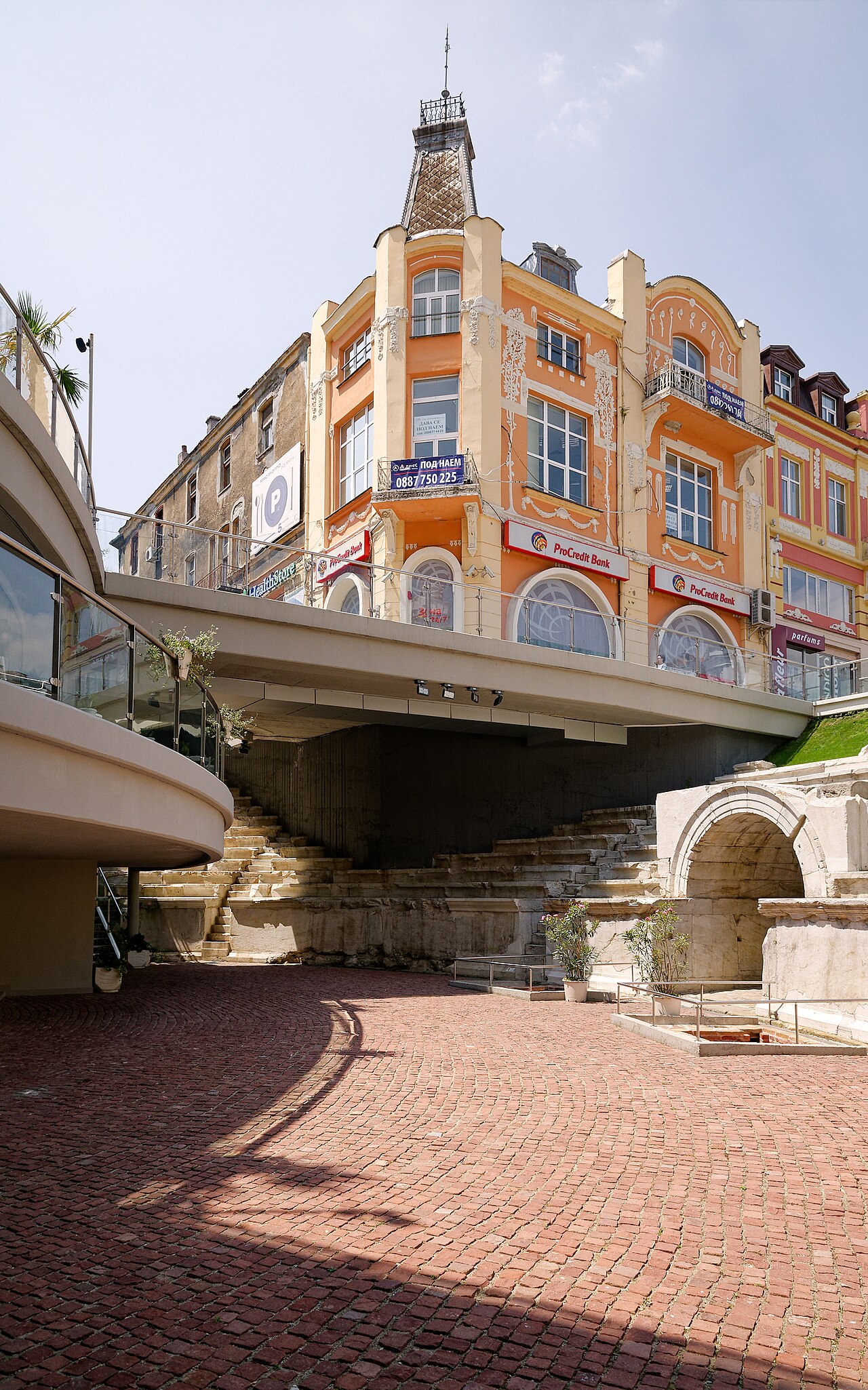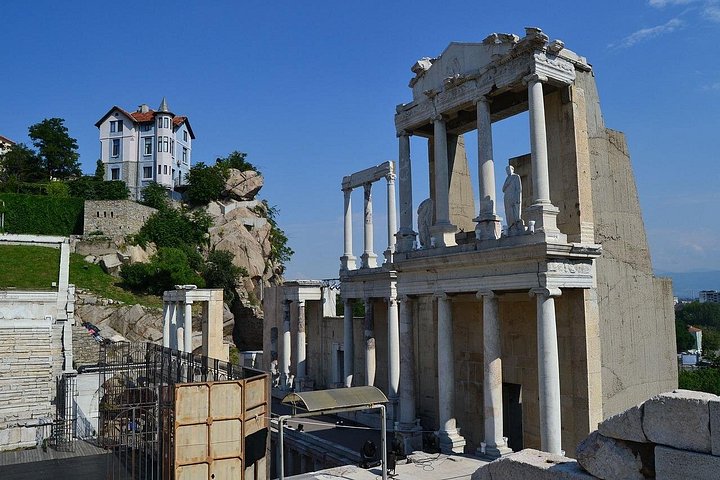
The Old Town, protected as the Ancient Plovdiv Architectural and Historical Reserve, is one of the most attractive historic quarters in the Balkans. It climbs the slopes of the city's hills along steep cobbled streets, where the houses of nineteenth-century merchants lean over the lane on timber upper storeys, painted in deep reds, blues and ochres, with big windows and carved ceilings inside. Several of these mansions are open to visitors. The Ethnographic Museum occupies the house built for the merchant Argir Kuyumdzhioglu, with a richly decorated reception room, folk costume, musical instruments, agricultural tools and displays of traditional life, and an audio tour is available. Balabanov House, another of the open mansions, shows a restored family home and hosts cultural events, while Hindliyan House, Nedkovich House and Stambolyan House are other names to look for on the walk. Beyond the houses, the Old Town has churches, craft shops and galleries, and the Roman Theatre sits right at its edge. Walking it is free; museum rooms charge a modest entry. The museum itself closes on Mondays and keeps shorter hours in winter, with a 9 to 17 schedule given for the colder months, so plan your day around it.
What you are looking at is a specific moment in Bulgarian history. In the nineteenth century, during the National Revival, wealthy merchants and craftsmen built grand houses to show their prosperity and their national pride, borrowing Ottoman and European ideas and adding their own: wide eaves, enclosed balconies, painted facades and rooms with carved wooden ceilings and built-in furniture.
Plovdiv's Old Town preserves dozens of them, and the Ethnographic Museum is the best way to step inside one and see how a family lived. Its upper rooms, with their painted decoration and view over the street, are the highlight. Allow an hour for the museum and more for the lanes outside.
Walking tips
The cobbles are uneven and steep, so comfortable shoes are essential, and cars are restricted in the Old Town, so the streets are calm. Start at the top near the Ethnographic Museum and walk down, popping into whichever houses are open, then come out near the Roman Theatre and the pedestrian street. Look up as well as ahead: many of the best details are carved ceilings in doorways and painted eaves.
Small galleries and craft studios along the way sell ceramics, textiles and paintings, and several houses double as cafes, wine bars and guesthouses. The nearby Dzhumaya Mosque, one of the older Ottoman mosques in the Balkans, is worth a stop, with modest dress required.
Choosing what to enter
You do not need to see every house. The Ethnographic Museum is the one we would put first, followed by one more, such as Balabanov House or Hindliyan House, depending on opening days. In summer, midday is hot on the exposed lanes, so go early; in winter, the houses are quiet and the Old Town is atmospheric on a crisp day, though some spaces keep shorter hours.
Combine the visit with the audio walk linked from the Roman Theatre page if you like a guided route, and finish with a drink in one of the courtyard cafes.
What to expect
The experience
A self-guided walk through the cobbled lanes of the Old Town, with paid entry to the Ethnographic Museum and whichever Revival houses are open on the day.
Best time
Mornings, when the lanes are quiet and the museum rooms are least crowded, or a crisp autumn day when the colours of the houses glow.
How long
Two to three hours for the museum, a couple of houses and an unhurried walk down the hill.
Tips
The museum is closed on Mondays and uses shorter winter hours, so check before you climb. Wear shoes with grip, and note that an audio tour is available at the museum.
Quick picks
- Best for
- Anyone who wants to see what Bulgarian Revival architecture looks like from the inside.
- Families
- Children enjoy the folk costumes and instruments, but the cobbles are steep and strollers struggle.
- Couples
- A slow morning in the lanes, a drink in a courtyard cafe and a look into Balabanov House is a romantic Plovdiv day.
- Pair with
- The Roman Theatre at the edge of the Old Town and the climb to Nebet Tepe.
- Time needed
- Two to three hours.
Good questions
Which Old Town house should I visit if I only choose one?+
The Ethnographic Museum, which occupies the house of a wealthy nineteenth-century merchant and has the most complete interiors. Balabanov House and Hindliyan House are good second choices.
Is the Ethnographic Museum open every day?+
No. It is closed on Mondays, with longer hours in summer and shorter ones in winter, so check the visit page before you go.
Is the Old Town free to walk?+
Yes, the lanes are open to everyone, and only the museum rooms and individual houses charge a modest entry.
Is the Old Town accessible for wheelchairs or strollers?+
The steep, uneven cobbles make it hard. Visitors with limited mobility may prefer the lower lanes near the pedestrian street and the museum with a taxi to the top.
Can I visit the Old Town in winter?+
Yes, and it is quiet and atmospheric. Some houses keep shorter hours or close for the season, so confirm opening times for the ones you want to enter.