The Castello Svevo is the great fortress of Bari, standing at the edge of the old town between the cathedral and the old harbour, surrounded by a dry moat and thick walls that have been rebuilt many times. Emperor Frederick II of Hohenstaufen reshaped it in the 1230s on top of an earlier Norman stronghold, and later rulers, from the Angevins to the Aragonese and the Sforza family, added bastions, towers and elegant rooms. Today the castle works as a museum and a cultural venue, and it is one of the easiest ways to understand how Bari was shaped by successive rulers who all wanted control of a harbour on the Adriatic. The approach is half the pleasure. You walk across a bridge over the moat, pass under the entrance gate and emerge in a courtyard with a monumental staircase, then climb to the upper floor and the walls for views over the sea and the rooftops of Bari Vecchia. It sits only a few minutes on foot from the Basilica di San Nicola, so it slots naturally into a morning in the old town.
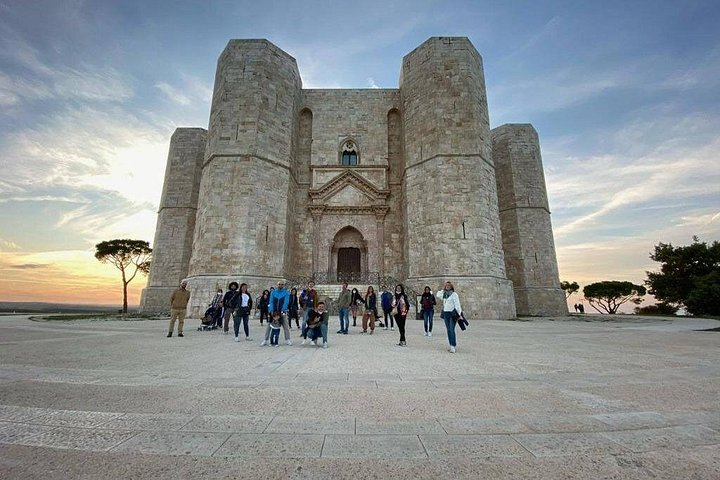
The layers of history are visible in the stone. The oldest parts belong to the Norman and Byzantine period, and the main body of the castle dates to the work Frederick II ordered between roughly 1233 and 1240, when he was building or rebuilding a chain of fortresses and hunting lodges across southern Italy, including the more famous Castel del Monte not far inland.
Later centuries brought sloping bastions with corner towers, a lavish Renaissance court under Isabella of Aragon and Bona Sforza, and then a long decline in which the building served as barracks and as a prison. Careful restoration has turned it back into a place that visitors can enjoy.
Inside, the castle is arranged as a museum. The ground floor holds the Gipsoteca, a remarkable collection of plaster casts of Apulian sculpture made for an exhibition in Rome in the early 20th century, which lets you study details of cathedral portals and capitals at eye level. Rooms on the upper floor hold archaeological displays, ceramics and changing exhibitions, and the layout shifts from year to year, so it is worth asking at the ticket desk what is on during your visit.
Do not expect a huge collection. The castle is best treated as a short, atmospheric stop of about an hour rather than an all-day museum.
Practical planning is simple. The castle is open most days with a weekly closing day, and the closing day and the shorter winter hours have changed from time to time, so check before you go rather than assuming. Tickets are sold at the entrance and can also be bought in advance through the museum ticket page. The courtyard and some rooms are step-free, but the upper floor and the walls involve stairs.
Pair the castle with the cathedral, the basilica and the seafront walls for a classic loop of Bari Vecchia, and finish with focaccia or a plate of orecchiette in the lanes nearby. Late afternoon is lovely, when the light softens on the limestone and the walls catch the breeze from the harbour.
What to expect
The experience
A self-guided visit to a moated castle: the entrance bridge, the courtyard, the Gipsoteca of plaster casts, the museum rooms and the upper walls.
Best time
Morning, or late afternoon when the stone is golden and the walls are breezy; avoid the hottest hours of summer.
How long
About an hour, a little longer if you linger on the walls or catch a temporary exhibition.
Tips
Check the weekly closing day and the seasonal hours before you go, expect stairs to the upper floor, and combine the visit with the nearby cathedral and basilica.
Quick picks
- Best for
- History lovers and first-timers who want a compact look at Bari's Swabian and Norman past.
- Families
- Children usually enjoy the moat, the bridge and the walls, and the visit is short enough to keep attention.
- Couples
- A quiet late-afternoon visit followed by a walk along the seafront walls and dinner in the old town.
- Pair with
- Bari Vecchia, the Basilica di San Nicola, the cathedral and the seafront promenade.
- Time needed
- One hour for the castle; add two to three hours for a full old town loop.
Good questions
Is the Castello Svevo worth visiting if I only have a day in Bari?+
Yes, if you enjoy history. It takes about an hour and sits a few minutes from the basilica, so it fits easily into an old town loop. If you are short of time, the basilica and the lanes come first.
Who built the castle?+
The oldest parts are Norman and Byzantine, and Emperor Frederick II rebuilt it in the 1230s. Later rulers added bastions and a Renaissance court, so the building shows several centuries of changes.
Does the castle close one day a week?+
Yes, it has a weekly closing day, and the day and the winter hours have shifted over the years. Check the museum ticket page before you travel so you do not arrive to a closed gate.
What is the Gipsoteca?+
It is a collection of plaster reproductions of Apulian sculpture, made in the early 20th century for an exhibition. It lets you see portals, capitals and statues from across the region up close in one room.
Can I buy tickets in advance?+
Tickets are sold at the entrance and through the museum ticket page. Booking ahead is rarely essential, but it saves time in busy periods and when a special exhibition is on.