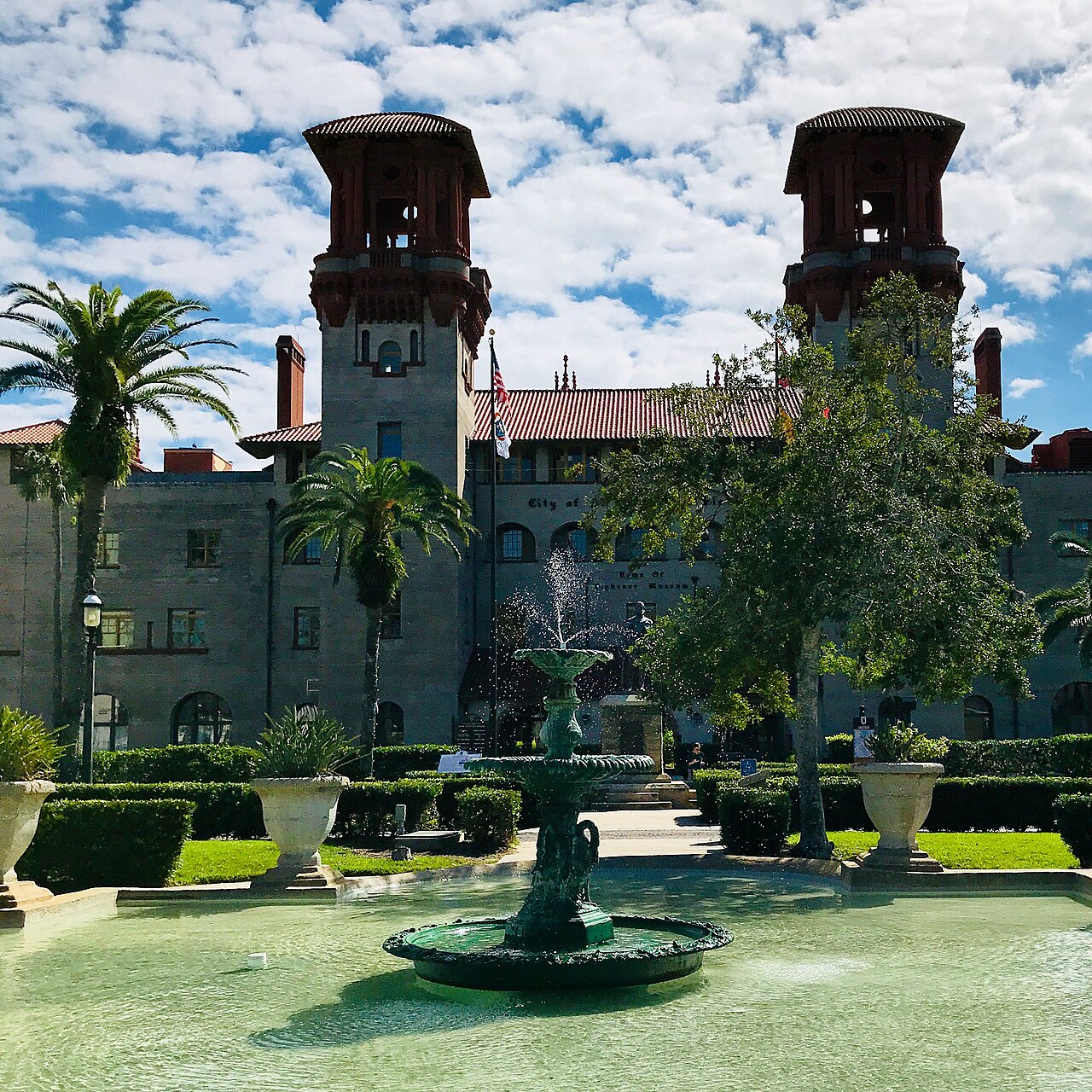
Washington Oaks is two parks in one, and both are unlike anything else on this coast. On the river side, the formal gardens grow around an ancient live oak hammock on the Matanzas River: winding paths, reflecting ponds and fountains, beds of azaleas and camellias that peak in late winter and early spring, bird-of-paradise and other exotic plantings, and a rose garden of around 150 bushes. The gardens date from the decades when this was the winter estate of Owen D. Young, the former chairman of General Electric, and his wife Louise, who expanded the plantings; she donated the property to the state in the 1960s, and it has been a state park since. On the ocean side of A1A, the beach is one of the most dramatic in Florida: instead of plain sand, the shore is lined with outcrops of coquina rock, the same shell stone that built the Castillo, weathered into orange-brown ledges, boulders and tide pools where you find anemones, crabs and small fish at low tide. The sand itself is coarse and tinted with crushed shell. It is a beachcombing and photography beach rather than a swimming one — the rocks and currents make it a poor place to swim — and it is at its most striking at low tide and in early-morning light. Between the two, short trails wind through maritime hammock and along the river, and you can picnic, fish from the seawall on the Matanzas or bicycle the park roads. Manatees sometimes pass along the river in warm months.
Getting there and fees: the park is at 6400 North Oceanshore Boulevard (A1A) in Palm Coast, about forty minutes south of the historic district and a few minutes south of Marineland. It opens daily from 8 a.m. until sunset, every day of the year, and charges a small per-vehicle fee, which can be paid online as a single-use day pass. The gardens and beach have separate parking areas, both covered by the same entry. Facilities are modest — restrooms, picnic shelters and a small visitor area — so bring water and snacks.
Timing: check the tide tables before you go and aim for low tide to see the coquina formations and tide pools at their best. The gardens are lovely year-round but most colorful from late winter into spring, when the camellias and azaleas bloom; mornings are cooler and quieter. Combine both halves in about two hours, or stay longer for the trails, a picnic under the oaks and photography.
The perfect A1A day: drive south from St. Augustine over the Bridge of Lions and down Anastasia Island, stop at Fort Matanzas for the free ferry (Thursday through Monday), continue to Marineland, then end at Washington Oaks for the gardens and the rock beach, and return north along the coast for a seafood dinner. It is the most scenic day trip from the city, with miles of undeveloped dunes along the way and, at Washington Oaks, a beach that looks like nowhere else in the state.
What to expect
The experience
A state park with formal gardens, reflecting ponds and a rose garden under live oaks on the river side, and a coquina-boulder beach with tide pools on the ocean side, plus short trails and picnic areas.
Best time
Low tide for the rock beach; late winter and spring for camellias and azaleas; mornings for light and quiet.
How long
Two to three hours for both halves.
Tips
Check tide tables. The beach is for exploring, not swimming. Bring water and snacks. Pair with Fort Matanzas and Marineland on the drive south.
Quick picks
- Best for
- Photographers, garden lovers and anyone who wants a beach that is genuinely different.
- Families
- Tide pools and easy trails keep kids busy; watch footing on the rocks.
- Couples
- Garden paths under the oaks, then golden-hour light on the coquina boulders.
- Pair with
- Fort Matanzas and Marineland on the same stretch of A1A.
- Time needed
- Half a day with the drive.
Good questions
How far is Washington Oaks from St. Augustine?+
About forty minutes south on A1A, a few minutes past Marineland, in Palm Coast.
How much does it cost?+
A small per-vehicle entry fee, payable at the park or online as a day pass. It is open 8 a.m. to sunset daily.
Can you swim at the beach?+
It is not a swimming beach; the coquina rock formations and currents make it better for beachcombing, tide-pooling and photography.
When are the gardens best?+
Late winter into spring, when camellias and azaleas bloom, though the oaks, ponds and roses make it pleasant all year.
What is the rock on the beach?+
Coquina, a natural limestone of compacted shells, the same stone the Spanish quarried to build the Castillo de San Marcos.