Strasbourg is an excellent base for day trips, because Alsace packs a remarkable amount into a small area. Within an hour or so you can reach a city of canals and museums, a string of wine villages, a hilltop castle and the edge of the Black Forest. This guide describes the best options and how to get to them, so you can decide between the train, a car and a small-group tour.
Colmar by train
Colmar is the easiest and most rewarding day trip. Regional trains leave from Strasbourg station and take about half an hour, so you can leave after breakfast and be exploring by mid-morning. The old town is compact and walkable, and the highlights are within a short stroll of each other: Little Venice along the river Lauch, the Unterlinden Museum with its famous altarpiece, and the family-friendly Choco Story and Toy Museum. The Museum of Alsatian Wines adds a tasting to the day. Remember that the Unterlinden Museum and the Toy Museum close on Tuesdays. Colmar is also a good place for lunch, with winstubs along the quays, and in December its Christmas markets are among the best in the region.
The Alsace Wine Route
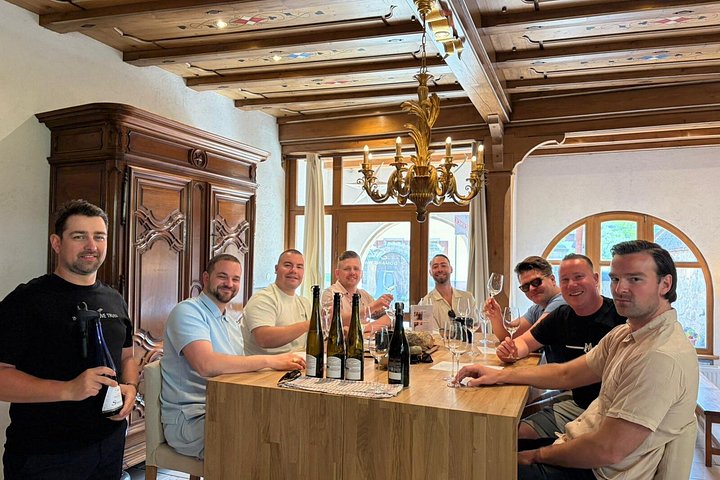
The Wine Route runs for about 170 kilometres along the foothills of the Vosges, and the most famous villages cluster south of Strasbourg, between Obernai and Colmar. Riquewihr, with its half-timbered main street and gate tower, is the classic stop. Kaysersberg offers a fortified bridge, castle ruins and the birthplace of Albert Schweitzer, and Eguisheim, built in concentric rings around a castle, is a favourite for photography. Ribeauvillé, with its three castles above the vines, makes a fine fourth. Public transport is limited, so a car or small-group tour is far easier. Tours typically combine two or three villages with a tasting, and some add Colmar or the castle. If you drive, choose a designated driver, and park at the edge of each village.
Haut-Koenigsbourg Castle
The mighty red-sandstone castle above the Alsace plain is one of the most visited monuments in the region. It lies about an hour from Strasbourg and half an hour from Colmar by car, perched on a spur of the Vosges with sweeping views. Inside, you can explore the keep, the great hall and the ramparts, and families love the drawbridge and the sense of a story book fortress. It is closed on a few holidays, including 25 and 26 December and 1 January, and the last entry is an hour before closing. Pair it with Riquewihr or Kaysersberg for a full day.
Obernai and Mont Sainte-Odile
Closer to Strasbourg, Obernai is a pretty walled town with a market square and a good choice for a half-day, and it is the northern gateway to the Wine Route. Nearby, Mont Sainte-Odile is a hilltop convent with views over the plain, and a good stop for walkers. Both are easiest by car, though a bus and train combination exists, so check timetables.
Across the Rhine
The German border is only a few kilometres from the old town. Kehl, the town on the far bank, can be reached by tram, and it is a short, easy excursion for a change of scenery and a walk along the river. Further afield, organised day trips run to Baden-Baden, the elegant spa town on the edge of the Black Forest, and to Heidelberg, often combined in one long day. If you have a car, the Black Forest high road and the lakes of the region are within reach, although a full day is needed.
Choosing between train, car and tour
Use the train for Colmar and Obernai, a car for the Wine Route and the castle if you are confident driving on narrow roads, and a small-group tour if you want tastings without worrying about driving or if you are travelling alone and want company. Guided tours also take care of timing and parking, which is a real advantage in the busy summer and Christmas periods. Private drivers can tailor the route if you have a group.
Practical tips
Start early, since village life winds down in the late afternoon and shops often close at lunchtime. Check opening days before you go, as small museums and cellars close on different days. In winter, daylight is short and public transport thins, so plan fewer stops. Book tickets for the castle and museums in advance in peak season, and carry a light waterproof, because the weather can change quickly in the foothills.