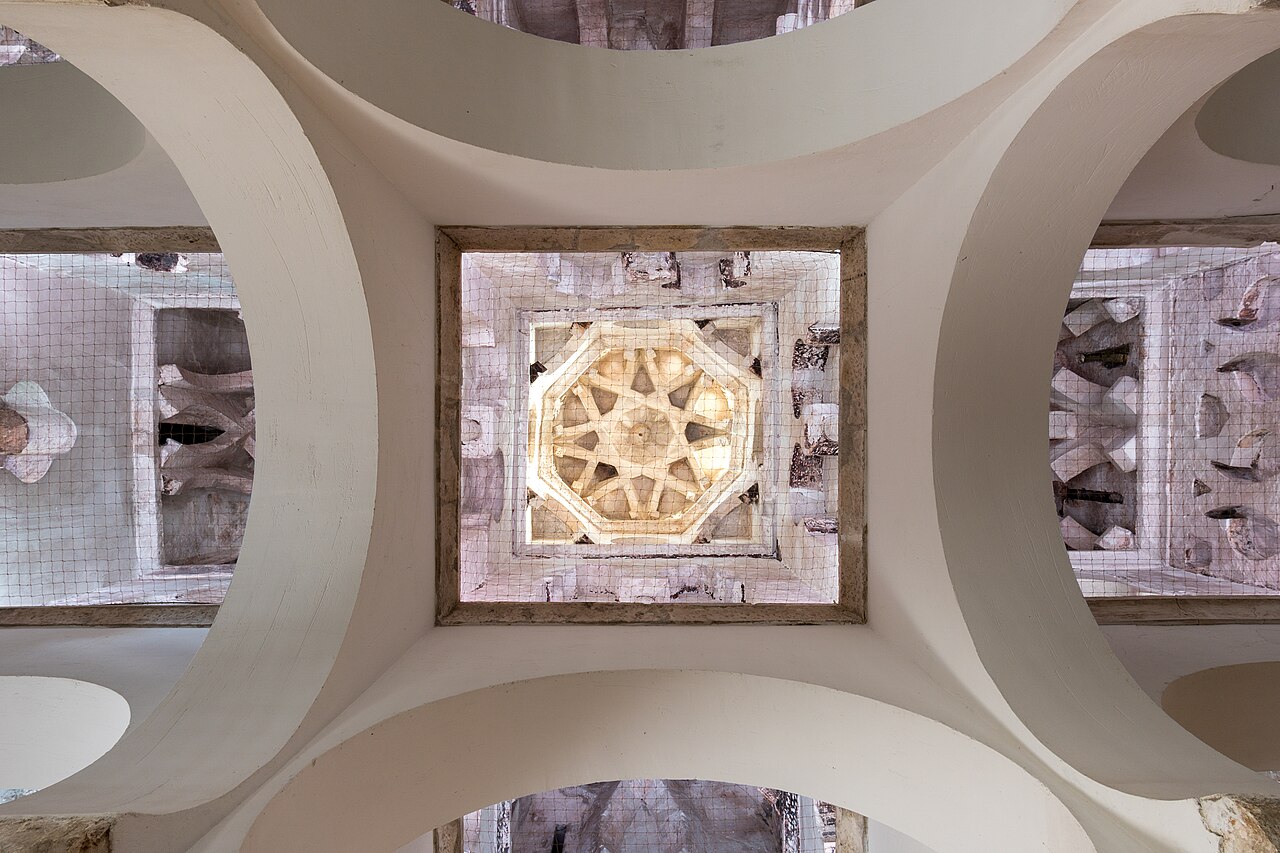
Tucked into the hillside beside the Puerta del Sol, the Mosque of Cristo de la Luz is one of the oldest buildings in Toledo and a rare survivor from the time of the Caliphate of Cordoba. It was built around the year 999 as a neighborhood mosque, a square room divided by four columns into nine small bays, each topped with a different ribbed vault in brick. The result is both simple and surprisingly elegant, a miniature version of the great mosque of Cordoba. When Alfonso VI took Toledo in 1085 the building was turned into a church, and later a Mudejar apse was added at the east end, creating a layering of Islamic and Christian styles that fits Toledo's reputation as a city of cultures. Legend ties the name to a lamp that burned inside for centuries and to a horse that knelt before the wall, but the real draw is the architecture. A small garden surrounds the mosque and offers a pleasant spot to sit and look out over the rooftops.
Walk in and stand in the center of the room. The nine bays, each vaulted in a different pattern, appear to float above the four central columns, whose capitals were reused from earlier Roman and Visigothic buildings. Look for the Kufic inscription on the exterior facade that records the builder and the date, and for the bands of decorative brickwork that run across the walls. The Mudejar apse at the east end is an interesting counterpoint, with horseshoe arches and blind arcades echoing the original while clearly belonging to a later era.
The building is small, so most visits last no more than twenty or thirty minutes, though the garden and view are worth lingering over. An audio guide or information panels help explain the building's history, and staff are usually helpful. A modest entry fee applies, typically included in a combined monument ticket. The mosque closes for lunch on some days and keeps shorter hours in winter, so confirm times if you are working to a tight schedule.
Location is a major plus. The mosque sits on the way to the Puerta del Sol and the Puerta de Bisagra, and a short climb leads up to the Plaza de Zocodover, so it fits naturally into a walk around the northern edge of the old city. Combine it with the city gates and the Alcazar, and end the day with a coffee overlooking the plain north of the walls. For photographers, mid-morning light in the garden is flattering, and the brick pattern of the exterior comes alive in late afternoon sun.
A few details are worth looking for. The ceiling vaults are all different, a feature designed to show the skill of the builders rather than to follow a single pattern; try tracing them with your eye from one bay to the next. Outside, the brickwork above the entrance includes decorative bands in a style that appears in several Toledo buildings.
If you have a camera with good low-light performance, the interior is photogenic when the sun slants through the windows. The garden also holds fragments of older stonework, a reminder of how many cultures have built on this same hillside, and the wall offers a bench with a surprisingly good view.
What to expect
The experience
A short visit inside a small tenth-century mosque, with nine vaulted bays and a Mudejar apse, plus a garden terrace outside.
Best time
Mid-morning or late afternoon for the best light on the brick.
How long
Thirty minutes, more if you linger in the garden.
Tips
Look for the Kufic inscription outside. Combine with the Puerta del Sol and city gates.
Quick picks
- Best for
- Architecture fans and anyone wanting a quick look at Moorish Toledo.
- Families
- Short enough to keep kids interested; garden helps.
- Couples
- A peaceful corner with a view.
- Pair with
- The Puerta del Sol, Puerta de Bisagra and the Alcazar.
- Time needed
- Half an hour.
Good questions
When was it built?+
Around the year 999, during the Caliphate of Cordoba.
Why is it called Cristo de la Luz?+
After a Christian dedication and legends about a lamp and an image of Christ.
Is it still a mosque?+
No. It has been a church and is now a monument.
Can I photograph inside?+
Usually yes without flash. Follow posted rules.
Is it accessible?+
The old town is hilly and the site has steps, so access is limited.