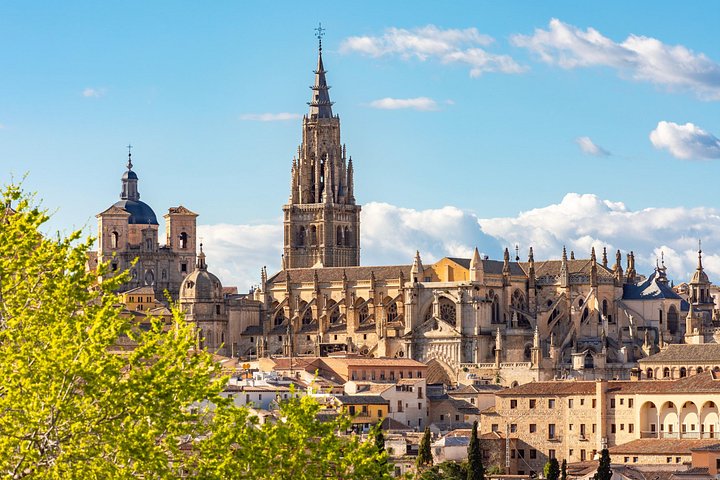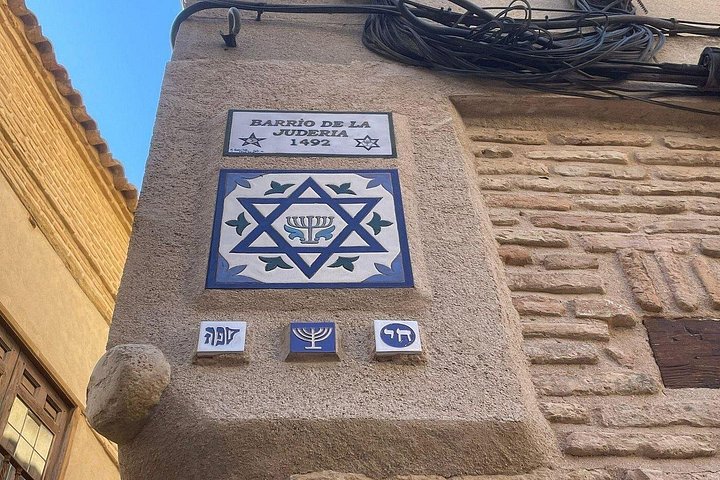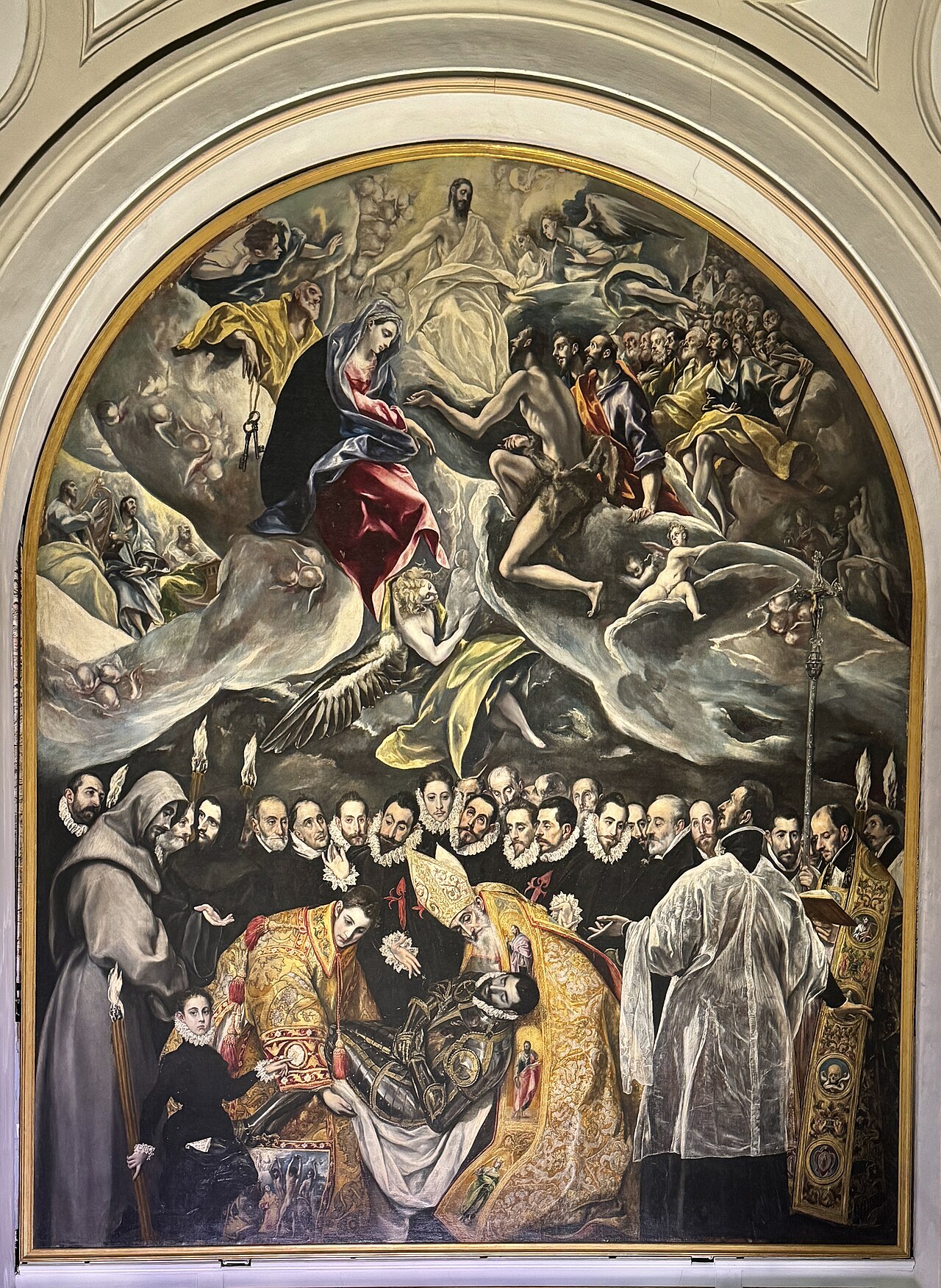
Santo Tome looks like any other Mudejar church in Toledo, with a brick bell tower banded in white decorative arches, but inside it holds the painting most associated with the city. The Burial of the Count of Orgaz, completed by El Greco in the late 1580s, hangs in a purpose-built chapel on the church's side wall. The canvas divides into two worlds. Below, the dead count is lowered into his tomb by Saint Augustine and Saint Stephen, surrounded by a row of Toledo notables who stare straight out at the viewer, and the faces feel strikingly alive. Above, a swirling heaven receives the count's soul, with Christ, Mary and a crowd of saints stretched into the long, flame-like forms that mark El Greco's mature style. The painting commemorates a medieval benefactor of the parish and has hung in this spot for more than four centuries. The church itself dates back to the Mudejar period, with a tower said to be built over a former mosque minaret, and its small interior is easy to take in during a short pause on a walk through the Jewish Quarter.
Approach the painting slowly. The lower half is almost like a group portrait; look for the boy in the left foreground, a figure by tradition linked to the painter's son, with a torch and a handkerchief in his pocket bearing the artist's signature and date. The robes of the saints are rendered in glittering brocade, with delicate embroidery that scholars have studied for what it says about contemporary craftsmanship.
Above, the sky rolls open like a theater curtain; the stretched anatomy and electric colors are exactly the features that made El Greco a rediscovered hero for later painters.
The visit itself is brief. Queues can form in high season because the chapel is compact, so book or arrive early. Photography is limited, and staff may ask for quiet. Short explanatory panels and an audio option provide the background, and there is a small display about the parish and the story of the commission. It is a little pricey for a single painting, but nearly everyone leaves feeling it justified.
Santo Tome sits a few steps from the Sephardic Museum and El Greco Museum, so the three combine naturally into a morning of art and history. Many visitors pair it with the cathedral sacristy to see El Greco's Expolio, which together give a rounded sense of how the Cretan-born painter, who settled in Toledo in the 1570s, shaped his adopted city. If you only see one painting in Toledo, this is the one. Avoid the middle of the day when tour groups cluster, and remember that the church may close for services or lunch breaks.
A few practical notes will improve the visit. Standing slightly to the side of the painting, rather than dead center, helps you see the surface texture and the way the brushwork shifts between the earthly and heavenly halves. Check whether a short talk or video is running, because context about the commission, the parish and the contract between painter and church adds depth that a quick glance cannot.
The shop at the exit sells reproductions and guides, and the staff can suggest other El Greco works in town. If the line is long, do not worry: it moves steadily, and most people spend only a few minutes at the painting itself.
What to expect
The experience
A short visit to a small church and its purpose-built chapel, with an audio option and brief displays about the parish and the commission.
Best time
Early morning or late afternoon, outside tour-group peaks.
How long
About 30 to 45 minutes.
Tips
Look at the lower half first, then follow the figures upward. Spot the signature handkerchief on the boy.
Quick picks
- Best for
- Art lovers and anyone who wants Toledo's signature painting.
- Families
- Short enough for older kids; small space can feel crowded.
- Couples
- A quiet art stop on a Jewish Quarter walk.
- Pair with
- The El Greco Museum and Sephardic Museum.
- Time needed
- Under an hour.
Good questions
What is the painting about?+
The funeral of a medieval benefactor, with saints descending to bury him and his soul rising to heaven.
When was it painted?+
In the late 1580s, and it has hung in the same chapel since.
Can I take photos?+
Rules are strict; follow the signs and staff instructions.
Is it worth the ticket?+
For most visitors, yes. It is El Greco's best-known work in Toledo.
What else is nearby?+
The Sephardic Museum, the El Greco Museum and Santa Maria la Blanca are all within a few minutes on foot.