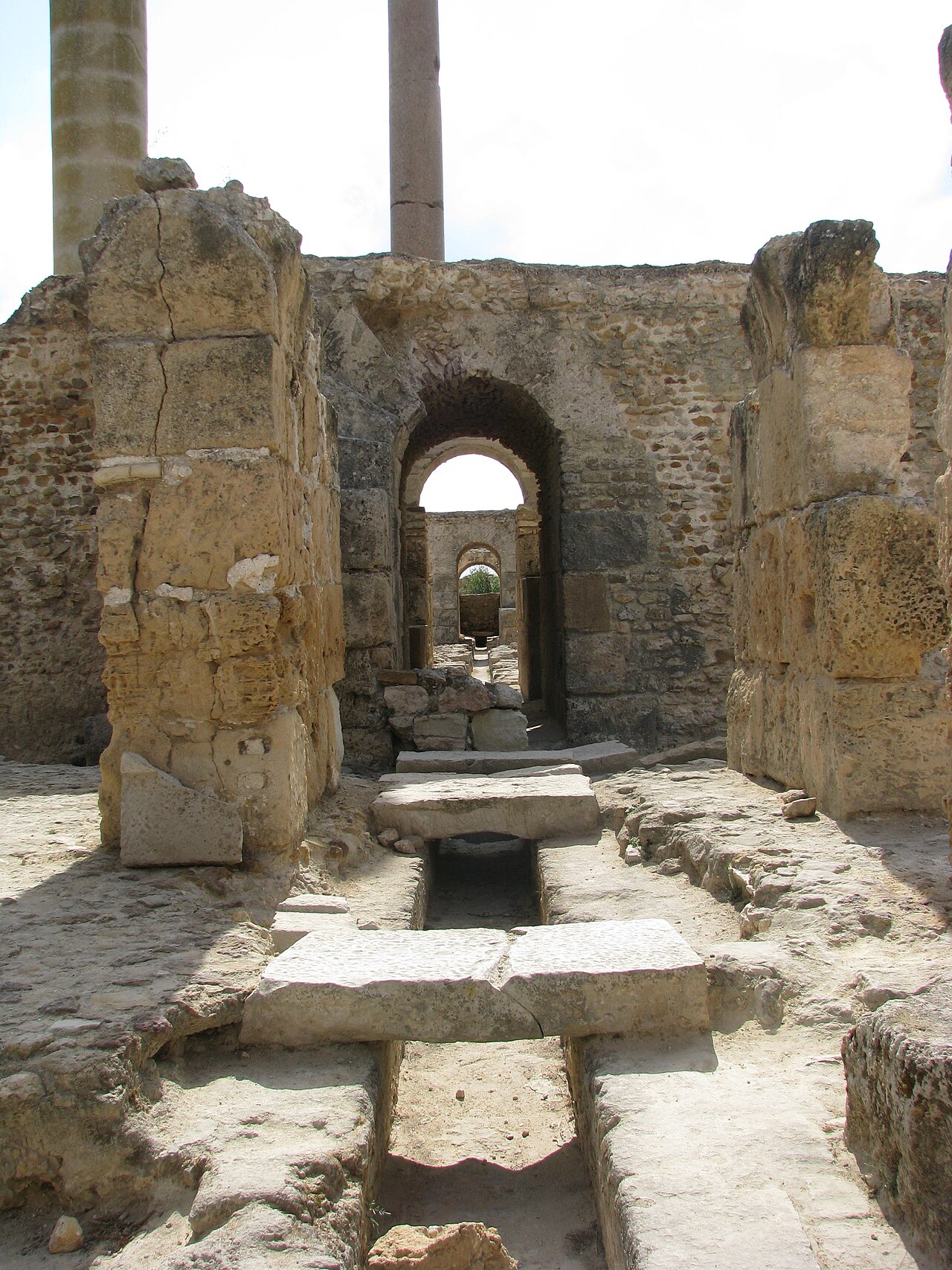
The Antonine Baths are the finest open-air ruin at Carthage and the easiest to appreciate. Named after Emperor Antoninus Pius, who may have helped fund them, the complex was inaugurated in the middle of the second century and completed around 162. The national heritage agency describes it as the largest thermal baths in Africa, built along the sea. The site has a monumental scale: a vast platform with cold, warm and hot rooms, a symmetrical plan, massive vaulted substructures, a palaestra for exercise and latrines. The baths declined after the vaults collapsed in the late fourth century, and by the seventh century quarrymen were removing columns and marble, so what you see is the foundation and part of the lower walls. At the heart rises a single reconstructed column that shows how tall the original rooms were. The setting, on the edge of the Gulf of Tunis, makes it a good place for photographs and for thinking about how Romans bathed.
Visiting: start at the entrance and follow the path through the underground service corridors, which are cool and dim, then emerge on the upper level for the sea view. Explanatory panels help in places, and a guide helps more. The site is a short walk from the Carthage Hannibal and Salammbo stations on the TGM line, and it is easy to combine with the Roman villas and the Tophet. According to the heritage agency the baths are open in winter from morning to late afternoon and in summer a little later, with different hours in Ramadan, and tickets are modest, with a cheaper rate for residents and a combined ticket for groups. Confirm hours before going, since they can change.
Why go: of all the Carthage sites this one best shows the Roman scale of the city. Early morning and late afternoon give the best light, and the sea breeze keeps it comfortable most of the year. Bring water and sun protection, because there is little shade on the upper level. The terrain is uneven, with steps and gravel, so wear sturdy shoes. Photography is welcome. If you are short on time, this site and Byrsa Hill together give the clearest picture of ancient Carthage, and the baths are a good place to finish the day with a sea view and a short stroll to a cafe in the suburb.
What to expect
The experience
A self-guided walk through the baths' underground corridors and across the platform above, with a tall reconstructed column and sea views.
Best time
Early morning or late afternoon for soft light and a cooler sea breeze.
How long
About an hour, or ninety minutes with photographs.
Tips
Wear sturdy shoes for gravel and steps, bring water and a hat, and check seasonal hours.
Quick picks
- Best for
- Anyone who wants one Carthage site that delivers scale and a sea view.
- Families
- Open space and tunnels to explore; hold hands near the edges and steps.
- Couples
- Late afternoon light on the stone and the sea, then dinner in Sidi Bou Said.
- Pair with
- Carthage Roman villas and Tophet, then Sidi Bou Said.
- Time needed
- An hour or so on site.
Good questions
What are the Antonine Baths?+
They are the ruins of a vast Roman bath complex at Carthage, described as the largest thermal baths in Africa. They were completed around 162 and stand on the seafront.
What are the opening hours?+
The heritage agency lists winter hours from morning to late afternoon and slightly longer summer hours, with shorter hours in Ramadan. Check before you go because hours can change.
How much is a ticket?+
Tickets are modest for non-residents, with a lower resident rate and a grouped ticket option. Bring cash.
How do I get there?+
Take the TGM to Carthage Hannibal or Carthage Salammbo and walk a short distance, or take a taxi from central Tunis.
Can I see the baths on a day tour?+
Yes, most Carthage tours include the baths along with Byrsa Hill and the theatre, usually with a guide.